
Media & Connectivity
Physical reality meets protocol theory. How copper, fibre, and wireless constraints shape network behaviour. Where network assumptions meet physical reality.
Industrial protocols define how machines actually communicate - foundational knowledge for designing networks where timing, determinism, and reliability matter more than raw speed.
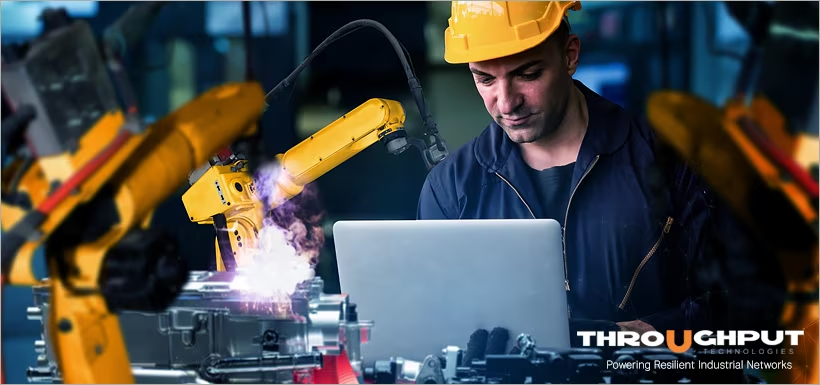
Industrial networks are often described in terms of speed, bandwidth, and infrastructure. Yet none of these explain how machines actually communicate.
Protocols define the rules, timing, structure, and expectations of communication. They determine what data is exchanged, how, when, and with what tolerance for delay or disruption. Understanding industrial protocols is foundational. Without it, network design becomes guesswork, interoperability becomes fragile, and troubleshooting becomes speculative. This section establishes that foundation.
It is common to hear that “everything is Ethernet now.” This is only partially true.
While Ethernet has become the dominant transport layer, the communication logic riding on top remains deeply industrial and highly specialised. Real‑time control, safety signalling, time synchronisation, and deterministic data exchange impose requirements that general‑purpose IT protocols were never designed to meet. In practice, modern industrial networks are layered: Ethernet provides transport; industrial protocols define behaviour, timing, and intent. Ignoring the protocol layer is one of the most common causes of unreliable OT networks.
One persistent misconception is that legacy protocols are inherently obsolete.
In reality, many remain in service because they are tightly coupled to proven control logic, devices have lifecycles measured in decades, replacement risk exceeds perceived benefit, and their deterministic behaviour is well understood. Serial communications such as RS‑232 and RS‑485, along with protocols built on them, continue to operate reliably in harsh environments where simplicity and predictability matter. The challenge is not their existence - it is integrating them safely into modern networks.
Industrial protocols make assumptions about timing. Some expect fixed polling cycles and bounded latency. Others rely on event‑driven messaging and precise time synchronisation.
When these assumptions are violated - through congestion, buffering, or inappropriate network design - the protocol may still function, but the process may not. Symptoms often include intermittent faults with no obvious cause, devices dropping offline under load, and control instability that appears “random.” These are not protocol failures - they are mismatches between protocol behaviour and network design.
| Protocol Family | Primary Timing Expectation | Common Network Design Pitfall |
|---|---|---|
| Polling/Cyclic (Modbus, DNP3) | Fixed intervals; bounded response latency. | Congestion delaying poll‑response cycles; jitter exceeding allowed window. |
| Real‑Time Industrial Ethernet (PROFINET IRT, EtherNet/IP CIP Motion) | Deterministic micro‑second‑level cycle times; jitter‑free delivery. | Non‑prioritised background traffic; improper switch configuration. |
| Time‑Sensitive (IEC 61850 GOOSE, PTP‑based) | Precise synchronisation; event‑driven delivery within milliseconds. | Network asymmetry; incorrect PTP boundary clock placement. |
| Serial/Fieldbus (PROFIBUS, DeviceNet) | Fixed token rotation; consistent medium access timing. | Excessive cable length; improper termination; electrical noise. |
Modern industrial environments are rarely homogeneous. Multiple vendors, generations, and protocol families coexist.
Gateways and converters bridge gaps - sometimes successfully, sometimes not. True interoperability requires understanding how each protocol structures data, how timing expectations differ, where buffering introduces delay, and what information is lost or altered in conversion. Simply making devices communicate does not guarantee that the meaning of the data is preserved. This becomes critical when safety‑related signals are involved or control decisions depend on timely updates.
Ethernet‑based industrial protocols brought higher bandwidth, standardised infrastructure, and easier IT integration.
They also introduced new risks. Ethernet is inherently flexible. That flexibility can undermine determinism if not carefully managed. Broadcast traffic, multicast storms, improper segmentation, and uncontrolled devices can all impact protocol performance. Industrial Ethernet protocols assume correct network architecture, appropriate prioritisation, and controlled traffic flows. When these assumptions are not met, the protocol is often blamed - unfairly. The network is the problem.
Designing industrial networks without protocol awareness is like designing mechanical systems without understanding load.
Protocol‑aware design considers communication patterns, update rates, sensitivity to delay and jitter, and interaction with redundancy mechanisms. This awareness informs topology, segmentation, redundancy strategy, diagnostics placement, and cybersecurity architecture. Without it, networks may function initially - but degrade unpredictably over time as traffic grows, devices are added, or conditions change. Protocol literacy prevents architectural debt.
Most industrial protocols were not designed with hostile environments in mind. Authentication, encryption, and integrity checking were often absent or minimal.
This does not make them unusable. It means they must be protected by architecture, not retrofitted with assumptions they cannot support. Effective OT cybersecurity starts by understanding which protocols are in use, what trust assumptions they make, where exposure exists, and how to contain risk without altering behaviour. Blindly applying IT security models often creates instability without improving safety. Security must respect protocol determinism.
One of the most valuable outcomes of protocol literacy is better decision‑making.
When engineers and decision‑makers understand why a protocol behaves the way it does, what it expects from the network, and where its limitations lie, they are far better equipped to evaluate design options, ask the right questions, avoid costly retrofits, and plan for long‑term coexistence. This is why protocols sit at the foundation of the Knowledge Hub. Everything else builds on them. Knowledge here prevents problems later.
This section exists to build conceptual clarity, reduce uncertainty, and enable informed architectural choices - not to advocate for specific protocols.
Whether dealing with legacy serial systems, modern industrial Ethernet, or hybrid environments, protocol understanding turns complexity into something manageable. And in industrial networks, manageability is reliability. It allows teams to design, troubleshoot, and modernise with confidence - because they understand the language the machines are actually speaking.
Throughput Technologies approaches industrial protocols as behavioural systems, not just data formats. We focus on timing expectations, deterministic requirements, and the architectural implications of protocol choice - ensuring networks support communication intent, not just connectivity.
When protocols and networks align, systems are reliable. When they do not, failures appear mysterious. This knowledge eliminates the mystery.
Protocol understanding interacts with every other domain of industrial networking. These related Knowledge Hub sections build on this foundation.
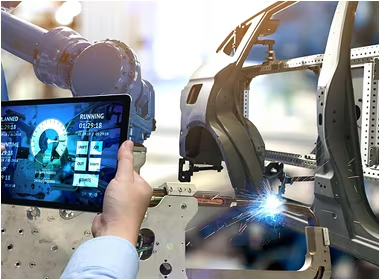
Physical reality meets protocol theory. How copper, fibre, and wireless constraints shape network behaviour. Where network assumptions meet physical reality.
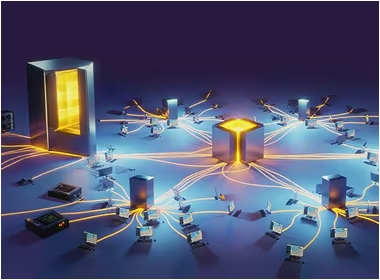
How things are actually designed to survive. Resilience through architecture - not device duplication. Redundancy models, segmentation, and operational resilience.
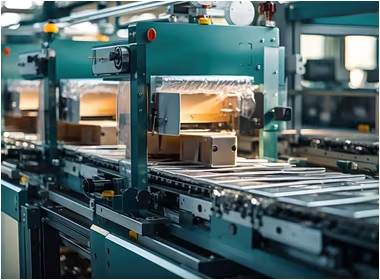
Modernisation without destruction. Introducing intelligence at the edge - protocol conversion, data normalisation, controlled integration - without destabilising proven systems.