
Newsletter

Welcome to "The Throughput Connection"
This is the latest edition - interesting & relevant information in byte sizes
Words From the Tech Desk
As we move through July, we've reached the halfway point of the year - a natural opportunity to reflect, reassess and prepare for the months ahead. Winter is firmly upon us, but in engineering and industry, progress never slows. While global markets continue to navigate uncertainty, there are encouraging signs of greater stability in key regions. If sustained, this could improve confidence across international supply chains, energy markets and infrastructure investment - developments that ultimately benefit industries here in South Africa, from utilities and manufacturing to mining and transport.
For industrial organisations, however, one principle remains constant: resilience is built long before it is tested. The businesses that continue to invest in reliable communications, secure OT networks and future-ready infrastructure today will be better positioned to adapt to tomorrow's challenges. At Throughput, we remain committed to helping our customers build resilient industrial networks through practical engineering expertise and globally proven technology partnerships. Our focus is not simply on products, but on delivering solutions that improve operational reliability, visibility and long-term performance. Thank you for your continued trust and partnership. We look forward to supporting your projects throughout the remainder of the year. Stay warm, stay safe, and we wish you every success in the months ahead.
Onwards,
Anton van der Westhuizen

Reliable industrial wireless communications are now fundamental to safe, efficient and resilient operations. Whether supporting onboard rail systems, utility infrastructure, mining or industrial automation, wireless networks must perform in conditions where commercial Wi-Fi was never designed to operate.
Modern industrial environments expose wireless equipment to vibration, electrical noise, extreme temperatures, humidity and radio frequency interference. In these conditions, reliable connectivity depends less on headline speed and more on the engineering behind the platform.
The latest Westermo Ibex-1310 has been developed for this operational reality. Now available with a 12–48 VDC low-voltage power option, the rugged outdoor access point offers greater deployment flexibility across transportation and critical industrial infrastructure.
Engineered For Operational Reality
At the heart of the Ibex-1310 is Westermo's ResilientRF technology. It addresses three critical challenges:
1. electrical and RF protection against surges, static discharge and disturbances, 2. interference-free coexistence, allowing multiple radios to operate simultaneously, and 3. consistent high-power throughput for stable coverage and dependable communications.
Advanced RF filtering helps reject interference from neighbouring radios, cellular networks and other transmitters, while linear power amplifiers maintain signal integrity at higher output levels. The result is predictable wireless performance in tunnels, depots, stations, mines and exposed industrial sites.
Proven Where Reliability Matters
Designed to meet demanding railway standards including EN 50155 and EN 50121-4, the Ibex platform brings Westermo's industrial wireless experience to environments where network availability directly affects operations.
For system integrators and operators, that means fewer interruptions, more predictable performance and a wireless platform designed around long-term availability. Reliable industrial wireless is not created by bandwidth alone. It is engineered around the electrical, environmental and RF conditions the network must survive.
Rail Recovery Needs Resilient Networks
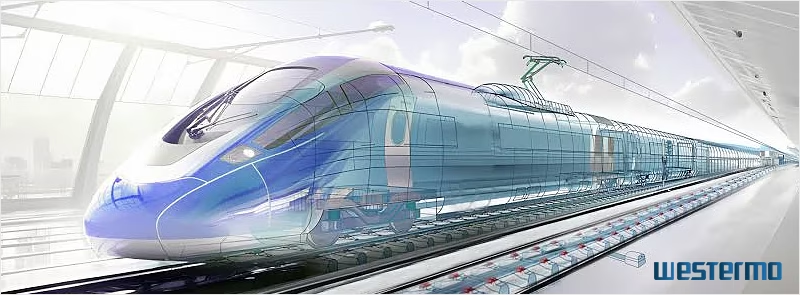
South Africa's rail sector is entering a period of renewed investment and modernisation, with increasing focus on improving freight capacity, signalling systems and operational performance.
While new rolling stock and upgraded infrastructure often attract the headlines, resilient communications networks are becoming just as critical to long-term success.
Beyond The Track
Modern rail operations rely on continuous connectivity between signalling equipment, control centres, trackside assets and operational systems. As networks become more digital and data-driven, reliable communications, cybersecurity and operational visibility are no longer optional - they are fundamental to safe and efficient railway operations. For organisations planning new rail projects or upgrading existing infrastructure, network resilience should be considered a core engineering requirement from the outset. Building communications infrastructure that can support today's operations while accommodating tomorrow's technologies will be essential to delivering a more reliable, efficient and future-ready rail network.
Success Story
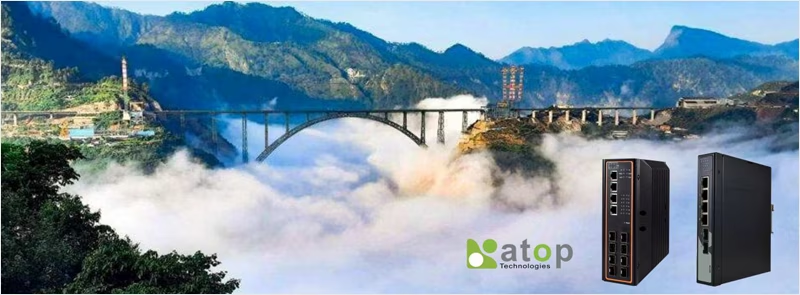
Surveillance Without Blind Spots (ATOP Technologies)
Delivering continuous visibility across almost 50 kilometres of railway infrastructure is about far more than installing cameras. It demands a communications network capable of operating reliably through tunnels, across bridges and in some of the most demanding environmental conditions imaginable.
India's Banihal-Sangaldan section of the Udhampur-Srinagar-Baramulla Rail Link (USBRL) is one of the country's most ambitious rail infrastructure projects. Stretching 48.1 kilometres through the Himalayan region, more than 90% of the route passes through tunnels and incorporates 16 bridges, advanced safety systems and continuous CCTV monitoring to help protect passengers and railway operations.
Built For Critical Infrastructure
To support this extensive surveillance network, ATOP Technologies supplied more than 1,800 industrial Ethernet switches, creating a resilient IP-based communications backbone linking tunnels, bridges, stations and trackside infrastructure. Real-time video is transmitted over a hardened fibre network to both local control rooms and a central monitoring facility, providing operators with uninterrupted visibility across the entire route.
The project demonstrates that critical infrastructure depends not only on surveillance equipment, but on the reliability of the industrial network transporting that information. In environments exposed to vibration, temperature extremes, humidity and electromagnetic interference, resilient networking becomes an operational necessity rather than a technology choice.
Engineering That Scales
The USBRL project is an excellent example of designing communications infrastructure for long-term operational resilience. By combining industrial-grade networking with a scalable fibre architecture, the railway operator has established a platform capable of supporting future expansion while maintaining the reliability expected of modern transport systems.
Engineering Lessons
The world's most successful infrastructure projects rarely begin with products - they begin with sound engineering. ATOP's contribution to the USBRL railway demonstrates how resilient industrial networking underpins operational safety, situational awareness and long-term reliability. For engineers designing rail, utility, mining or industrial networks, the lesson is clear: when communications are mission-critical, network resilience becomes part of the infrastructure itself.
Designing For Tomorrow's Capacity
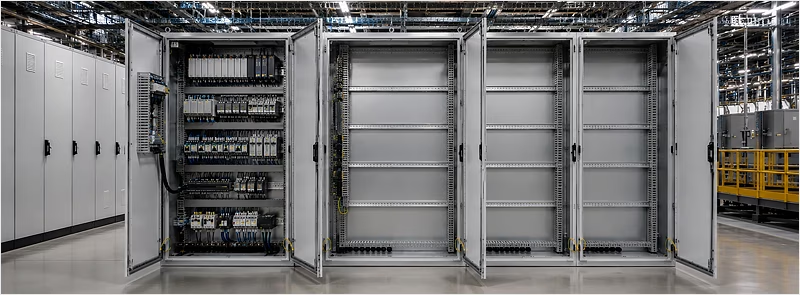
Industrial systems rarely remain static. Production expands, new process streams appear and today's capacity becomes tomorrow's constraint. The real question is whether the architecture can grow with the operation.
Built For Growth
When a U.K. fuel producer upgraded its Class 1 metering system, Flotech Performance Systems integrated ProSoft Technology's Advanced Flow Computer directly into the ControlLogix® platform. The in-chassis approach reduced panel space and engineering complexity while supporting up to 16 meter runs, with four streams per run. The same flow computing architecture could also extend across a 1 GB fibre network to the import jetty, avoiding a standalone flow computer and cabinet footprint.
Capacity Without Complexity
As new streams and internal transfer lines are introduced, capacity can be added without redesigning the metering architecture. Included configuration software and no additional licensing for extra meter runs further helped control costs.
The lesson extends beyond flow computing: scalable systems are designed for growth before extra capacity is needed. infrastructure with confidence, knowing it has been proven where reliability matters most.
Did You Know?
Industrial Wi-Fi reliability is often determined long before the first packet is transmitted.
The Westermo Ibex-1310 uses ResilientRF technology to address three of the biggest causes of industrial wireless failure: electrical disturbances, RF interference and inconsistent signal performance. In harsh OT environments, engineering the radio platform is often more important than simply increasing wireless bandwidth.
Not every industrial switch needs to be managed.
The Westermo SandCat series was developed for applications where simplicity, reliability and rapid deployment matter more than advanced network management. A correctly selected unmanaged switch can improve reliability, reduce installation time and lower lifecycle costs - without compromising industrial robustness.
OPC UA doesn't replace protocols - it gives them context.
Unlike traditional industrial protocols that primarily move data, OPC UA adds structure, relationships and meaning to information. That's why successful OPC UA projects are built around information modelling and architecture - not simply replacing one communications protocol with another.
Building the Next Generation of Resilient Industrial Networks
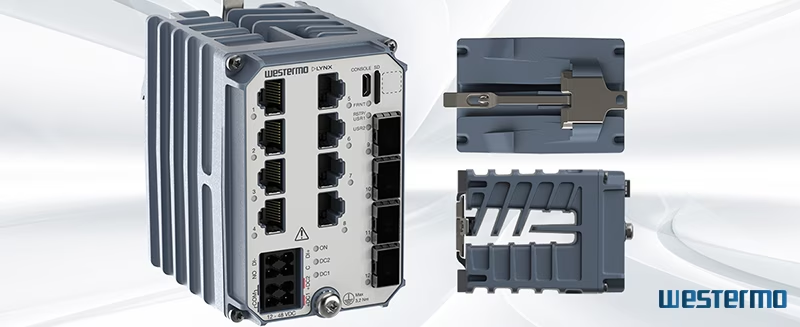
As industrial networks become more connected, distributed and cybersecurity-focused, the role of the industrial Ethernet switch has evolved far beyond simply moving data. Today's critical infrastructure demands networking platforms that combine long-term reliability, intelligent network management and built-in cybersecurity.
The Westermo Lynx 3000 series has been developed with exactly this challenge in mind. Representing the next generation of managed industrial Ethernet switches, the platform combines ultra-compact design with high-performance Layer 2 and Layer 3 networking, making it well suited to rail, energy, manufacturing and other mission-critical industrial environments.
Powered by Westermo's latest WeOS 5 operating system, the Lynx 3000 introduces enhanced cybersecurity capabilities designed around modern industrial networking requirements. Features such as Secure Boot, advanced authentication and a stateful firewall help organisations strengthen network resilience while supporting the growing demands of standards such as IEC 62443.Beyond cybersecurity, the Lynx 3000 reflects Westermo's longstanding engineering philosophy: equipment should continue to perform reliably throughout its operational life, even in the harshest environments. Certified to EN 50121-4 for railway applications and designed to operate reliably between -40°C and +70°C, the platform delivers dependable performance without compromising on size or flexibility.
We believe resilient networks begin with sound engineering decisions. The Lynx 3000 is another example of how Westermo continues to develop technologies that address the evolving needs of critical infrastructure - combining robust industrial design, advanced cybersecurity and long-term operational reliability into a networking platform built for the future.
Africa Automation Indaba 2026
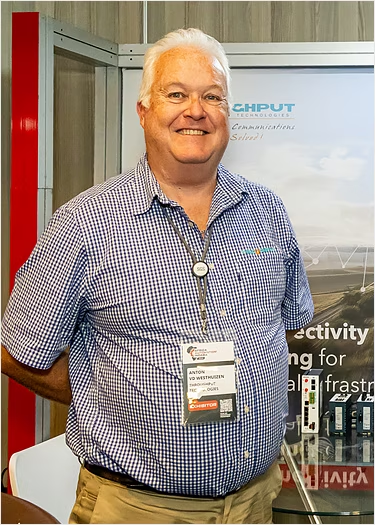
Industry events are valuable because they reveal where industrial engineering is heading. This year's Africa Automation Indaba reinforced one clear message: resilient OT networks, industrial cybersecurity, edge intelligence and interoperable systems are rapidly becoming the foundation of modern industrial operations.
Throughput was pleased to attend the Indaba, held in Cape Town on 13 - 14 May, where we reconnected with customers, met new industry contacts and exchanged ideas with engineers, system integrators and technology partners from across Southern Africa.
Key Takeaways
One theme stood out throughout the event: organisations are moving beyond simply connecting assets. The focus is now on building resilient architectures that improve operational visibility, strengthen cybersecurity and enable better decision-making through connected industrial data.
Events like these are an opportunity to learn from industry, share engineering knowledge and remain aligned with emerging technologies and best practices. The conversations reinforced our belief that successful digital transformation begins with sound engineering, trusted technology partnerships and resilient industrial network design.