
Interoperability Authority for Industrial Control Modernisation
When industrial control systems must evolve without disruption, ProSoft Technology provides the interoperability, protocol fluency, and control-layer intelligence that allows legacy and modern automation to coexist safely and productively.

ProSoft Technology
Purpose-Built for Control System Interoperability
Resolving Automation Fragmentation Without Compromising Operational Continuity
Industrial automation environments are rarely uniform. ProSoft exists to resolve protocol fragmentation and vendor incompatibility without compromising operational continuity.
Across manufacturing plants, utilities, energy assets, and infrastructure systems, automation environments evolve unevenly. Different generations of PLCs, drives, sensors, and control platforms coexist - often from multiple vendors, using incompatible protocols, deployed over decades. ProSoft Technology specialises precisely in this complexity. Rather than forcing replacement or consolidation, ProSoft enables communication between systems that were never designed to work together, preserving operational stability while unlocking modernisation.
This focus positions ProSoft not as a peripheral accessory, but as a control-layer enabler - allowing data, commands, and diagnostics to move reliably between disparate automation domains while maintaining deterministic behaviour and operational trust.
Control-Layer Expertise, Not Generic Connectivity

Direct integration into leading control platforms enables native protocol support without external gateways.
ProSoft operates where control logic, industrial protocols, and real-time automation intersect - inside the automation architecture, not merely around it.
Unlike general networking vendors, ProSoft's expertise lives inside PLC racks, control cabinets, and automation backplanes. Their in-chassis communication modules integrate directly into leading control platforms, enabling native protocol support without external gateways, additional cabinets, or architectural workarounds.
This tight integration is especially significant in Rockwell Automation environments, where ProSoft modules extend ControlLogix® and CompactLogix™ platforms with protocol capabilities such as Modbus, PROFIBUS, DNP3, and IEC 61850 - while behaving as first-class system components. Where in-chassis integration is not feasible, ProSoft's standalone gateways provide deterministic, protocol-aware translation between automation ecosystems, ensuring interoperability without introducing control uncertainty.
Protocol Fluency as a Strategic Capability
ProSoft's strength lies in deep, practical fluency across industrial protocols - treating interoperability as an engineering discipline, not a checkbox.
ProSoft supports over 60 industrial protocols and more than 100 protocol combinations, spanning Ethernet, serial, legacy fieldbus, and modern IP-based standards. This breadth allows automation systems from different eras and vendors to communicate as if they were designed together. Supported protocols include EtherNet/IP, PROFINET, Modbus RTU/TCP, PROFIBUS, DNP3, IEC 60870, IEC 61850, and OPC UA, among others.
Crucially, this support is implemented with an understanding of industrial timing, control semantics, and fault behaviour, not just data transport. This protocol mastery allows ProSoft solutions to act as stable translators - preserving control intent, data integrity, and operational predictability across complex automation landscapes.
Phased Modernisation Without Operational Risk
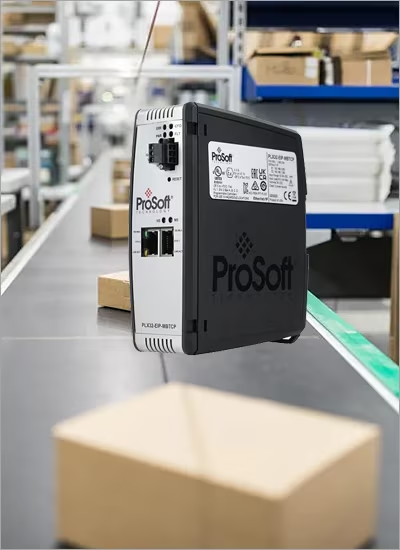
Protocol gateways enable phased migration strategies that reduce risk, cost, and downtime.
Industrial systems cannot stop to modernise. ProSoft enables phased migration strategies that reduce risk, cost, and downtime.
Rip-and-replace strategies introduce unacceptable risk in operational environments where uptime is paramount. ProSoft's approach recognises that legacy systems often remain functionally sound - and should be preserved while modern layers are introduced incrementally.
Through protocol gateways and migration solutions, ProSoft enables phased modernisation: legacy PLCs, drives, and HMIs continue operating while newer systems are introduced alongside them. Data is shared, control remains deterministic, and operators gain visibility without destabilising production. This strategy is particularly effective when combined with resilient industrial networking from partners such as Westermo, where ProSoft ensures control-layer interoperability and Westermo provides deterministic, secure transport across the wider OT network.
Secure Remote Access with OT Reality in Mind
Remote access is essential - but only when it respects operational boundaries, cybersecurity principles, and control system realities.
ProSoft's remote connectivity platforms are designed specifically for OT environments, where simplicity, security, and determinism must coexist. Their cloud-native remote access solutions enable engineers to monitor, diagnose, and support systems globally -without exposing control networks to unnecessary risk.
Features such as OT-friendly access models, encrypted communications, and simplified routing ensure that remote connectivity enhances operational efficiency rather than creating new attack surfaces. In architectures where remote access must be tightly segmented from network transport, ProSoft's control-layer access frequently complements perimeter and segmentation strategies delivered by partners such as Secomea, aligning secure access with zero-trust industrial design principles.
Strategic Alignment Across Throughput's Core Verticals
ProSoft's capabilities align naturally with industries where control system continuity, vendor diversity, and legacy preservation are unavoidable realities.
| Vertical | Control Challenge | ProSoft Contribution | Ecosystem Synergy |
|---|---|---|---|
| Manufacturing | Multi-vendor PLC environments with mixed generations of automation | In-chassis and gateway interoperability for seamless data exchange between control platforms | Works alongside Westermo for resilient plant networks and deterministic communication |
| Energy & Utilities | Legacy SCADA and protection systems requiring modern integration | Protocol translation and phased upgrades for grid modernisation without disruption | Complements Welotec cellular solutions and Westermo substation networking |
| Water & Wastewater | Distributed assets with ageing PLCs and serial communications | Secure SCADA connectivity and migration paths for remote monitoring systems | Integrates with Secomea for secure remote access and edge connectivity |
| Infrastructure | Mixed automation platforms across transportation and critical systems | Vendor-agnostic communication enabling unified monitoring and control | Enables coherent architectures across Throughput's partner ecosystem |
Built on Depth, Support, and Longevity
ProSoft's credibility is reinforced by depth of experience, exceptional technical support, and long-term commitment to industrial customers.
With over three decades of industrial automation focus, ProSoft combines technical depth with a practical understanding of field realities. Their solutions are supported by lifetime technical support, extended warranties, and engineering teams experienced in niche automation challenges.
This long-term commitment mirrors Throughput's own philosophy: solutions must remain supportable, understandable, and secure throughout their operational life - not just at commissioning. ProSoft's focus on backward compatibility and product lifecycle management ensures that automation investments remain viable across technology refresh cycles.
The Throughput–ProSoft Fit: Coherent Architecture, Not Fragmented Solutions
Throughput partners with ProSoft to resolve complex automation interoperability challenges as part of coherent, resilient OT architectures.
ProSoft does not operate in isolation. Throughput positions ProSoft within broader industrial network designs - aligning control-layer interoperability with resilient transport, secure access, and lifecycle-aware architecture. For clients, this means automation modernisation without fragmentation: legacy systems preserved where valuable, modern platforms introduced safely, and communication unified across vendors and generations.
The partnership delivers complete architectural coherence: where ProSoft ensures control systems communicate effectively, and Throughput ensures that communication occurs across networks designed for reliability, security, and long-term viability.
In industrial automation, interoperability failures create hidden risk - ProSoft eliminates that risk by making communication predictable, explicit, and architecturally sound.
Throughput Technologies partners with ProSoft Technology because control system modernisation must proceed without disruption, compromise, or unnecessary replacement. By enabling deterministic communication across disparate automation platforms, ProSoft removes one of the most common sources of industrial downtime: misaligned protocols, brittle integrations, and undocumented workarounds.
The result is an automation environment that can evolve confidently - without sacrificing the stability, safety, and reliability that operations demand.
Talk with a Solutions Specialist
What systems are not communicating - and what is that preventing?
Answered – Some Frequently Asked Questions
ProSoft's in-chassis modules install directly into control platform backplanes, becoming native components that share power, cooling, and diagnostics with the host system. This eliminates additional cabinets, simplifies wiring, and ensures the module behaves as a first-class citizen within the automation architecture. External gateways, while still deterministic, introduce additional failure points, require separate power and networking, and operate outside the control platform's diagnostic ecosystem. The in-chassis approach delivers higher reliability, better integration, and reduced complexity in applications where direct control platform compatibility is essential.
Yes. ProSoft designs with deterministic behaviour as a core requirement, not an afterthought. Their protocol implementations preserve timing characteristics, support synchronous operation where required, and maintain predictable latency profiles. This is critical in applications like motion control, safety systems, and protection relay coordination where timing is integral to correct operation. When combined with deterministic network infrastructure from partners like Westermo, the complete communication path maintains the timing integrity essential for industrial control applications.
ProSoft implements protocol translation with deep semantic understanding, not just packet reformatting. Their engineering team understands the control intent behind each protocol, ensuring that data types, scaling, status bits, and error conditions map correctly between systems. This prevents common translation errors like endianness mismatches, scaling misinterpretations, or status bit misalignment. Extensive testing and validation across thousands of real-world installations ensure that translation is accurate, reliable, and preserves the operational meaning of the data being exchanged.
ProSoft maintains expertise in legacy protocols through dedicated engineering resources, comprehensive documentation archives, and sustained product support. Their technical support team includes engineers with decades of experience in protocols like PROFIBUS, Modbus RTU, and DH+, ensuring that even niche implementations receive knowledgeable assistance. This commitment to legacy support enables organisations to maintain older systems while planning phased migrations, rather than facing forced obsolescence or risky overnight replacements.
Throughput positions ProSoft as the control-layer interoperability specialist within broader architectures that include: Westermo for deterministic network transport and cybersecurity, Secomea for secure remote access, and Welotec for cellular connectivity. This integration ensures that control systems communicate effectively across networks designed for reliability and security. Throughput's architectural oversight coordinates these capabilities into coherent solutions where interoperability, network resilience, and secure access work together rather than in isolation.