
The Design Decision Quietly Defining Failure
The network was designed in 2016. The specification was approved. A decade later, it fails in ways no one predicted.
A network rarely fails because of the equipment installed today. More often, it behaves exactly as the original design intended. The real question is whether those early decisions anticipated tomorrow.
Most network problems begin before the network exists.
A network rarely fails because of the equipment installed today. More often, it behaves exactly as the original design intended. The real question is whether those early decisions anticipated tomorrow.
Why do perfectly commissioned industrial networks develop problems years later?
This is not about poor products. It is not about poor installation. It is about decisions made before procurement.
Engineers often judge a project by successful commissioning. Reality judges it five years later.
The network that performs flawlessly during acceptance testing may behave unpredictably when the plant expands, when firmware updates are applied, or when a new application is added. The equipment was correct. The installation was correct. The commissioning was correct.
The architecture was incomplete.
Why has industrial networking become dramatically harder?
Networks used to perform one task. Today they must support legacy PLCs, IIoT, historians, AI, cloud, remote maintenance, cybersecurity, compliance, and analytics. None of these existed when many plants were designed.
The architecture is now expected to support requirements it was never designed for.
Complexity has increased faster than architecture has evolved.
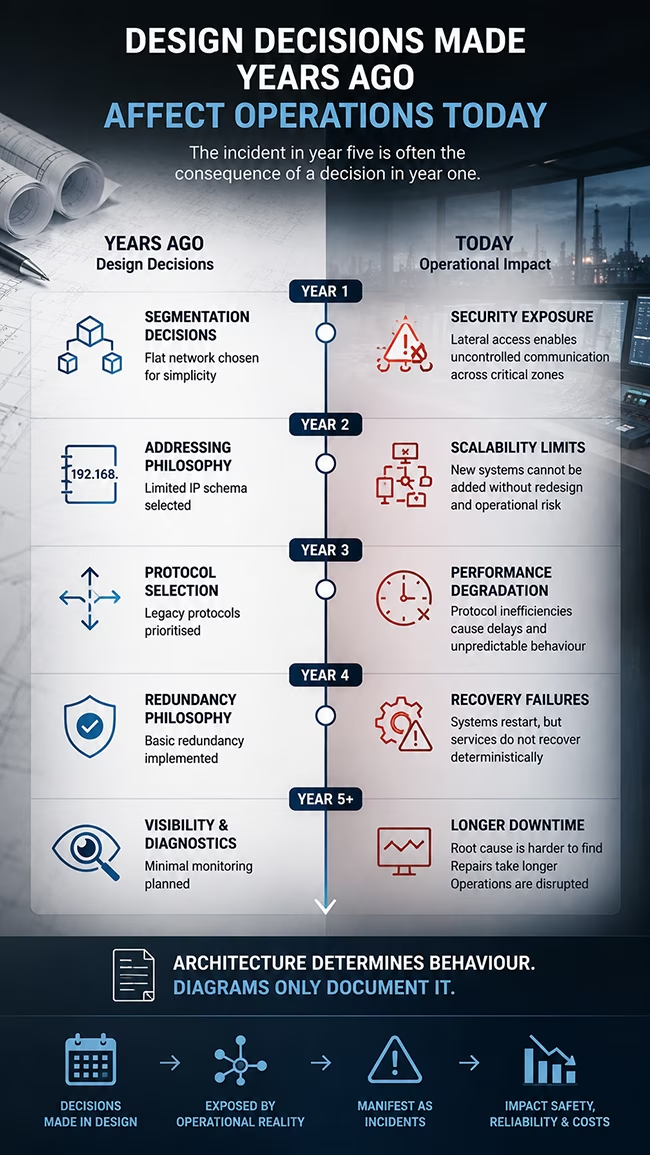
Decisions made years ago shape operations today.
Traditional projects focused on connectivity, bandwidth, redundancy, and equipment. Modern projects require architecture around behaviour, timing, visibility, segmentation, deterministic recovery, and lifecycle management.
Traditional design assumptions no longer scale. A network designed for connectivity alone cannot provide visibility. A network designed for bandwidth alone cannot provide timing. A network designed for redundancy alone cannot provide deterministic recovery.
The requirements have changed. The architecture has not.
People think architecture means switches, routers, rings, VLANs, and IP addresses. Architecture actually defines how systems interact, how they recover, how they evolve, how they are maintained, how evidence is retained, and how risk is managed.
Products implement architecture. They do not create it.
A network diagram is a record. It describes what is connected. It does not describe how the network behaves. A diagram cannot tell you what happens during a power restoration. It cannot tell you how the network recovers from a firmware failure. It cannot tell you whether the network will still support operations in five years.
The diagram is not the architecture. The architecture determines the behaviour. The diagram documents it.
Failures usually begin with decisions about addressing philosophy, segmentation, protocol selection, timing, clock hierarchy, resilience philosophy, maintenance philosophy, remote access, logging, future expansion, asset ownership, and documentation.
These decisions are almost invisible after commissioning but continue influencing every operational event.
"Every restart is simply the network revealing decisions made years earlier."
A design decision made during procurement becomes visible only during failure. The decision about recovery philosophy determines whether the process restarts in minutes or hours. The decision about visibility determines whether the investigation finds the root cause or records it as unknown.
The failure that occurs in year five is the result of decisions made in year one.
Commissioning tests prove installation. They rarely prove behaviour.
Behaviour includes power restoration, firmware differences, device replacement, future expansion, maintenance shutdowns, mixed generations, and temporary bypasses.
A network that passes commissioning may still behave unpredictably during a power restoration. A network that passes acceptance may still fail during a firmware update. A network that supports today's operations may still be unable to support tomorrow's requirements.
Architecture should anticipate behaviour rather than today's topology.
Good architecture is defined by principles, not products.
Lifecycle. Visibility. Deterministic recovery. Documentation. Observability. Maintainability. Scalability. Operational simplicity. Designing for unknown future requirements.
These principles determine whether the network survives expansion, evolution, and change. They determine whether the network remains maintainable as the original project team moves on. They determine whether the network can support applications that do not yet exist.
Products are selected to support these principles. The principles do not emerge from the products.
Architecture requires products capable of supporting it.
Westermo provides industrial resilience through FRNT, WeOS, and Layer 2/3 switching platforms designed for deterministic behaviour under operational stress.
ProSoft Technology enables protocol migration and legacy integration, ensuring that existing assets can participate in modern architectures without being replaced.
Welotec provides edge computing and local processing, enabling data contextualisation before it moves to central systems.
Secomea enables secure lifecycle maintenance through controlled remote access that supports operational continuity without introducing exposure.
Products support principles. They are not the principles.
Leading organisations now begin projects by asking: "How will this network behave in ten years?" instead of "Which switch should we buy?"
That is a huge difference.
The switch question focuses on procurement. The behaviour question focuses on architecture. Procurement is about today. Architecture is about the lifecycle. Procurement is about specifications. Architecture is about outcomes.
Organisations that ask the behaviour question design networks that survive expansion, evolution, and change. Organisations that ask the switch question design networks that must be redesigned when the plant changes.
Industrial networks rarely become unreliable because the equipment deteriorates. They become unreliable because operational reality eventually exposes assumptions made during design.
Good engineering produces a functioning network. Great engineering produces a network that continues functioning long after the original project team has left.
That is Throughput's position.
Throughput helps organisations develop architectures capable of supporting reliable industrial operations throughout the network lifecycle.
When was the architecture defined on your last project – and who defined it?

The network was designed in 2016. The specification was approved. A decade later, it fails in ways no one predicted.

Commissioning proves installation. Operational readiness proves behaviour. Most projects only do the first.

The ring reconverged in 50ms. The process failed anyway. The network did its job. The control system did not recover.