
Cybersecurity & Network Resilience
Protecting critical infrastructure networks from cyber threats while ensuring operational continuity through defense-in-depth architectures and resilient design principles.
Transport infrastructure networks must maintain operational control, passenger safety, and service continuity through equipment failures, security events, and environmental stress while supporting decades of incremental technology evolution.
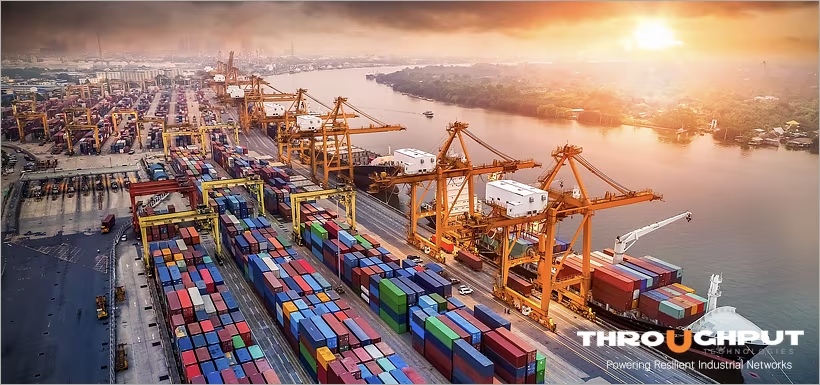
Airports, ports, bridges, and tunnels cannot pause operations for network maintenance, upgrades, or recovery from failures.
Transport infrastructure operates 24/7 with peak demand periods that test network capacity and resilience. An airport during weather disruptions, a port during vessel turnaround, a bridge during rush hour, or a tunnel during emergency response - these are moments when network performance directly impacts public safety, economic activity, and operational efficiency. Unlike commercial enterprises that can schedule downtime, transport infrastructure must maintain continuous operation while evolving to support new technologies and services.
This creates a dual challenge: networks must be both extremely reliable and adaptable. They must survive harsh environmental conditions (salt corrosion at ports, vibration on bridges, jet blast at airports) while integrating legacy systems with modern IoT, supporting increasing passenger expectations, and meeting evolving security requirements. Failure manifests not as lost productivity, but as stranded passengers, delayed cargo, or compromised safety.
Airport networks integrate airside operations, terminal systems, and passenger services with strict separation requirements.
Modern airports operate as complex ecosystems where air traffic control systems, baggage handling, security screening, retail operations, and passenger information must coexist securely. The network architecture must enforce rigorous segmentation between safety-critical systems (airfield lighting, fuel management, emergency services) and commercial operations while allowing controlled data exchange where necessary.
Airside networks face unique challenges: extreme RF environments with radar and navigation systems, large geographic coverage requirements, and strict regulatory compliance (ICAO, FAA, EASA). Equipment must survive temperature extremes, jet fuel exposure, and frequent maintenance vehicle traffic. Networks must also support increasing demands from aircraft connectivity, IoT sensors for predictive maintenance, and digital twin applications for operational optimization.

Port networks must withstand salt corrosion, constant vibration from heavy equipment, and integrate systems from multiple international standards.
Port networks bridge maritime and terrestrial systems while surviving some of industry's harshest environments.
Port operations integrate vessel traffic management, crane control, container tracking, customs systems, and terminal operations. Networks span kilometers of coastline with equipment exposed to salt spray, high winds, and constant vibration from heavy machinery. Communication must be maintained between moving assets (cranes, straddle carriers, trucks) and fixed infrastructure with minimal latency for precise control operations.
Maritime communications add complexity: vessel-to-shore links, port community systems connecting multiple stakeholders, and integration with global shipping networks. Cybersecurity is particularly critical as ports represent economic choke points. Network design must balance operational efficiency with defense-in-depth security, ensuring that a compromise in one system (such as passenger terminal Wi-Fi) cannot propagate to critical operational networks (crane control or hazardous material tracking).
Structural health monitoring requires networks that survive decades of environmental exposure while delivering precise sensor data.
Modern bridges and tunnels incorporate extensive sensor networks: strain gauges, accelerometers, corrosion sensors, displacement monitors, and environmental sensors. These networks provide early warning of structural issues, guide maintenance planning, and ensure public safety. However, they operate in exceptionally challenging conditions - temperature extremes, constant vibration from traffic, exposure to de-icing chemicals or saltwater, and limited physical access for maintenance.
Monitoring networks must be designed for longevity with components rated for 25+ year lifespans. They often combine wired and wireless technologies: fibre optics along the structure backbone with wireless mesh networks for difficult-to-wire locations. Data transmission must be reliable enough to distinguish actual structural changes from network anomalies, requiring sophisticated error checking and validation algorithms at the network level.
Multimodal transport hubs combine multiple transport modes with shared infrastructure and common passenger services.
Modern transport hubs integrate airports with rail stations, bus terminals, parking structures, and commercial developments. This creates networks that must support diverse operational requirements: airline check-in systems, rail signalling, retail payments, security screening, wayfinding, and emergency communications. The architecture must provide segregation between different transport operators' systems while enabling shared services like passenger information displays and emergency response coordination.
Network capacity planning must account for peak passenger flows that can reach tens of thousands per hour, with corresponding demands on Wi-Fi, digital signage, and mobile connectivity. Redundancy is critical - a single point of failure could disrupt multiple transport modes simultaneously. Geographically diverse network cores with automatic failover ensure continuity even during localized incidents like fires or floods in equipment rooms.
Transport infrastructure evolves over decades, requiring networks to bridge generation gaps in technology.
A single transport facility may contain operational technology from the 1970s (relay-based control systems), 1990s (early SCADA), and cutting-edge IoT deployments. Network architecture must support this heterogeneity without creating security vulnerabilities or operational fragility. Protocol gateways, industrial firewalls, and secure data diodes provide controlled interfaces between legacy and modern systems.
Modernization typically follows a phased approach: first establishing a robust network backbone, then gradually migrating systems with careful testing at each step. The network must support parallel operation of old and new systems during transition periods, which can last years for critical safety systems. This requires careful capacity planning and traffic management to prevent legacy system characteristics (like broadcast storms) from affecting modern network segments.
Transport infrastructure networks must survive events that would destroy commercial IT infrastructure.
From hurricane-force winds at coastal airports to seismic activity near bridges, from chemical exposure in road tunnels to electromagnetic interference from rail systems - transport networks face environmental challenges that demand specialized equipment. Conduits must be watertight and corrosion-resistant, fiber optic cables must have robust armor, wireless equipment needs specialized antennas and lightning protection, and all components require wide temperature tolerance.
Physical security is equally important. Network equipment located in publicly accessible areas (tunnel walls, bridge pylons, airport terminals) must be housed in tamper-resistant enclosures. Critical infrastructure should have redundant physical paths - diverse cable routes, separate equipment rooms, and geographically dispersed network cores to survive localized physical damage from accidents, construction errors, or intentional attacks.
Transport hub networks must segregate operational systems from public services while enabling necessary data exchange for coordinated operations.
Public-facing networks must provide service without compromising operational security or safety.
Passenger Wi-Fi, digital signage, wayfinding apps, and mobile services have become expected amenities. These public networks must be completely isolated from operational systems while still allowing controlled data exchange (such as flight information feeding display systems). The isolation must be architectural, not just logical, with separate network infrastructure, different physical equipment, and air-gapped management systems.
Capacity planning for public networks must account for extreme peak usage - thousands of passengers simultaneously streaming video during delays, or crowds using wayfinding apps during major events. Quality of service mechanisms ensure that operational communications (security, emergency response) always have priority, while public services receive fair access during normal conditions. Network monitoring must detect and mitigate abuse (such as denial-of-service attacks originating from passenger devices) without disrupting legitimate use.
Transport networks must satisfy multiple regulatory frameworks that often have conflicting requirements.
Aviation (ICAO, FAA, EASA), maritime (IMO, port state control), rail (national rail authorities), and road (transport departments) each impose specific requirements on communication systems. These may cover cybersecurity, availability metrics, interference limits, backup power duration, and maintenance procedures. Networks must be designed with these requirements from inception, as retrofitting compliance is often impossible or prohibitively expensive.
Certification processes can take years and require extensive documentation, testing, and third-party validation. Network architecture should facilitate rather than complicate certification by providing clear boundaries between systems with different certification requirements, comprehensive logging for audit trails, and standardized interfaces that simplify testing. Designing with certification in mind from the beginning avoids costly redesigns later in the project lifecycle.
Transport infrastructure must maintain operations through natural disasters, security incidents, and equipment failures.
Networks must support disaster recovery plans that may involve partial operation, degraded modes, or complete facility evacuation. Critical systems (emergency lighting, ventilation in tunnels, airfield lighting at airports) must have independent communication paths that survive loss of primary infrastructure. Network design should enable graceful degradation rather than catastrophic failure.
Continuity planning extends beyond the facility itself. Transport infrastructure often forms part of broader emergency response networks - airports as emergency staging areas, ports for disaster relief shipments, bridges and tunnels as evacuation routes. Networks must support these roles with additional capacity, priority communication channels for emergency services, and interoperability with external response networks. This requires coordination with multiple government agencies and adherence to national emergency communication standards.
Throughput Technologies advises on transport infrastructure network architectures that balance operational demands, security requirements, and public service expectations across airports, ports, bridges, and tunnels.
Talk with a Solutions Specialist to review your transport infrastructure network requirements.
Three primary reasons: environmental hardening, deterministic performance, and regulatory compliance. Airport equipment faces jet blast, fuel exposure, wide temperature swings, and constant vibration that enterprise gear cannot withstand. Airside operations require deterministic latency for control systems (like airfield lighting), which standard networks don't guarantee. Aviation regulations (FAA, EASA) mandate specific certifications for safety-related systems that enterprise equipment lacks. Additionally, airports require 24/7 operation with maintenance windows measured in minutes, not hours.
Through layered segmentation and controlled interfaces. Port networks should be divided into security zones: vessel communications, crane/equipment control, terminal operations, administrative, and public services. Industrial firewalls or data diodes control traffic between zones. The Port Community System (connecting shipping lines, customs, terminals) should be in a dedicated DMZ. All external connections (vessel links, global shipping networks) should terminate in isolated segments. Regular security audits, network monitoring for anomalies, and strict access controls for maintenance personnel are essential. Physical security of network equipment in spread-out port areas is equally important.
Extreme longevity requirements, challenging physical access, and critical safety implications. Sensors and network equipment must operate reliably for 25+ years with minimal maintenance in hostile environments (salt, vibration, temperature extremes). Data quality is paramount - network anomalies must be distinguishable from actual structural changes. The network must support both high-frequency vibration data (for seismic monitoring) and low-frequency corrosion data. Redundancy is critical because false negatives (missing actual structural issues) could have catastrophic consequences. Finally, networks often span long distances with limited power availability, requiring innovative power-over-fiber or energy harvesting solutions.
Through proactive capacity planning and dynamic resource allocation. Networks are designed for peak loads (major holidays, events) with 30-50% headroom beyond normal maximums. Quality of Service (QoS) policies ensure operational traffic (security, emergency communications) always has priority. During disruptions (like weather cancellations), network administrators can dynamically reallocate bandwidth - for example, shifting resources from retail Wi-Fi to passenger information systems. Some advanced systems use AI to predict congestion based on flight schedules, weather, and social media sentiment, preemptively adjusting network configuration. The key is designing flexibility into the architecture from the beginning.
Maintaining continuous operation during transition. Unlike greenfield projects, legacy modernization must occur while systems remain operational 24/7. This requires careful phasing: first establishing a new parallel network backbone, then migrating systems one by one with extensive testing at each step. The biggest technical challenge is often interfacing modern IP networks with legacy serial or proprietary protocols without introducing latency or reliability issues. Organizationally, the challenge is coordinating multiple stakeholders (different transport operators, maintenance contractors, regulatory bodies) who may have conflicting priorities and timelines. A comprehensive migration plan with built-in rollback options is essential.
Protecting critical infrastructure networks from cyber threats while ensuring operational continuity through defense-in-depth architectures and resilient design principles.
Network design for water treatment, distribution, wastewater management, and environmental monitoring systems that protect public health and ecosystem integrity.
Designing resilient networks for power generation, transmission, distribution, and renewable energy infrastructure that ensure grid stability and operational continuity.