
Cybersecurity & Network Resilience
Protecting critical infrastructure networks from cyber threats while ensuring operational continuity through defense-in-depth architectures and resilient design principles.
Water infrastructure networks must maintain treatment process control, distribution integrity, and contamination monitoring through flood events, equipment failures, and cyber threats while ensuring uninterrupted service to communities and ecosystems.
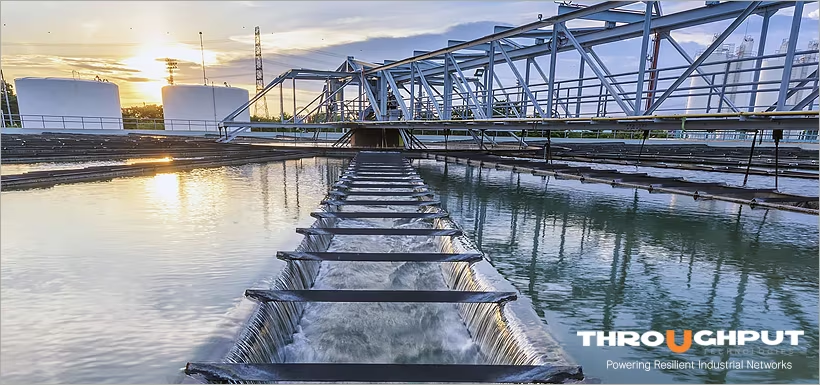
Water systems cannot fail silently; network disruptions directly impact public health, environmental compliance, and community resilience.
Water treatment plants, distribution networks, wastewater facilities, and environmental monitoring systems form interconnected critical infrastructure where communication failures have immediate consequences. A loss of visibility into water quality parameters could allow contamination to reach consumers. Pump station communication failures could cause pressure loss or flooding. Wastewater treatment process upsets could result in environmental violations. Unlike many industries where production can be paused, water systems must maintain continuous operation through all conditions.
These networks operate in some of the most challenging environments: corrosive atmospheres in treatment plants, flooded vaults during storms, remote locations with limited power, and expansive distribution systems spanning hundreds of kilometers. They must integrate decades-old equipment with modern sensors and controls while meeting increasingly stringent regulatory requirements for both water quality and cybersecurity.
Treatment plants are chemical and biological process facilities where network reliability directly affects water quality and regulatory compliance.
Modern water treatment employs complex processes: coagulation, flocculation, sedimentation, filtration, disinfection, and advanced treatment for specific contaminants. Each process stage requires precise control of chemical dosing, flow rates, and retention times. The network must deliver deterministic communication between sensors (turbidity, pH, chlorine residual), analyzers, controllers, and actuators while surviving corrosive chemicals, humidity, and constant vibration from pumps and motors.
Treatment plant networks typically follow a hierarchical design: field-level networks connecting instruments and valves, control-level networks for PLCs and RTUs, and information-level networks for SCADA, historians, and maintenance systems. Critical processes often have redundant communication paths, with fiber optic backbones providing electrical isolation between different plant areas. Cybersecurity is paramount as treatment processes could be manipulated to cause public health impacts.

Distribution networks require reliable communications to remote sensors and valves across vast geographic areas, often with limited power availability and challenging physical access.
Water distribution spans entire communities with critical assets in difficult-to-access locations.
Distribution networks include pumps, valves, tanks, hydrants, and sensors spread across cities and rural areas. Pressure sensors detect leaks, flow meters monitor consumption, water quality sensors check for contamination, and control valves manage pressure zones. These devices often operate on battery or solar power with intermittent communication windows to conserve energy. Network design must balance data freshness with power constraints.
Communications technologies vary by location: fiber along major transmission mains, cellular for urban areas, licensed radio for remote locations, and sometimes power line communication (PLC) leveraging the water system's own electrical infrastructure. The network must provide sufficient bandwidth for occasional high-resolution data (like leak noise correlators) while maintaining low-power operation for routine monitoring. Redundancy is critical - a single communication failure shouldn't isolate multiple critical assets.
Wastewater networks combine corrosive environments, explosive atmospheres, and biologically active processes with stringent environmental regulations.
Wastewater treatment involves grit removal, primary sedimentation, biological treatment (activated sludge, trickling filters), secondary clarification, disinfection, and sludge processing. Each stage generates specific gases (hydrogen sulfide, methane), creates corrosive conditions, and requires precise control of biological processes. Network equipment must be rated for these hazardous environments with appropriate certifications (ATEX, IECEx) and corrosion resistance.
Collection systems add complexity with lift stations and force mains spread across sewer sheds. These remote sites often experience power fluctuations, flooding during storms, and limited physical access. Communications must survive these conditions while providing reliable data on pump status, wet well levels, and equipment health. Increasingly, networks also support real-time control of sewer systems to prevent combined sewer overflows (CSOs) during heavy rain, requiring low-latency communication between distributed control points.
Flood control networks must operate most reliably when all other systems are failing.
Pump stations, gates, barriers, and retention basins form flood defense systems that activate during extreme weather when communication networks are most stressed. These systems require fail-safe operation: if communication is lost, pumps should continue operating based on local sensors, and gates should fail in safe positions. The network design must prioritize flood control traffic during emergencies, often using dedicated communication paths or priority channels on shared infrastructure.
Real-time monitoring of rainfall, river levels, soil moisture, and tidal conditions enables predictive control of flood systems. This requires integration of diverse sensor networks (rain gauges, stream gauges, weather radar, satellite data) with control systems. The communication network must handle burst traffic during storm events while maintaining connectivity despite power outages, physical damage, and electromagnetic interference from lightning.
Environmental sensors provide early warning of contamination, ecological stress, and regulatory compliance issues.
Water utilities monitor source water quality in rivers, lakes, and reservoirs; discharge quality from treatment plants; and ambient conditions in receiving waters. Environmental agencies monitor broader ecosystem health. These networks deploy sensors for parameters like dissolved oxygen, temperature, conductivity, turbidity, nutrients, and specific contaminants (heavy metals, pesticides, pathogens).
Environmental monitoring presents unique challenges: sensors in remote locations with limited power, communication through vegetation and terrain, biofouling of sensor surfaces, and calibration drift over time. Networks often combine satellite communication for remote sites, cellular for accessible locations, and wireless mesh for dense sensor arrays. Data validation algorithms distinguish real environmental changes from sensor or communication artifacts - a critical capability when data triggers regulatory reports or public health alerts.
Water systems contain equipment with 50+ year lifecycles, requiring networks to bridge multiple technology generations.
Many water utilities operate electromechanical equipment installed decades ago alongside modern digital controls. Large valves may have 4-20mA positioners from the 1970s, pumps may have hardwired control circuits, and treatment plants may use relay logic for critical safety interlocks. Network architecture must interface with these legacy systems during lengthy transition periods without compromising reliability or safety.
Integration strategies include: I/O marshalling cabinets that convert legacy signals to modern protocols, dedicated legacy networks isolated from modern systems with secure gateways, and phased replacement that maintains parallel operation during transition. The key is maintaining operational continuity - water cannot be turned off for system upgrades. Network design must support hot cutovers, parallel operation, and comprehensive testing of new interfaces before they assume critical functions.
Water system cybersecurity must protect treatment processes and distribution control without disrupting continuous operation or introducing single points of failure.
Water infrastructure is increasingly targeted by cyber threats with potential public health consequences.
Recent incidents have demonstrated vulnerabilities in water systems worldwide. Cybersecurity must address both intentional attacks and unintentional disruptions. Key principles include: network segmentation to isolate critical control systems, unidirectional gateways for data export without inbound access, strict access controls for remote maintenance, and continuous monitoring for anomalies. However, water systems present unique challenges - many sensors and controllers cannot run modern security software, and treatment processes cannot be easily stopped for security updates.
A risk-based approach focuses protection on systems that could directly affect water quality or supply if compromised: chemical dosing controls, disinfection systems, pump station controls, and reservoir level management. Defense-in-depth combines physical security (locked control panels, tamper switches), network security (firewalls, intrusion detection), and procedural security (access logs, change management). Incident response plans must prioritize maintaining water supply and quality over forensic investigation during active incidents.
Water infrastructure must withstand floods, earthquakes, wildfires, and other disasters while maintaining essential services.
Climate change intensifies the challenges: more frequent floods test drainage systems, droughts stress water supplies, wildfires threaten watersheds, and sea level rise affects coastal facilities. Networks must be designed with these threats in mind: equipment elevated above flood levels, conduits sealed against inundation, wireless paths that survive vegetation loss from fires, and redundant communication paths that avoid common failure modes.
During disasters, water systems play dual roles: maintaining essential services and supporting emergency response. Networks must prioritize critical communications (treatment plant control, emergency water distribution points, coordination with emergency services) while potentially deprioritizing non-essential functions. Portable communication equipment (mobile cell towers, satellite terminals, deployable mesh networks) can restore connectivity to damaged areas. The network design should facilitate rather than hinder disaster response and recovery.
Water systems operate under multiple regulatory frameworks with strict data integrity and reporting requirements.
Regulations cover water quality (drinking water standards), environmental protection (discharge limits), operational practices (cross-connection control), and increasingly cybersecurity. These regulations mandate specific monitoring frequencies, data retention periods, reporting timelines, and audit trails. The communication network must support these requirements with reliable data collection, secure storage, and verifiable transmission.
Data integrity is particularly important for regulatory compliance. Networks must ensure that sensor readings are not corrupted in transit, that timestamps are accurate and synchronized, and that data cannot be tampered with. Cryptographic techniques (digital signatures, secure time stamps) and chain-of-custody logging create auditable records. The network design should facilitate compliance rather than creating obstacles, with clear documentation of communication paths, security controls, and data handling procedures.
Throughput Technologies advises on water and environmental infrastructure network architectures that ensure reliable operation, regulatory compliance, and resilience to both cyber and physical threats across the complete water cycle.
Talk with a Solutions Specialist to review your water infrastructure communication requirements.
Three primary reasons: corrosive environments, continuous operation requirements, and public health consequences. Treatment plants use chlorine, ozone, acids, and bases that corrode standard network equipment. Processes run 24/7 with no scheduled downtime for maintenance. Network failures can directly impact water quality - a delayed chemical dose adjustment or lost disinfection monitoring could have health consequences. Additionally, plants often have legacy equipment spanning decades that must be integrated, and they're increasingly targets for cyber attacks. Network design must address all these challenges simultaneously while meeting stringent regulatory requirements.
Through a combination of power-efficient technologies and adaptive communication strategies. Solar panels with battery storage power many remote sensors. Low-power wide-area networks (LPWAN) like LoRaWAN or NB-IoT enable years of operation on small batteries. Devices often sleep most of the time, waking periodically to transmit data. Communication protocols are optimized for minimal overhead. For critical sites, redundant power sources (solar plus grid or generator) ensure continuous operation. Network design must match communication frequency and data volume to available power - high-resolution data from remote sites may need to be stored locally and transmitted in compressed batches during optimal conditions (daylight for solar-powered sites).
Several key differences: wastewater is biologically active and generates corrosive/explosive gases; collection systems rely heavily on gravity flow with lift stations at low points; treatment involves biological processes with longer time constants; and environmental regulations focus on discharge quality rather than product quality. Communication networks in wastewater must withstand hydrogen sulfide corrosion, potentially explosive atmospheres in wet wells and digesters, and frequent flooding during storms. They also support different control strategies - drinking water focuses on pressure management and quality maintenance, while wastewater manages flow volumes, biological treatment parameters, and combined sewer overflow prevention. Cybersecurity concerns differ too - while both need protection, wastewater attacks might aim to cause environmental damage rather than direct health impacts.
Through redundant, resilient design with multiple communication paths and local autonomy. Primary communication might use fiber or licensed radio, with satellite or cellular as backup. Critical sites often have elevated antennas, flood-proof equipment enclosures, and backup power that outlasts commercial power outages. Networks are designed to prioritize flood control traffic during emergencies, potentially deprioritizing other traffic. Most importantly, control systems are designed for local autonomy - if communication is lost, pumps continue operating based on local level sensors, and gates fail in safe positions. The communication network enhances control but doesn't enable it; the system can function, albeit less optimally, without central communication. Regular testing during actual storm events validates these designs.
Through risk-based segmentation and security controls designed for continuous operation. Critical systems (chemical dosing, disinfection, pump control) receive the highest protection with network segmentation, strict access controls, and continuous monitoring. Less critical systems have appropriate safeguards. Security controls are designed not to create single points of failure - firewalls are in high-availability pairs, security monitoring is passive rather than active where possible. Patch management is scheduled during maintenance windows, with compensating controls for vulnerabilities that can't be immediately addressed. The principle is that water must keep flowing - security measures cannot disrupt essential operations. This requires close collaboration between cybersecurity experts and water operations personnel to understand what's truly critical versus merely important.
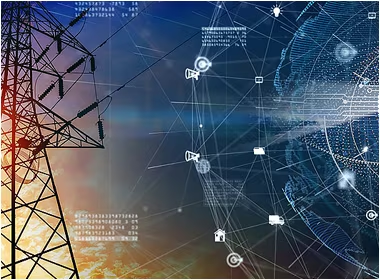
Protecting critical infrastructure networks from cyber threats while ensuring operational continuity through defense-in-depth architectures and resilient design principles.
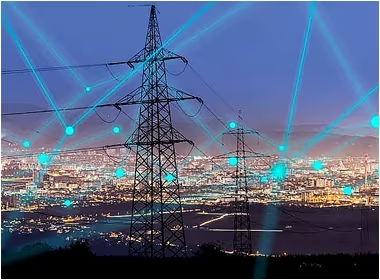
Designing resilient networks for power generation, transmission, distribution, and renewable energy infrastructure that ensure grid stability and operational continuity.
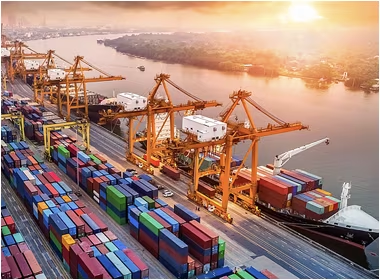
Designing resilient networks for airports, ports, bridges, and tunnels that maintain operational control, safety systems, and service continuity through diverse challenges.