
Network Architecture for Fire & Security
Designing segmented, predictable network architectures that preserve alarm integrity and long-term life safety reliability.
Most failures in fire and security systems occur at the edge. Field connectivity determines whether alarms are trustworthy or merely assumed during faults, congestion, and emergency operating conditions.
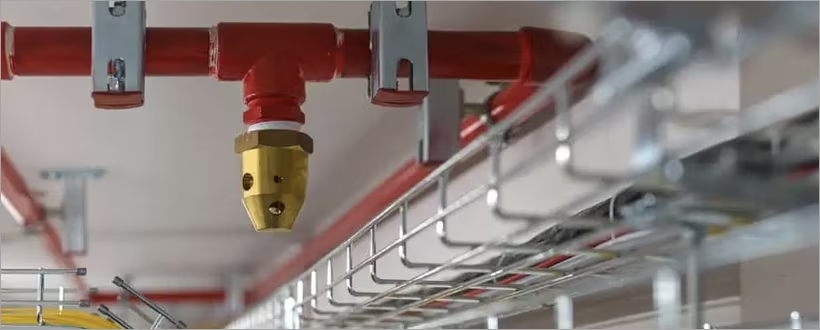
Life safety reliability is won or lost at the field level.
Sensors, panels, controllers, cameras, and access devices form the operational edge of fire and security systems. These assets are exposed to environmental stress, power instability, physical damage, and ad-hoc expansion. While core systems are often well protected, the edge quietly accumulates risk over time.
Field connectivity failures rarely present as clean outages. They appear as intermittent visibility, delayed alarms, nuisance faults, or devices that behave unpredictably under load. These symptoms are often misdiagnosed as equipment failure when the root cause lies in the connectivity architecture itself.
Field infrastructure must survive conditions that core networks never see.
Fire and security systems span basements, risers, car parks, rooftops, perimeter fences, and remote structures. Long cable runs, electrical interference, grounding differences, and exposure to heat or moisture all affect signal integrity. Connectivity choices that appear sufficient on drawings often fail under real-world conditions.
Robust field design accounts for distance, isolation, and environmental exposure from the outset. Fibre, properly managed copper, and industrial-grade interfaces are selected not for convenience, but for predictable performance over decades.

Structured edge aggregation prevents device-level faults from destabilising life safety systems
Panels and controllers are no longer passive endpoints.
Modern fire and security panels increasingly rely on IP communication for coordination, diagnostics, and monitoring. This transforms them from isolated devices into active network participants. Without architectural discipline, this shift introduces broadcast traffic, unmanaged dependencies, and unexpected failure modes.
Controlled aggregation at the edge ensures that field devices communicate through defined paths, preserving alarm integrity while limiting the impact of misbehaving or compromised endpoints.
Edge connectivity must tolerate unstable power conditions.
Power events are common in fire and security environments, particularly during incidents. Brownouts, generator transitions, and localized outages affect edge devices first. Networks that are not designed to handle these transitions gracefully can flood control systems with false events or drop critical signals.
Stable edge architectures isolate power-related disturbances, ensuring that recovery behaviour is predictable and does not overwhelm monitoring or control platforms.
Edge networks must expand without becoming fragile.
Fire and security systems are rarely static. New zones, cameras, doors, and sensors are added continuously. Without disciplined edge design, each addition increases load and complexity, eventually eroding reliability.
Structured edge connectivity allows systems to scale incrementally while preserving predictable behaviour. Growth becomes a controlled activity rather than a cumulative risk.
Stability at scale is achieved through aggregation, not direct attachment.
One of the most common causes of instability in fire and security systems is excessive direct attachment of field devices into core or shared switching environments. As the number of panels, controllers, cameras, and sensors grows, unmanaged edge connections create unpredictable traffic patterns and hidden dependencies.
Edge aggregation introduces structure into this complexity. By grouping field devices behind controlled aggregation points, communication paths become explicit and bounded. This reduces broadcast amplification, limits fault propagation, and ensures that abnormal behaviour at the device level does not destabilise higher layers of the system.
Alarm integrity depends on predictable edge behaviour, not device performance alone
Not all traffic generated by field devices is equally important.
Modern fire and security devices generate far more than simple alarm signals. Status updates, diagnostics, video streams, and maintenance data all compete for network resources. Without deliberate prioritisation, non-critical traffic can delay or obscure safety-relevant events.
Architectures that prioritise alarm and event traffic at the edge ensure that critical signals are delivered even during congestion or partial failure. This prioritisation must be enforced structurally rather than relying on device behaviour alone.
Physical conditions shape network behaviour more than specifications suggest.
Field connectivity operates in environments where temperature variation, electrical noise, lightning, and grounding differences are routine. These factors affect signal integrity and device behaviour long before outright failure occurs.
Effective edge design uses isolation, fibre where appropriate, and industrial-grade interfaces to separate sensitive life safety systems from environmental disturbances. This protects both devices and the networks that connect them.
If faults cannot be isolated quickly, availability degrades over time.
Field-level faults are inevitable. What distinguishes resilient systems is how quickly those faults can be identified and isolated. Architectures that provide clear aggregation points, defined zones, and observable interfaces allow maintenance teams to diagnose issues without extensive physical investigation.
Over time, this diagnosability reduces downtime, improves maintenance planning, and prevents recurring issues from being treated as random failures.
Fire and security infrastructure must remain serviceable for decades.
Edge connectivity decisions made during initial deployment often persist for the life of the system. Designing for longevity means avoiding brittle configurations, undocumented dependencies, and technology choices that cannot be supported or extended over time.
Structured, well-documented edge architectures allow systems to evolve gradually without compromising reliability or safety performance.
Throughput Technologies advises on field and edge connectivity architectures that preserve alarm integrity and long-term reliability.
Talk with a Solutions Specialist to review your fire and security field infrastructure.
Because the edge is where environmental exposure, power instability, physical damage, and incremental expansion converge. Unlike core systems, edge devices are added over time, often under operational pressure. Without structured connectivity and aggregation, small issues accumulate into intermittent faults that are difficult to diagnose and resolve.
Not always, but fibre is often the most reliable option for long distances, electrical isolation, and EMI-prone environments. The decision should be based on distance, grounding conditions, exposure, and lifecycle expectations rather than convenience or cost alone. In many cases, a hybrid approach delivers the best balance.
Power fluctuations cause devices to reboot, reconnect, and generate bursts of traffic. If edge connectivity is not designed to contain this behaviour, control systems can be flooded with events, masking real alarms or causing loss of visibility. Stable architectures isolate power-related disturbances so recovery is predictable.
They can share physical infrastructure when aggregation and segmentation are enforced. Shared infrastructure without architectural controls allows non-critical systems to interfere with life safety signalling, especially during faults or maintenance activities. Sharing must be deliberate and validated, not assumed.
Scaling requires structured aggregation, clear zoning, and predictable behaviour. Adding devices directly into flat networks increases complexity and risk. Architectures that anticipate growth allow new devices to be integrated without destabilising existing systems.
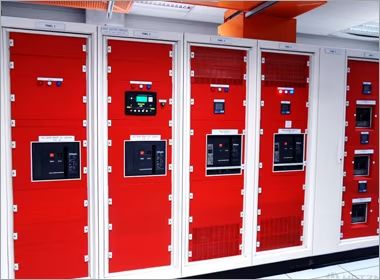
Designing segmented, predictable network architectures that preserve alarm integrity and long-term life safety reliability.

Structuring monitoring environments that support clear alarm handling, operator confidence, and coordinated response.

Containing cyber and access risk without compromising life safety availability or alarm performance.