
Field & Edge Connectivity for Fire & Security
Designing robust connectivity between panels, sensors, cameras, and controllers that remains stable across distance, power variation, and environmental stress.
Fire and security networks are not support systems. They are life safety infrastructure, and their network architecture directly influences detection reliability, response time, and operational trust.
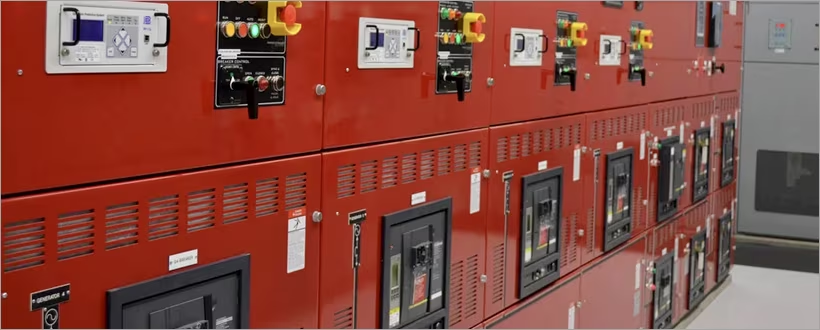
Life safety systems fail silently long before they fail visibly.
Fire detection, access control, intrusion detection, video surveillance, and emergency notification systems increasingly share IP-based infrastructure. While convergence improves visibility and operational efficiency, it also introduces new risks. When life safety systems rely on networks designed for convenience rather than determinism, reliability erodes gradually and often unnoticed.
In fire and security environments, network failure does not announce itself with alarms. It manifests as delayed signals, missed events, false positives, or systems entering degraded states. Architecture, not individual devices, determines whether these systems behave predictably during stress, maintenance, or abnormal conditions.
Convenience-driven convergence is the most common architectural failure.
Many fire and security networks evolve organically. New panels, cameras, readers, and sensors are added incrementally, often sharing infrastructure with IT, building management, or tenant systems. Initially functional, these flat architectures accumulate implicit dependencies that remain undocumented and untested.
When faults occur, their impact propagates unpredictably. A misconfigured switch, overloaded uplink, or maintenance activity intended for non-critical systems can impair alarm delivery or monitoring functions. In life safety environments, this uncertainty is unacceptable.

Segmented network architecture prevents non-critical systems from impacting fire and life safety operations
Segmentation protects detection, not just data.
Architectural segmentation ensures that fire and security systems operate within defined, controlled domains. Fire detection panels, access controllers, video systems, and monitoring platforms should communicate only through explicitly designed interfaces. This limits fault propagation and preserves predictable behaviour.
Proper segmentation also simplifies compliance and certification. When system boundaries are clear, acceptance testing is more objective, changes are safer to implement, and long-term maintenance becomes manageable rather than reactive.
Alarm delivery is time-sensitive, not best-effort.
While fire and security systems are often perceived as tolerant of delay, this assumption breaks down under load or fault conditions. Alarm escalation, video correlation, and operator response depend on predictable timing. Networks that exhibit jitter, congestion, or unstable recovery undermine response effectiveness.
Architectural determinism ensures that signalling paths remain bounded and prioritised. Alarm traffic is insulated from non-critical data, recovery behaviour is known in advance, and systems respond consistently during abnormal events.
Systems must degrade safely, not unpredictably.
Fire and security networks must assume failure as an operational condition. Power loss, device faults, cable damage, and maintenance errors are inevitable over the lifespan of the infrastructure. Architecture determines whether these failures are contained or cascading.
Predictable degradation allows operators to trust what they see. When parts of the system are unavailable, remaining components behave consistently and transparently, enabling informed decision-making under pressure.
Life safety networks outlive projects and vendors.
Fire and security systems often remain in service for decades, while staff, integrators, and vendors change repeatedly. Network architecture must therefore prioritise clarity, documentation, and disciplined change control rather than short-term optimisation.
Clear zoning, controlled interfaces, and predictable behaviour reduce reliance on tribal knowledge. This protects system integrity over time and ensures that safety performance does not degrade as environments evolve.
Life safety alarms are only meaningful if they arrive intact, in order, and on time.
In fire and security systems, alarm integrity is often discussed in terms of sensors and panels, while the network is treated as a neutral transport layer. This assumption is dangerous. Alarm messages that are delayed, reordered, duplicated, or dropped undermine operator confidence and slow response, even if the detection devices themselves are functioning correctly.
Predictable network behaviour ensures that alarms follow validated paths with known latency and recovery characteristics. When congestion, topology changes, or maintenance activity occur elsewhere on the network, alarm delivery remains unaffected. This predictability is essential for operators who must make rapid decisions based on what they see and hear during critical incidents.
Life safety networks must remain reliable during faults, congestion, and emergency operating conditions
Many reliability issues are architectural, not device-related.
False alarms, intermittent device visibility, and unexplained system resets are often attributed to faulty equipment or environmental interference. In practice, these symptoms frequently originate in poorly structured networks. Broadcast amplification, unstable switching behaviour, or shared uplinks can introduce transient conditions that mimic device failure.
When architecture is disciplined, these symptoms diminish. Systems behave consistently, diagnostics become meaningful, and maintenance effort shifts from reactive troubleshooting to planned intervention. Over time, this improves trust not only in the technology, but in the organisation responsible for operating it.
Life safety networks must perform best when everything else is failing.
Fire and security networks are rarely stressed during normal operation. Their true test comes during emergencies, when power conditions are unstable, human activity is elevated, and multiple systems are under load simultaneously. Architectures optimised only for steady-state operation often degrade unpredictably under these conditions.
Designing for emergency conditions means prioritising alarm traffic, ensuring bounded recovery behaviour, and avoiding dependencies on systems that may be unavailable during incidents. When this discipline is applied, networks support emergency response rather than becoming an additional source of uncertainty.
Not all data deserves equal treatment.
Modern buildings and facilities generate vast amounts of non-safety data, from video analytics to occupancy monitoring and reporting systems. While valuable, these functions must never compete with life safety signalling for network resources. Architecture must enforce this separation explicitly rather than relying on informal prioritisation.
By clearly distinguishing between safety-critical and convenience-driven traffic, networks remain stable even as auxiliary systems evolve. This protects the core purpose of fire and security infrastructure: protecting people and property under all conditions.
Throughput Technologies works with consultants, integrators, and operators to design fire and security network architectures that prioritise reliability, containment, and long-term operational clarity.
Talk with a Solutions Specialist to review your current fire and security network architecture.
Network architecture determines how alarms, events, and control signals behave under real-world conditions. Poorly designed networks introduce hidden dependencies that cause delays, dropped messages, or unpredictable behaviour during faults or maintenance. In life safety systems, this uncertainty erodes trust and response effectiveness long before a visible failure occurs.
Only under ideal conditions. While some systems appear tolerant during normal operation, delays and jitter during congestion, topology changes, or faults can disrupt alarm escalation and correlation. Life safety networks must therefore be engineered so that worst-case performance remains within acceptable bounds, not just average behaviour.
Segmentation prevents faults, traffic surges, or misconfigurations in non-critical systems from affecting alarm and monitoring functions. It creates clear boundaries that limit fault propagation and preserve predictable behaviour, which is essential for reliable detection and response in emergency situations.
They can share physical infrastructure if architectural separation is enforced. Logical convergence without segmentation introduces unacceptable risk, as changes or failures in IT systems can directly impact life safety functions. Sharing must be deliberate, controlled, and validated rather than assumed.
Long-term reliability comes from clear architecture, disciplined change control, and predictable behaviour. Systems must be understandable and supportable decades after installation, regardless of changes in vendors, staff, or auxiliary systems. Architecture, not equipment alone, enables this longevity.
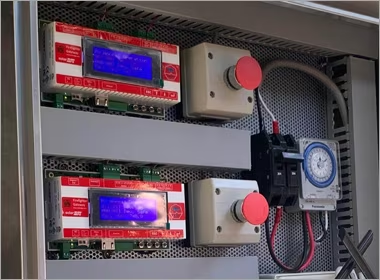
Designing robust connectivity between panels, sensors, cameras, and controllers that remains stable across distance, power variation, and environmental stress.

Structuring monitoring environments that support clear alarm handling, operator confidence, and coordinated response during critical incidents.

Containing cyber risk and access exposure without undermining alarm integrity, availability, or life safety performance.