
Industrial Automation & PLC Systems
Designing networks for PLC architectures, distributed I/O systems, motion control, and legacy fieldbus integration that ensure reliable automation across continuous and discrete manufacturing.
Factory floor networks must deliver deterministic control to machines, integrate safety systems without compromise, support mobile equipment seamlessly, and maintain segmentation that contains faults while enabling production flexibility across manufacturing cells.
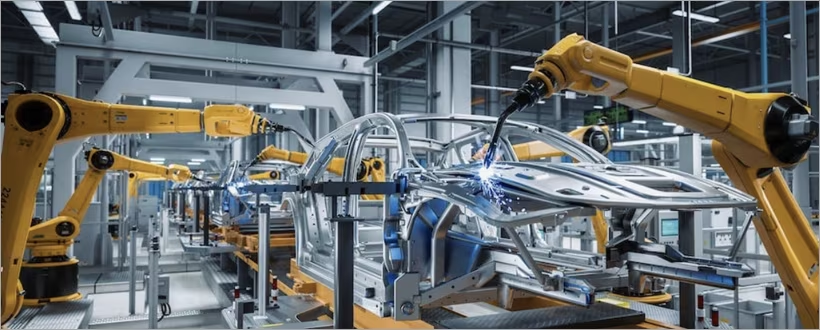
Production peaks reveal network weaknesses that remain hidden during normal operation, causing unexplained stoppages, quality variations, and safety system challenges.
Manufacturing networks operate in demanding environments where electromagnetic interference from variable frequency drives, physical stress from vibration and temperature cycles, and chemical exposure gradually degrade performance. During normal production, networks often appear stable. However, during peak throughput - when every machine runs at capacity, AGVs move constantly, and safety systems are most active - latent issues emerge. Timing becomes critical, bandwidth constraints become apparent, and subtle configuration problems cause cascading failures.
These failures rarely present as complete network outages. Instead, they manifest as milliseconds of additional latency that disrupt motion control, occasional packet loss that corrupts recipe data, or temporary congestion that delays safety responses. The symptoms are often misdiagnosed as machine problems, leading to unnecessary equipment repairs while the underlying network issues persist. Effective factory floor network design anticipates these peak conditions, building in headroom and resilience that standard office networks never require.
PROFINET, EtherNet/IP, and other industrial Ethernet protocols demand network design that respects their timing and determinism requirements.
Industrial Ethernet protocols are not simply Ethernet with different data formats; they have specific timing requirements that influence network architecture. PROFINET IRT (Isochronous Real-Time) requires dedicated bandwidth and precise synchronization for motion control. EtherNet/IP with CIP Motion needs consistent latency for coordinated drives. These requirements dictate switch selection, topology design, and configuration parameters far beyond standard networking.
Successful implementation starts with understanding each protocol's characteristics: update cycles, jitter tolerances, synchronization methods, and network discovery behaviors. Network design must provide sufficient bandwidth for cyclic data (control loops) while accommodating acyclic data (configuration, alarms) without disrupting timing. Quality of Service (QoS) prioritization, VLAN segmentation, and careful switch configuration ensure that real-time traffic receives predictable service while other traffic doesn't interfere.

Safety networks must provide deterministic response times for emergency stops and protective devices while maintaining separation from standard control traffic.
Safety networks carry life-critical signals but share infrastructure with standard control - requiring careful design to maintain integrity.
Modern safety systems like PROFIsafe and CIP Safety transmit safety signals over the same Ethernet cables as standard control data, using additional protocol layers for validation and security. This convergence reduces wiring but increases network design complexity. Safety messages must have guaranteed delivery within specified times (typically 10-100ms for emergency stops), with mechanisms to detect corruption, repetition, incorrect sequence, or loss.
Network architecture must ensure that safety traffic cannot be delayed or blocked by non-safety communications. This often requires dedicated switch ports for safety devices, strict traffic prioritization, and sometimes separate network segments bridged only by safety-rated gateways. The entire path from safety sensor to safety controller must be validated, including switches and cables. Network monitoring must detect and alert on conditions that could compromise safety performance, such as excessive latency or packet loss on safety-critical paths.
Automated Guided Vehicles and mobile robots require seamless wireless connectivity as they move through dynamically changing radio environments.
Modern factories increasingly use AGVs for material transport and mobile robots for flexible automation. These systems depend on continuous wireless connectivity for navigation, task assignment, and safety coordination. Factory environments present unique wireless challenges: metal structures that create multipath and shadowing, moving equipment that changes propagation paths, and electromagnetic interference from welding, induction heating, and motor drives.
Effective factory wireless requires careful site surveys that consider not just static conditions but operational dynamics. Access point placement must provide overlapping coverage for seamless roaming, with careful channel planning to minimize interference. For control applications, wireless networks should use deterministic protocols (like 802.11e QoS) and may require dedicated frequency bands. Security is critical - wireless networks must authenticate devices, encrypt communications, and prevent rogue access points. For safety-rated mobile systems, wireless must meet the same reliability requirements as wired safety networks, often requiring redundant paths and validated performance.
Manufacturing cells should operate as independent units with controlled interfaces to factory-wide systems, not as nodes on a flat network.
Modern factories organize production into cells - groupings of machines that complete specific operations. Network architecture should mirror this organizational structure, with each cell having its own network segment. This segmentation contains faults (a problem in one cell doesn't spread to others), simplifies troubleshooting (issues are localized), and enhances security (compromise is contained).
Cell networks typically include machines, robots, local HMIs, and cell controllers. They connect to factory-wide systems (MES, SCADA, central engineering) through controlled gateways - often industrial firewalls or routers with specific filtering rules. This architecture supports flexible reconfiguration: cells can be added, removed, or modified with minimal impact on other operations. It also enables different security policies - a cell with legacy equipment might have stricter isolation, while a modern cell might have more integration with analytics systems.
TSN enables convergence of control, safety, and information traffic on a single network with guaranteed timing - but requires careful implementation.
Time-Sensitive Networking (IEEE 802.1 TSN standards) brings deterministic Ethernet capabilities to standard hardware, allowing precise synchronization, bounded latency, and zero packet loss for critical traffic. For manufacturing, this promises simplified architecture where motion control, safety, video, and IT traffic can share infrastructure while maintaining their respective requirements.
However, TSN implementation requires comprehensive network design: time synchronization across all devices (802.1AS), traffic shaping and scheduling (802.1Qbv), frame preemption (802.1Qbu), and redundancy (802.1CB). Not all industrial devices yet support TSN, so hybrid networks with both TSN and traditional industrial Ethernet are common during transition. Network design must account for these mixed environments, ensuring that non-TSN devices don't disrupt TSN timing. As TSN adoption grows, it will enable new manufacturing paradigms like highly flexible production lines with dynamically reconfigured machine connections.
Factory environments test network equipment with vibration, temperature extremes, dust, liquids, and electromagnetic interference that office equipment cannot withstand.
Manufacturing areas present specific challenges: welding cells with spatter and electromagnetic noise, washdown areas with high-pressure cleaning, foundries with extreme heat and dust, and machining areas with coolant mists and metal particles. Network equipment must be selected and installed to survive these conditions. Industrial-grade switches with wide temperature ranges (-40°C to +75°C), conformal coatings on circuit boards, IP67-rated connectors, and vibration-resistant mounting are essential.
Cable selection and routing require equal attention. Industrial Ethernet cables with appropriate shielding (often double-shielded foil and braid) resist EMI. Conduits protect against physical damage but must allow heat dissipation. Cable strain relief prevents connector damage from constant vibration. Grounding and bonding prevent ground potential differences that can damage equipment or corrupt data. The network infrastructure must be as robust as the manufacturing equipment it connects.
PROFIBUS, DeviceNet, and other legacy fieldbus systems require careful integration through gateways that preserve timing characteristics while enabling modern network connectivity.
Factories operate equipment across multiple technology generations, requiring networks that bridge fieldbus legacy with Ethernet futures.
Many factories still use PROFIBUS, DeviceNet, CC-Link, or other fieldbus systems for machine-level communication. These legacy systems have different characteristics than Ethernet: master-slave architectures, specific timing requirements, and often less bandwidth. Network design must integrate these systems during transition periods that can last decades.
Fieldbus-to-Ethernet gateways provide the interface, but configuration requires understanding both worlds. Gateway placement affects performance - typically close to fieldbus devices to keep fieldbus cable runs short. Gateway configuration must match the fieldbus timing (baud rates, update cycles) while providing appropriate Ethernet services. Network segmentation often isolates legacy systems to prevent their characteristics (like broadcast-heavy protocols) from affecting modern network segments. As fieldbus systems are gradually replaced, the network architecture must support this evolution without disrupting production.
Proactive network monitoring detects degradation before it causes production impacts, turning network infrastructure from a cost center into a reliability asset.
Modern industrial switches provide extensive diagnostic capabilities: port statistics, error counters, cable diagnostics, traffic analysis, and device health monitoring. When properly configured and monitored, these capabilities enable predictive maintenance of the network itself and can provide early warning of issues with connected equipment. For example, increasing error rates on a motor drive connection might indicate developing cable or connector problems before they cause drive faults.
Network monitoring systems should integrate with overall manufacturing maintenance systems, providing alerts through the same channels as equipment alarms. Trending network performance data helps distinguish between gradual degradation (requiring scheduled maintenance) and sudden failures (requiring immediate response). For critical applications, consider redundant monitoring paths - if the primary network fails, a secondary path (perhaps cellular or separate wireless) should still report the failure. The goal is to make the network transparently reliable, with issues identified and addressed before they affect production.
Throughput Technologies advises on factory floor network architectures that balance deterministic control, safety integration, mobile equipment support, and operational flexibility across diverse manufacturing environments.
Talk with a Solutions Specialist to review your factory floor network infrastructure.
Industrial Ethernet equipment is physically hardened for factory environments (wider temperature range, vibration resistance, better EMI protection). It supports deterministic protocols (PROFINET IRT, EtherNet/IP with CIP Motion) that require specific switch features like precise timing and traffic prioritization. Industrial switches often have different port configurations (more fiber, specific industrial connectors), support redundant protocols (MRP, PRP, HSR) for high availability, and provide extensive diagnostics for maintenance. The software is optimized for stability rather than feature richness - industrial switches might not have the latest Wi-Fi or advanced routing features, but they'll run unchanged for years without reboots. Essentially, industrial Ethernet is Ethernet engineered for reliability in harsh, critical environments.
Through multiple layers of validation. Protocols like PROFIsafe and CIP Safety add safety-specific data to standard Ethernet frames: sequence numbers detect lost or duplicated messages, time stamps ensure timely delivery, and cryptographic checksums (CRC) detect corruption. Safety controllers validate these parameters and will trigger a safe state if any check fails. The network infrastructure must guarantee maximum latency - if a safety message doesn't arrive within the specified time (typically 10-100ms for emergency stops), the system assumes failure and goes safe. This requires careful network design: dedicated bandwidth for safety traffic, quality of service prioritization, and sometimes separate VLANs. While different from hardwired safety, when properly implemented, networked safety can provide equivalent or better integrity with enhanced diagnostics and flexibility.
Three primary challenges: seamless roaming, deterministic performance, and environmental interference. AGVs move through areas covered by different access points; handoffs must be fast enough not to disrupt control (802.11r/k/v standards help). Control applications need consistent latency, which is difficult with wireless due to variable signal strength and interference. Factory environments are electrically noisy with metal structures that create radio shadows and reflections. Solutions include careful site surveys that consider equipment movement, access points with directional antennas focused on travel paths, dedicated channels for control traffic, and sometimes separate wireless networks for mobile equipment versus stationary devices. For safety-rated mobile systems, additional redundancy and validation are required.
Segmentation provides fault containment, security boundaries, and operational flexibility. If a machine in one cell has a network issue (like a broadcast storm), it's contained to that cell rather than affecting the entire factory. Security breaches are similarly contained. Cells can have different security policies based on their equipment and risks. Operationally, cells can be reconfigured, taken offline for maintenance, or upgraded independently. Segmentation also simplifies troubleshooting - problems are localized. From a network performance perspective, segmentation reduces broadcast domains, improving efficiency. The key is providing controlled gateways between segments for necessary communication (production data to MES, alarms to SCADA) while blocking unwanted traffic. This approach mirrors modern manufacturing philosophy where cells are semi-autonomous production units.
TSN is emerging but not yet ubiquitous. The standards are stable, and some switches and devices support key TSN features. However, full ecosystem maturity (all devices in a production line supporting TSN) is still developing. Today, TSN is most applicable in greenfield installations or specific applications needing extreme determinism (like multi-vendor motion synchronization). Most current implementations are hybrid: TSN for critical timing, standard industrial Ethernet for other devices. The transition will be gradual as equipment refreshes. When evaluating TSN, consider: do your specific applications need the convergence benefits? Are your device vendors TSN-ready? Is your team prepared for the additional configuration complexity? TSN is powerful but requires more sophisticated network design and management than traditional industrial Ethernet. For many manufacturers, a phased approach makes sense.
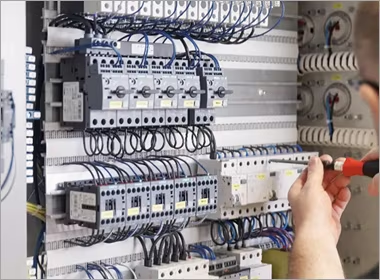
Designing networks for PLC architectures, distributed I/O systems, motion control, and legacy fieldbus integration that ensure reliable automation across continuous and discrete manufacturing.
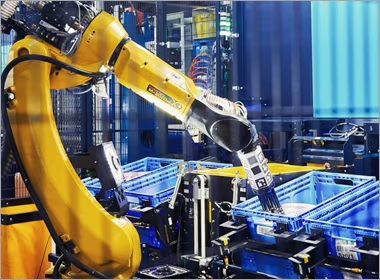
Enabling industrial IoT communication between machines, edge computing for data processing, and integration with enterprise systems for predictive maintenance and production optimization.

Protecting production networks from cyber threats while ensuring operational continuity through segmentation, secure remote access, and resilient design for 24/7 manufacturing operations.