
Factory Floor Networks
Designing robust industrial Ethernet, safety systems, wireless networks, and segmented architectures for manufacturing cells, machines, and mobile equipment.
PLC networks must synchronize distributed I/O, coordinate multi-axis motion, maintain redundancy for continuous processes, and integrate legacy fieldbus systems - all while delivering deterministic performance through production cycles that test timing boundaries.
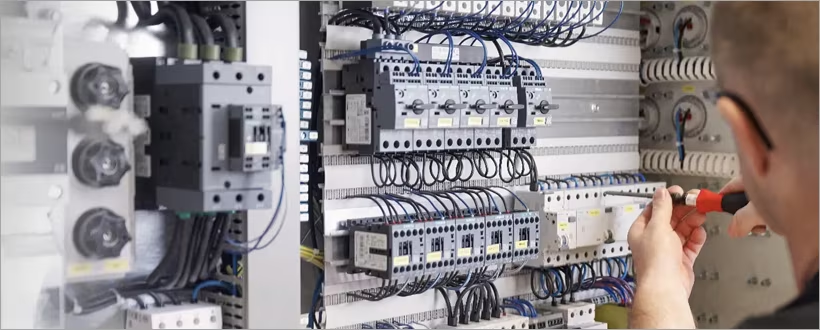
PLC networks operate at the intersection of software cycles and physical processes, where microseconds of network jitter become millimeters of positional error or degrees of temperature variation.
Programmable Logic Controllers execute control loops with fixed cycle times - typically 1ms to 100ms depending on the process. Within these cycles, the PLC must read inputs from distributed I/O, execute logic, and write outputs. Network delays or jitter disrupt this rhythm, causing control instability. In motion applications, network timing directly affects synchronization between axes. In process control, it influences batch consistency. The network is not merely transporting data; it is part of the control loop itself, with performance characteristics that directly affect product quality and equipment safety.
These timing requirements become most critical during production peaks, equipment startups, or fault conditions - exactly when networks experience increased load. Network design must therefore guarantee performance under worst-case conditions, not just average operation. This requires understanding both network technology and control system requirements, then designing infrastructure that meets the intersection of these demands.
Modern PLC systems distribute intelligence across networks, requiring architecture that supports both centralized coordination and localized autonomy.
Traditional PLC architectures used centralized controllers with hardwired I/O. Modern systems distribute intelligence: remote I/O racks, distributed drive systems, smart sensors, and safety controllers all connected via industrial Ethernet. This distribution improves flexibility and reduces wiring but increases network complexity. The architecture must support different communication patterns: cyclic data for real-time control, acyclic data for configuration and diagnostics, and event-driven data for alarms.
Network design starts with understanding data flows: which devices communicate with which controllers, at what frequency, with what latency requirements. High-speed I/O for motion control might need 1ms update cycles, while temperature sensors might tolerate 100ms. Safety systems need guaranteed response times. The network topology, switch selection, and configuration must accommodate these varied requirements on shared infrastructure, using VLANs, Quality of Service (QoS), and traffic shaping to ensure critical traffic receives priority.

Distributed I/O networks must deliver deterministic communication between PLCs and remote racks while surviving electrical noise and physical stress in factory environments.
Distributed I/O replaces miles of wiring with network cables, but introduces timing dependencies that affect control stability.
Remote I/O racks connect sensors, actuators, and instruments to PLCs via industrial Ethernet. While reducing wiring costs, this approach makes control performance dependent on network reliability. Each I/O module has specific timing requirements: digital inputs for limit switches need fast response, analog inputs for process variables need consistent sampling, and safety inputs need guaranteed maximum latency. The network must deliver data within these timing windows consistently.
Network design for distributed I/O considers cable lengths, switch latency, and protocol overhead. PROFINET IRT or EtherNet/IP with CIP Sync provide mechanisms for synchronized sampling across distributed I/O. Network topology affects reliability - star topologies provide simple fault isolation, while rings provide redundancy. For critical applications, redundant networks (like PRP or HSR) ensure continuous operation even during single failures. The key is matching network capabilities to I/O requirements, not over-engineering unnecessarily nor under-engineering critically.
Multi-axis motion systems turn network timing into mechanical synchronization, where microseconds matter at the drive but manifest as millimeters at the tool.
Modern motion control distributes intelligence: PLCs coordinate motion, dedicated motion controllers calculate trajectories, and drives execute with local control loops. These components communicate over networks that must deliver synchronized commands and feedback. PROFINET IRT, EtherNet/IP with CIP Motion, or SERCOS III provide mechanisms for deterministic communication, but require specific network design.
Motion networks prioritize low jitter over raw bandwidth. A consistently timed 1ms update with 10µs jitter is better than a 0.5ms update with 100µs jitter. Network switches must support the specific real-time protocol features: synchronization, traffic scheduling, and frame preemption. Cable quality matters - Category 6A or better for Gigabit motion networks, with proper termination and shielding. Grounding and bonding prevent electrical noise from corrupting motion commands. The network becomes part of the mechanical system, with performance directly affecting positioning accuracy and surface finish.
Manufacturing facilities operate equipment across decades of technology, requiring networks that bridge fieldbus legacy with Ethernet futures.
Many factories still use PROFIBUS DP, DeviceNet, Modbus RTU, or other fieldbus systems for machine-level communication. These legacy systems have different characteristics than Ethernet: typically lower bandwidth, master-slave architecture, and specific timing requirements. Network design must integrate these systems during transition periods that can last for the remaining life of capital equipment.
Fieldbus-to-Ethernet gateways provide the interface but require careful configuration. Gateway placement affects performance - typically close to fieldbus devices to keep fieldbus cable runs short. Configuration must match fieldbus timing characteristics (baud rates, update cycles) while providing appropriate Ethernet services. Network segmentation often isolates legacy systems to prevent their characteristics (like broadcast storms on DeviceNet) from affecting modern network segments. The goal is gradual migration: as fieldbus equipment reaches end of life, it's replaced with Ethernet-native devices, but the network supports both during the transition.
24/7 operations cannot tolerate network downtime, requiring redundancy that switches automatically without disrupting control sequences.
Continuous process industries (chemical, pharmaceutical, food & beverage) and critical discrete manufacturing (automotive paint shops, glass furnaces) operate without scheduled downtime. Network redundancy must therefore be hitless, with automatic failover that doesn't disrupt control loops. Protocols like Media Redundancy Protocol (MRP), Parallel Redundancy Protocol (PRP), or High-availability Seamless Redundancy (HSR) provide sub-second recovery for Ethernet networks.
Redundancy planning extends beyond network switches to include controllers, I/O systems, and power supplies. Some architectures use paired controllers with synchronized programs, where the backup takes over instantly if the primary fails. Others use redundant I/O connections with voting logic. The choice depends on process criticality and acceptable risk. Network design must support these redundancy schemes with appropriate topology (rings for MRP, parallel paths for PRP) and switch capabilities. Testing redundancy during commissioning and periodically during operation validates that failover works as intended when needed.
When automation systems fail, network diagnostics should identify whether the problem is in the control logic, field devices, or communication infrastructure.
Traditional automation troubleshooting focuses on PLC programs and field devices, often overlooking the network. Modern industrial networks provide extensive diagnostics: port statistics show error rates and traffic patterns, device discovery identifies connected equipment, and protocol analyzers decode industrial communications. These tools can distinguish between a faulty sensor, a network cabling problem, and a configuration error - saving hours of diagnostic time.
Effective network monitoring for automation requires understanding normal patterns: typical update rates, normal traffic volumes, expected device communications. Baseline establishment during commissioning enables anomaly detection during operation. Integration with automation systems allows network events to trigger alarms in SCADA or maintenance systems. For example, increasing CRC errors on a motor drive connection might indicate developing cable damage before it causes drive faults. Proactive network maintenance thus becomes part of overall equipment reliability programs.
Segmented network architecture protects PLC control systems from external threats while enabling necessary data exchange with MES, SCADA, and enterprise systems.
Control networks must be protected from enterprise threats while enabling data exchange for production optimization and maintenance.
Modern manufacturing connects control systems to Manufacturing Execution Systems (MES), Enterprise Resource Planning (ERP), and cloud analytics. This connectivity creates security risks: threats from corporate networks could propagate to control systems. Network segmentation creates security zones with controlled gateways. Industrial Demilitarized Zones (IDMZ) provide secure data exchange between OT and IT networks.
Segmentation design starts with identifying communication requirements: which data needs to flow where, at what frequency, with what criticality. One-way data flows (from OT to IT) can use unidirectional gateways for maximum security. Bidirectional flows require firewalls with deep packet inspection for industrial protocols. The architecture must also accommodate remote access for OEM support and maintenance, using secure remote access solutions rather than traditional VPNs. The goal is enabling necessary connectivity while containing threats - a compromise in corporate IT should not automatically become a compromise in control systems.
Automation equipment operates in electrically noisy environments where proper power and grounding determine network reliability.
Variable frequency drives, welding equipment, induction heaters, and large motors create electromagnetic interference that can corrupt network communications or damage equipment. Network design must include proper power conditioning and grounding. Uninterruptible Power Supplies (UPS) protect against power fluctuations and brief outages. Line conditioners filter electrical noise. Proper equipment grounding provides a low-impedance path for interference, preventing it from coupling into sensitive circuits.
Grounding practices are particularly important for networks spanning large areas. Ground potential differences between buildings or distant equipment can reach tens of volts during motor starts or fault conditions. These differences can damage equipment or corrupt data. Fiber optic connections provide electrical isolation for long runs or between areas with different ground potentials. For copper connections, isolated or differential signals can tolerate some ground difference. The key is understanding the electrical environment and designing the network to survive it.
Automation investments last decades; network infrastructure must support evolving technologies without complete replacement.
Manufacturing equipment often operates for 20+ years, while network technology evolves every 3-5 years. Network design must accommodate this mismatch. Key principles include: overspecifying bandwidth (install fiber even if currently using copper, provision Gigabit even if currently needing Fast Ethernet), using standardized cabling (TIA-1005 for industrial areas), implementing structured cabling with patch panels, and documenting everything thoroughly.
Modular design allows incremental upgrades: new switches can be added without rewiring, new protocols can be supported with gateway additions. Network management systems should support mixed environments during transitions. Most importantly, the network should be designed for manageability - clear documentation, logical addressing, consistent configuration - so that future technicians can understand and modify it. The goal is a network that supports today's requirements while having clear migration paths for tomorrow's technologies, protecting the automation investment over its full lifecycle.
Throughput Technologies advises on industrial automation and PLC network architectures that deliver deterministic performance for control systems, motion coordination, and legacy integration across diverse manufacturing environments.
Talk with a Solutions Specialist to review your industrial automation network infrastructure.
Different control applications have different tolerance for network delays. Discrete control (conveyors, packaging) typically tolerates 10-100ms delays. Process control (temperature, pressure, flow) needs 100-1000ms consistency more than absolute speed. Motion control requires 1-10ms with minimal jitter (under 100µs). Safety systems have maximum allowable latency defined in standards (typically 10-100ms for emergency stops). The critical factor is often consistency rather than absolute speed - a consistently timed 50ms update is better than a variable 10-100ms update. Network design must match the most demanding requirement in each system, with understanding that mixed applications on shared networks need careful traffic management.
PROFINET IRT (Isochronous Real-Time) adds hardware-based timing and bandwidth reservation specifically for motion control, while standard PROFINET RT (Real-Time) uses software-based prioritization. IRT requires specific switches that support time-aware scheduling (IEEE 802.1Qbv) and precise clock synchronization (IEEE 1588). It reserves dedicated time slots for motion data, guaranteeing delivery within defined cycles (typically 250µs to 4ms). Standard PROFINET RT uses VLAN prioritization (802.1Q) which provides best-effort real-time but can't guarantee strict timing. IRT is for multi-axis coordination where microseconds matter; RT suits most other applications. The network infrastructure must match the protocol choice - IRT requires IRT-capable switches throughout the motion control path.
Through careful gateway placement and network segmentation. Place fieldbus-to-Ethernet gateways close to fieldbus devices to keep fieldbus cable runs short (reducing noise susceptibility and timing issues). Use network segmentation to isolate legacy traffic - put gateways and fieldbus devices on separate VLANs or even separate physical networks if necessary. Configure gateways to match fieldbus timing characteristics (baud rates, update cycles). Monitor gateway performance to ensure they're not becoming bottlenecks. For critical fieldbus systems, consider redundant gateways. The goal is to contain the unique characteristics of fieldbus systems (like broadcast traffic on DeviceNet or token-passing delays on PROFIBUS) so they don't affect modern Ethernet segments. This allows gradual migration as fieldbus equipment reaches end of life.
It depends on the process criticality and acceptable risk. Media Redundancy Protocol (MRP) rings provide sub-200ms failover and are common in process industries. Parallel Redundancy Protocol (PRP) provides zero-time failover but requires duplicate infrastructure. For controllers, hot standby systems with synchronized programs provide seamless failover. For I/O, redundant modules with separate networks ensure single failures don't lose critical signals. The most robust approach combines multiple levels: redundant controllers on redundant networks with redundant I/O. However, this is costly. A risk-based approach identifies which processes would cause safety incidents, environmental releases, or major production losses if interrupted, and applies appropriate redundancy to those specifically. The key is testing redundancy regularly - untested redundancy often fails when needed.
Modern industrial networks provide diagnostics that can pinpoint problems before they affect production. Switch port statistics show error rates - increasing CRC errors might indicate cable damage before it causes communication failures. Traffic analysis can identify abnormal patterns - a device sending excessive broadcasts might be failing. Device discovery shows what's connected - missing devices indicate connection problems. Protocol analyzers decode industrial communications, showing exactly what data is being exchanged and identifying protocol violations. The key is establishing baselines during normal operation, then monitoring for deviations. Integration with automation systems allows network events to trigger alarms in SCADA or maintenance systems. For example, a switch port error threshold could trigger a maintenance work order for cable inspection before a failure occurs. This proactive approach reduces downtime.
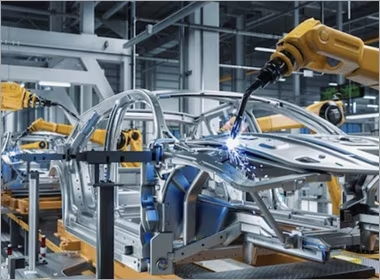
Designing robust industrial Ethernet, safety systems, wireless networks, and segmented architectures for manufacturing cells, machines, and mobile equipment.
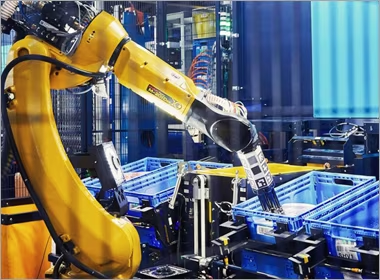
Enabling industrial IoT communication between machines, edge computing for data processing, and integration with enterprise systems for predictive maintenance and production optimization.

Protecting production networks from cyber threats while ensuring operational continuity through segmentation, secure remote access, and resilient design for 24/7 manufacturing operations.