
Smart City Network Backbone Architecture
Designing resilient municipal fibre and wireless backbone infrastructure for public services, IoT connectivity, and future smart city applications with appropriate redundancy and segmentation.
Edge networks process IoT data where it's generated – at streetlights, traffic intersections, and public spaces – reducing backbone bandwidth while enabling real-time responses, but must survive temperature extremes, vibration, electrical noise, and physical tampering in urban environments.

Edge computing devices installed in traffic cabinets, on light poles, and in underground chambers face environmental conditions that laboratory-tested equipment often cannot withstand – temperature swings, condensation, electromagnetic interference, and physical vandalism.
Municipal edge locations lack climate control: a traffic signal cabinet in direct summer sun can reach 60°C internally, while winter nights drop below freezing. Condensation forms during temperature transitions, risking electrical shorts. Vibration from nearby traffic shakes connections loose. Electrical noise from variable speed drives, welding equipment, or subway systems induces currents in communication cables. Commercial-grade computing equipment fails under these conditions, requiring industrial-hardened components designed specifically for harsh environments.
Effective edge network design starts with environmental assessment: temperature ranges, humidity, particulate contamination (dust, pollution), vibration sources, and electromagnetic noise levels. Equipment selection then matches these conditions: operating temperature range of at least -40°C to +75°C for exposed locations, IP67 rating for dust and water ingress protection, vibration resistance to 5g, and electromagnetic compatibility (EMC) testing for industrial environments. Installation practices matter equally – proper grounding, cable strain relief, and thermal management extend equipment life in challenging urban locations.

Edge gateways aggregate sensor data locally, requiring strategic placement near power and backbone connectivity while surviving harsh environmental conditions.
Edge gateways need power, connectivity to sensors, and backhaul to municipal networks – placement decisions balance these requirements against physical security and environmental protection.
Ideal edge gateway locations offer existing power (streetlight circuits, traffic signal cabinets), existing connectivity (fibre access points, wireless line-of-sight), and physical security (locked cabinets, elevated mounting). In practice, compromises are necessary: a gateway might need solar power with battery backup, wireless mesh backhaul, and tamper-resistant enclosures. The topology connects gateways in a hierarchy: sensors connect to local gateways via short-range wireless (LoRaWAN, Zigbee) or wired connections; gateways aggregate data and connect to neighbourhood aggregation points; aggregation points connect to municipal backbones.
Network design considers failure domains: a single gateway failure should affect only its local sensors, not the entire network. Redundancy at higher levels ensures gateway connectivity survives single backhaul failures. Management networks operate separately from data networks, allowing gateway configuration even during data network issues. Gateways from partners like Welotec provide multiple connectivity options – cellular, fibre Ethernet, wireless mesh – allowing flexible deployment based on local conditions. The key is designing for manageability: remote configuration, monitoring, and software updates reduce maintenance visits to challenging locations.
Low-Power Wide-Area Networks (LPWAN) connect thousands of battery-powered sensors across kilometres, but urban environments create unique propagation challenges that affect coverage and reliability.
LPWAN technologies like LoRaWAN and NB-IoT (Narrowband Internet of Things) enable sensors with 5–10 year battery life communicating over 2–15 km in ideal conditions. Urban environments are not ideal: buildings create shadows and reflections, vehicles cause signal fading, and electrical equipment generates interference. Coverage maps based on free-space propagation models overestimate actual performance, leading to dead zones where sensors cannot communicate.
Successful LPWAN deployment requires site surveys using actual equipment, not just theoretical models. Gateway placement considers building heights – elevated locations (water towers, tall buildings) improve coverage but may require structural reinforcement. Multiple gateways with overlapping coverage provide redundancy and fill shadows. Adaptive data rate mechanisms adjust transmission parameters based on signal conditions, conserving battery life in good conditions while maintaining connectivity in poor ones. Security is particularly important for LPWAN – while the protocols include encryption, key management at scale requires careful planning to prevent unauthorised access to municipal sensor networks.
Edge devices often lack dedicated power circuits, requiring creative solutions that balance energy needs with installation constraints and long-term reliability.
Municipal edge locations typically have limited power availability: a streetlight circuit provides 230V AC but may be switched off during daylight; a traffic cabinet offers 24V DC with limited current capacity; a park may have no power at all. Edge devices must operate within these constraints, which affects both hardware selection and network design. Power-over-Ethernet (PoE) can deliver both data and power up to 100 metres, but requires PoE switches with adequate power budgets.
For locations without grid power, solar systems with battery storage provide autonomy but require sizing for local sunlight conditions and load profiles. Winter months with shorter days and frequent cloud cover present the design challenge – systems sized for summer may fail in winter. Energy harvesting from vibration, temperature differentials, or ambient radio frequencies remains experimental for most municipal applications. Power management software reduces consumption during low-activity periods, extending battery life. Monitoring power status remotely allows proactive maintenance before failures occur – a critical consideration for essential services.
Air quality sensors require precise calibration and reliable connectivity in polluted environments where measurements directly inform public health decisions.
Environmental monitoring sensors measure air quality, noise levels, radiation, and meteorological conditions – data that informs public health decisions and requires high accuracy, calibration, and reliable transmission.
Air quality sensors measuring particulate matter (PM2.5, PM10), nitrogen oxides (NOx), ozone (O3), and volatile organic compounds (VOCs) must be calibrated against reference instruments and maintained regularly. Sensor placement considers airflow patterns, distance from pollution sources, and height above ground – typically 2–4 metres for pedestrian-level measurements, higher for background monitoring. Network connectivity must ensure near-continuous data transmission with time-stamping for correlation across multiple sensors.
Environmental sensor networks often use hybrid connectivity: LPWAN for basic measurements with cellular or fibre backup for high-frequency data during pollution events. Edge processing validates data quality – identifying sensor drift, compensating for temperature and humidity effects, and flagging anomalies before transmission. Data aggregation at edge gateways reduces transmission volume while preserving essential information. Security measures prevent tampering with environmental data that could affect public health advisories or regulatory compliance. Integration with public information systems requires careful data formatting and latency management – citizens expect near-real-time air quality updates during poor conditions.
Smart street lighting networks control thousands of luminaires while providing connectivity infrastructure for other municipal services, creating both opportunity and complexity at the urban edge.
Modern LED streetlights with embedded controllers enable dimming schedules, motion sensing, fault reporting, and energy monitoring. These controllers also provide potential mounting points and power for other sensors – traffic counters, air quality monitors, public Wi-Fi access points. However, lighting networks have unique characteristics: they follow road patterns rather than optimal communication paths, they power off during daylight (affecting 24/7 devices), and they require coordination with electricity distribution networks.
Lighting control networks typically use powerline communication (PLC) over existing electrical cables or wireless mesh between poles. PLC faces challenges with transformers and line noise; wireless mesh requires careful channel planning to avoid interference. Edge controllers at each light pole need local processing for immediate responses (turning on when motion detected) while communicating with central systems for coordination and monitoring. Redundancy considerations differ from other networks – lighting should degrade gracefully (individual pole failures) rather than catastrophically (entire area outages). Integration with traffic systems enables adaptive lighting – brighter illumination at pedestrian crossings or accident scenes.
Traffic counting, vehicle classification, and parking occupancy sensors generate time-sensitive data that requires local processing to reduce transmission volume while maintaining accuracy for traffic management decisions.
Inductive loops, magnetometers, radar, and video sensors monitor traffic flow, classifying vehicles by type, measuring speed, and detecting incidents. Raw sensor data – particularly from video – would overwhelm municipal networks if transmitted continuously. Edge processing extracts essential information: vehicle counts, average speeds, incident alerts, parking space occupancy. This reduces bandwidth requirements by 95% or more while preserving decision-making capability.
Edge devices for traffic applications need real-time processing capabilities and precise time synchronisation – incidents must be time-stamped accurately for correlation across multiple sensors. Connectivity requirements vary: inductive loops can use simple digital I/O connections; video analytics require Gigabit Ethernet. Power considerations are critical – traffic sensors often use solar power with battery backup, requiring efficient processing algorithms to minimise energy consumption. Data fusion at edge gateways combines information from multiple sensor types (e.g., video plus inductive loops) to improve accuracy before transmission to traffic management centres.
Throughput Technologies advises on edge connectivity for smart city IoT, designing networks that survive urban environmental challenges while providing reliable local processing and secure integration with municipal infrastructure.
Talk with a Solutions Specialist to design your municipal edge connectivity infrastructure.
Use multiple protection layers: tamper-resistant enclosures with security screws and break-off bolt heads; mounting at height (3+ metres) or in locked cabinets; motion sensors and tilt switches that trigger alarms; security cameras covering installation sites; and asset tracking with GPS or cellular modules. For particularly vulnerable locations, consider camouflaged installations or devices designed to look like municipal infrastructure (ventilation covers, utility boxes). Remote monitoring detects disconnections immediately – a stolen device that reports its last location before power loss helps recovery. Insurance and redundancy planning acknowledge that some losses will occur – design for graceful degradation rather than catastrophic failure.
Actual range is typically 20–50% of theoretical maximums in urban environments. LoRaWAN at 868 MHz (EU) or 915 MHz (US) might achieve 2–5 km in line-of-sight conditions but only 300–800 metres in dense urban cores with multi-storey buildings. Signal penetration into buildings adds further reduction – basement or deep interior locations may need repeater nodes. Site-specific testing is essential: deploy test gateways and sensors in representative locations before full rollout. Adaptive data rate features help – sensors closer to gateways transmit faster with less power, while distant sensors use slower rates that travel further. For city-wide coverage, plan for gateway density of approximately one per square kilometre in urban centres, less in suburban areas.
Process at the edge what needs immediate response or significantly reduces data volume. Immediate responses: traffic incident detection triggering warning signs, lighting motion sensors activating lights, safety sensors triggering alarms. Data reduction: video analytics extracting vehicle counts instead of streaming video, vibration sensors sending spectrum peaks instead of raw waveforms, air quality sensors sending validated measurements instead of raw readings. Keep in the cloud what requires historical analysis, correlation across multiple sites, or integration with other city systems. A good rule: if action must happen within one second, process at the edge; if within one minute, consider edge with cloud coordination; if longer, cloud processing may suffice. Edge gateways from Welotec provide flexible compute capabilities for this balance.
Use a staged, resilient update process. Test updates thoroughly on a small subset (1–5%) of devices before wider deployment. Deploy updates in geographical or functional batches – never all devices simultaneously. Ensure updates are resumable and reversible – interrupted updates should resume rather than brick devices; problematic updates should roll back automatically. Schedule updates during low-activity periods, considering both network traffic and municipal operations. Use multicast distribution where possible to reduce network load. Verify update success automatically and flag failures for manual intervention. Maintain compatibility with previous versions during transition periods – not all devices will update simultaneously. Secure the update process with cryptographic signatures to prevent malicious updates.
Apply redundancy proportionate to criticality. For essential services (traffic incident detection, emergency lighting), provide dual power sources (grid plus battery/solar) and dual communication paths (primary fibre with cellular backup). For important services (parking sensors, environmental monitoring), single power with battery backup and primary communication with automatic failover to alternative technology (e.g., fibre primary, wireless mesh backup). For non-critical services (tourist information, decorative lighting), accept single points of failure with quick repair service level agreements (SLAs). The key is identifying which services affect public safety versus convenience. Document failure scenarios and recovery procedures – knowing how long repairs take helps set realistic expectations for service restoration.

Designing resilient municipal fibre and wireless backbone infrastructure for public services, IoT connectivity, and future smart city applications with appropriate redundancy and segmentation.
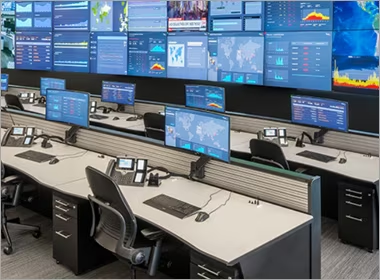
Network architecture for integrated operations centres: traffic management, public safety dispatch, emergency coordination, and municipal service monitoring with appropriate segmentation and redundancy.

Protecting municipal networks from cyber threats while ensuring operational continuity through segmentation, secure access, intrusion detection, and resilient design for critical urban infrastructure.