
Edge Connectivity for Urban Infrastructure & IoT
Designing local networks for IoT sensors, edge computing nodes, and last-mile connectivity that integrate with municipal backbones while surviving harsh urban environments.
Municipal network backbones must carry critical public safety communications, support thousands of IoT sensors, enable public internet access, and accommodate future smart city applications – all while achieving carrier-grade reliability in harsh urban environments.
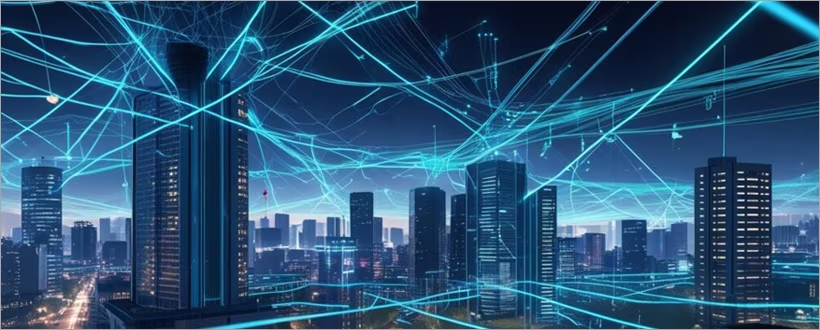
City network backbones become single points of failure for disparate municipal services when designed as separate systems rather than integrated infrastructure with appropriate segmentation and prioritization.
Traditional municipal networks developed organically: separate systems for traffic signals, public safety communications, water monitoring, and building management. As cities digitize, these systems converge onto shared infrastructure to reduce costs and enable data integration. However, without proper design, this convergence creates risk: a fiber cut affecting both traffic lights and emergency communications, or a bandwidth surge from public Wi-Fi disrupting water quality monitoring. The backbone must provide both connectivity and isolation – enabling data exchange where beneficial while preventing failure propagation.
Effective smart city backbone design starts with service categorization: which services are mission-critical (public safety, emergency communications), which are business-critical (traffic management, utility monitoring), and which are best-effort (public Wi-Fi, tourist information). Network architecture then implements appropriate quality of service (QoS), redundancy, and segmentation for each category. The backbone becomes a multi-service platform rather than just transport infrastructure, with intelligence to prioritize, protect, and monitor different traffic types across shared physical media.

Fiber optic rings provide sub-50ms failover for critical municipal services while offering virtually unlimited bandwidth for future smart city applications.
Self-healing fiber rings provide physical layer redundancy that automatically reroutes traffic during cable cuts or equipment failures, maintaining continuity for essential municipal services.
Metropolitan Area Network (MAN) rings typically follow major road corridors or utility rights-of-way, connecting key municipal sites: city halls, police stations, fire departments, traffic management centers, water treatment plants, and public facilities. Dual-counter rotating rings with nodes at approximately 2–5 km intervals provide geographic diversity – a single backhoe cut shouldn't isolate multiple critical sites. Protocols like Resilient Packet Ring (RPR) or Ethernet Ring Protection Switching (ERPS) provide sub-50 millisecond failover, transparent to applications.
Fiber selection matters: single-mode fiber provides virtually unlimited bandwidth for decades, while multi-mode may suffice for shorter campus-style networks. Splicing versus connectorized approaches balance reliability with flexibility – fusion splicing provides lower loss and better protection but makes reconfiguration difficult. Conduit design is equally important: spare ducts (typically 30–50% extra capacity) accommodate future growth without street re-excavation. For municipalities, partnering with utility companies to share existing duct infrastructure can reduce deployment costs by 40–60%.
Wireless mesh networks extend backbone connectivity to difficult-to-wire locations and provide temporary infrastructure for events or emergencies, but require careful design to avoid interference and ensure reliability.
While fiber forms the core backbone, wireless mesh fills gaps: connecting sensors in parks, providing temporary coverage for festivals, reaching remote monitoring points, or serving as interim connectivity during fiber deployment. Mesh networks use nodes that relay traffic to neighbors, creating self-forming, self-healing networks. However, each hop adds latency and reduces throughput, limiting practical mesh depth to 3–5 hops for real-time applications.
Frequency selection is critical: licensed spectrum (like 4.9 GHz for public safety in many regions) offers interference protection but requires licensing; unlicensed spectrum (5 GHz) is accessible but subject to congestion. Modern mesh systems use multiple radios – one for client access, others for backhaul – to separate functions. Antenna placement and alignment affect performance: municipal structures like light poles, water towers, and building facades provide elevation but may require structural reinforcement. Redundancy in wireless mesh requires multiple paths between nodes, not just single point-to-point links.
Public Wi-Fi networks create unpredictable bandwidth demands that can overwhelm municipal backbones if not properly designed with adequate backhaul and traffic shaping.
Citizens and visitors expect free Wi-Fi in public spaces – parks, libraries, transport hubs, downtown areas. Each access point might serve 50–100 simultaneous users, with bandwidth requirements varying from basic web browsing to video streaming. The backbone must aggregate traffic from dozens or hundreds of access points, requiring significant bandwidth at aggregation points. More importantly, public Wi-Fi traffic must be isolated from municipal operational traffic to prevent security risks and performance interference.
Backhaul design uses a hierarchical approach: Wi-Fi access points connect to local switches via Ethernet or fiber; these switches aggregate to neighborhood aggregation points; multiple neighborhoods connect to core data centers. At each aggregation layer, traffic shaping policies limit public Wi-Fi bandwidth during peak municipal operational periods. Virtual Local Area Networks (VLANs) separate public traffic from municipal operations. Content caching at edge locations reduces upstream bandwidth requirements for popular content. Authentication systems should integrate with municipal systems for residents while providing secure guest access for visitors.
Thousands of IoT sensors for parking, lighting, waste management, and environmental monitoring require scalable connectivity that doesn't compromise critical municipal communications.
Internet of Things (IoT) sensors for smart parking, lighting, waste management, and environmental monitoring generate small but numerous data packets that require efficient aggregation without overwhelming the backbone.
A medium-sized city might deploy 10,000–50,000 IoT sensors across various applications. While each sensor transmits minimal data (a few bytes to kilobytes per hour), collectively they create steady network load. More importantly, IoT devices have different characteristics: parking sensors need near-real-time updates during business hours; air quality sensors transmit continuously; waste bin sensors report only when full. The backbone must accommodate these varied patterns without dedicating excessive resources to any single application.
IoT integration typically uses edge gateways that aggregate sensor data before transmission to central systems. These gateways – such as those from Welotec – provide protocol translation (from LoRaWAN, Sigfox, or proprietary wireless to Ethernet), data filtering, and local processing. Placement is critical: gateways need power and connectivity, often co-located with streetlight controllers, traffic signal cabinets, or municipal buildings. The backbone provides connectivity between gateways and central IoT platforms, with appropriate security segmentation to prevent compromised sensors from affecting other municipal systems.
Intelligent Transportation Systems (ITS) require deterministic communications for traffic signal coordination and vehicle detection, with latency and reliability requirements that challenge shared municipal networks.
Traffic signal controllers operate on fixed timing cycles – typically 100–300 milliseconds for coordination between intersections. Network delays directly affect traffic flow efficiency and safety at signalized intersections. Traditional traffic systems used dedicated copper or fiber connections, but modern approaches converge onto shared municipal backbones to reduce costs. This convergence requires careful network design to maintain timing precision.
Traffic communications need guaranteed bandwidth and maximum latency bounds rather than just average performance. Network quality of service (QoS) mechanisms prioritize traffic signal data over less time-sensitive applications. Precision Time Protocol (PTP – IEEE 1588) synchronizes traffic controller clocks across the network, ensuring coordinated signal timing even with network propagation delays. Redundancy is critical: traffic systems should survive single failures without causing gridlock. Some municipalities implement diverse fiber paths for critical intersections – separate ducts entering from different directions to survive construction damage.
Water, electricity, and gas utilities require reliable communications for SCADA (Supervisory Control and Data Acquisition) and monitoring, often leveraging municipal fiber assets with appropriate service level agreements.
Municipal utilities – water treatment plants, pumping stations, substations, district heating systems – need continuous monitoring and control. Traditionally, utilities built separate networks, but sharing municipal fiber infrastructure reduces costs. However, utility operational technology (OT) has different requirements than general municipal IT: deterministic timing for protection systems, higher availability requirements (99.999% vs 99.9%), and different security considerations.
Shared infrastructure approaches use wavelength division multiplexing (WDM) to provide virtual dedicated fibers over shared physical fiber, or MPLS (Multiprotocol Label Switching) networks with virtual private networks (VPNs) for logical separation. Service level agreements (SLAs) define availability, latency, and restoration time objectives. For critical protection systems, some utilities maintain separate physical diversity as a last resort, even when using shared backbone for normal operations. Partners like Westermo provide ruggedized networking equipment that survives utility substation environments while interoperating with municipal backbone equipment.
Throughput Technologies advises on smart city network backbone architecture that balances public service reliability, IoT scalability, and future growth while surviving urban environmental challenges and evolving technology requirements.
Talk with a Solutions Specialist to design your municipal network backbone infrastructure.
Install at least twice the fiber count you think you'll need in the next decade, and ensure conduit space for 30–50% additional fibers later. A typical municipal backbone starts with 48–96 fibers per duct, with high-density cables (144–288 fibers) becoming standard. Single-mode fiber is essential – it supports virtually unlimited bandwidth with wavelength division multiplexing (WDM). Consider not just fiber count but fiber type: some municipalities install hybrid cables with both single-mode and multi-mode fibers for different applications. The key principle: excavation and duct installation represent 70–80% of network cost; adding fibers during initial construction costs only 10–20% more.
Implement a four-tier quality of service (QoS) model: Platinum for real-time public safety (voice, video, emergency alerts); Gold for operational control (traffic signals, SCADA); Silver for business applications (CCTV backhaul, building management); Bronze for best-effort (public Wi-Fi, web browsing). Use Differentiated Services Code Point (DSCP) markings at network edges, with appropriate queueing and scheduling in switches and routers. Test under congestion conditions – during major events when public Wi-Fi usage peaks, ensure traffic signals and emergency communications maintain performance. Document and enforce the policy across all departments to prevent "priority creep" where every department claims their traffic is critical.
Evaluate based on bandwidth requirements, reliability needs, and cost. For sites needing high bandwidth and reliability, consider micro-trenching or directional boring to extend fiber. For medium bandwidth needs, point-to-point wireless (60–80 GHz for short distances, licensed microwave for longer) provides 100 Mbps–1 Gbps. For low-bandwidth IoT sensors, Low-Power Wide-Area Networks (LPWAN) like LoRaWAN or NB-IoT work for a few kilometers. Often a hybrid approach works best: fiber to a neighborhood aggregation point, then wireless to individual sites. For temporary or seasonal sites, cellular connectivity with ruggedized routers from partners like Westermo provides flexibility. Always have a backup plan – even wireless links should have diverse paths or cellular fallback.
Implement defense-in-depth with multiple security layers. Segment the network: separate VLANs for different services, with firewalls between segments. Use 802.1X authentication for all wired and wireless connections – devices must authenticate before gaining network access. Deploy Network Access Control (NAC) to check device compliance before granting access. Monitor traffic patterns – anomaly detection can identify compromised devices even if they've passed authentication. For public Wi-Fi, use captive portals with terms of service acceptance, and isolate public traffic completely from municipal operations. Regular security audits and penetration testing identify vulnerabilities before attackers do. Solutions from Secomea can provide secure remote access for maintenance without exposing management interfaces.
Match redundancy to service criticality. Mission-critical services (emergency communications, 911 dispatch) need 99.999% availability – dual diverse fiber paths, redundant equipment at every layer, geographic diversity for key facilities. Business-critical services (traffic management, water SCADA) need 99.99% – self-healing fiber rings with equipment redundancy at aggregation points. Important services (public Wi-Fi, building management) need 99.9% – single rings or redundant star topologies. The cost increases exponentially with each nine – design accordingly. Document recovery time objectives (RTO) and recovery point objectives (RPO) for each service, then design to meet those targets. Test failover regularly – annual exercises for critical systems, biannual for others.

Designing local networks for IoT sensors, edge computing nodes, and last-mile connectivity that integrate with municipal backbones while surviving harsh urban environments.
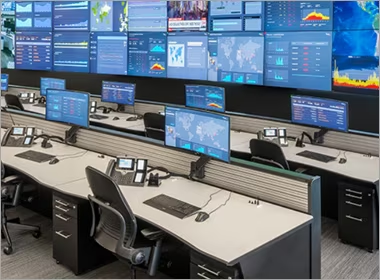
Network architecture for integrated operations centers: traffic management, public safety dispatch, emergency coordination, and municipal service monitoring with appropriate segmentation and redundancy.

Protecting municipal networks from cyber threats while ensuring operational continuity through segmentation, secure access, intrusion detection, and resilient design for critical urban infrastructure.