
Electric Power Systems
Networking for substation communications, protection systems, IEC 61850 architectures, and grid edge integration with deterministic timing requirements.
Pipeline networks span hundreds of kilometres through remote terrain while controlling high-pressure gas flows – requiring communications that deliver deterministic control for safety systems, reliable monitoring for leak detection, and long-distance connectivity that survives environmental extremes and maintains operational visibility across vast distances.
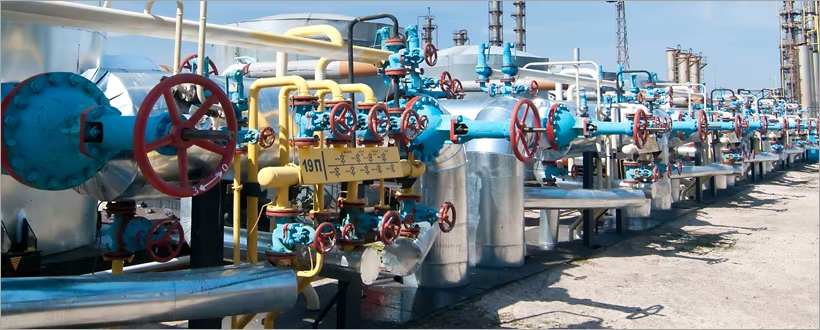
Isolated compressor stations, valve sites, and measurement points become operational blind spots when communications fail – potentially delaying leak response, losing pressure control, or missing critical safety alarms across pipeline segments spanning inaccessible terrain.
Gas transmission pipelines operate continuously with remote supervisory control – centralised operators monitor pressures, flows, and equipment status across hundreds of kilometres. Communication failures create segments where operators cannot see conditions or control equipment. During normal operation, this limits optimisation; during incidents, it delays response. The network must therefore provide not just connectivity but guaranteed availability – often 99.99% or higher for critical safety communications. Environmental challenges compound the problem: pipelines traverse mountains, deserts, water crossings, and urban areas, each with different communication constraints.
Effective pipeline networking starts with reliability analysis: identifying which sites must maintain communication during worst-case conditions (storms, earthquakes, equipment failures). Network architecture then implements appropriate redundancy – diverse communication paths using different technologies (fibre, microwave, satellite). Timing requirements vary: emergency shutdown systems need deterministic response within seconds, while pressure monitoring tolerates longer intervals. The network must also accommodate growth – new measurement points, additional compressor stations, expanded pipeline branches – without complete redesign. Security considerations are paramount: unauthorised access to pipeline controls could cause catastrophic releases or supply disruptions.

Pipeline supervisory control and data acquisition systems require continuous communication along the pipeline route with sufficient bandwidth for real-time monitoring and leak detection algorithms.
Supervisory control and data acquisition (SCADA) systems provide operational visibility and control, while computational pipeline monitoring (CPM) systems analyse data for leak detection – both requiring reliable, time-synchronised communications along the pipeline.
Pipeline SCADA collects data from remote terminal units (RTUs) and flow computers at compressor stations, valve sites, and measurement points. Typical data includes pressures, temperatures, flow rates, valve positions, and equipment status. Update intervals range from 1–10 seconds for critical parameters to minutes for less critical data. Leak detection systems use this data in real-time transient models that compare expected versus actual flow – requiring precise time-stamping and consistent data delivery to calculate mass balance accurately.
Network design for SCADA considers data volume and timing. A medium-sized transmission pipeline with 50 measurement points might generate 10–50 kbps of continuous SCADA data. Leak detection algorithms may need higher-frequency data during transient conditions. Time synchronisation via global positioning system (GPS) or precision time protocol (PTP) ensures data correlation across the pipeline. Redundancy approaches include dual communication paths with automatic failover – often fibre primary with satellite or microwave backup. Network segmentation separates SCADA traffic from other communications (voice, video surveillance, corporate data) to ensure priority during incidents. Security measures protect against unauthorised access to control systems.
Compressor stations maintain pipeline pressure over long distances, requiring continuous monitoring and control with communication networks that survive the electrically noisy environments of large rotating machinery.
Gas compressor stations house large turbine or electric motor-driven compressors, together with cooling systems, filtration, and pressure regulation equipment. Monitoring includes vibration analysis, temperature, pressure, flow, equipment status, and safety systems. Control functions range from continuous speed adjustment to emergency shutdown. The communication network must deliver deterministic performance for safety interlocks while supporting data-intensive condition monitoring.
Station networks typically use industrial Ethernet with appropriate hardening for the environment – extreme temperatures, vibration from machinery, electromagnetic interference (EMI) from variable frequency drives and switchgear. Network topology often follows a star or ring configuration within the station, with redundant connections to the wider pipeline network. Time-critical safety systems may use dedicated networks or VLANs with quality of service (QoS) guarantees. Remote access for vendor support requires secure connectivity – zero-trust approaches that grant limited, audited access to specific systems. Equipment from partners like Westermo provides the reliability needed for continuous operation in these demanding environments.
Cathodic protection systems prevent pipeline corrosion through impressed current or sacrificial anodes, requiring regular monitoring and adjustment that benefits from automated remote measurement rather than manual site visits.
Buried steel pipelines corrode without protection. Cathodic protection systems maintain the pipeline at a negative voltage relative to the surrounding soil, inhibiting corrosion. Monitoring points along the pipeline measure pipe-to-soil potential, current output from rectifiers, and other parameters. Traditional monitoring requires technicians to visit test points periodically – inefficient for long pipelines through difficult terrain.
Automated monitoring networks install remote monitoring units at test points, communicating via wireless (cellular, radio) or along the pipeline fibre if available. Each unit measures parameters periodically (hourly or daily) and transmits data to central systems. Network design considers power constraints – many test points lack mains power, requiring solar panels with battery storage. Data volumes are low (a few bytes per measurement) but reliability is important to detect protection system failures before corrosion occurs. Integration with geographic information systems (GIS) helps correlate protection performance with pipeline location and soil conditions. Alerts notify maintenance teams when parameters deviate from acceptable ranges, enabling proactive rather than reactive maintenance.
Distribution networks serving residential and commercial customers require secure communications that protect customer data and system integrity while enabling efficient operations.
Gas distribution networks – from city gate stations to end consumers – require secure communications for pressure regulation, leak detection in populated areas, and integration with smart metering systems, all while protecting customer privacy and system security.
Distribution networks differ from transmission: shorter distances but more endpoints, urban environments with communication options but also interference, and direct connection to consumer premises. Communication needs include district regulator monitoring, leak detection in distribution mains, and increasingly, advanced metering infrastructure (AMI) for billing and consumption monitoring. Security requirements are heightened due to connection to consumer networks and potential privacy concerns.
Network architecture for distribution uses hierarchical design: field area networks (FANs) connect local devices (regulators, sensors), which aggregate to neighbourhood concentrators, then to central systems. Technologies include cellular (4G/LTE, 5G), radio frequency mesh, and power line communication (PLC). Security implementation follows the utilities core guidance: segmentation between distribution operational technology (OT) and corporate networks, encrypted communications for sensitive data, and intrusion detection for anomalous traffic patterns. Smart meter networks require additional privacy protections – consumption data revealing occupancy patterns, and secure disconnect controls that prevent unauthorised operation.
Pipeline rights-of-way provide ideal corridors for fibre optic cable installation, offering communication infrastructure for pipeline operations while potentially generating revenue through dark fibre leasing to third parties.
Many pipeline operators install fibre optic cables along their routes during construction or maintenance. The cable typically runs in the same trench as the pipeline, either directly buried or in conduit. Fibre provides virtually unlimited bandwidth for pipeline communications while surviving the same environmental conditions as the pipeline itself. Additional fibres beyond operational needs can be leased to telecommunications providers, creating revenue streams that offset installation costs.
Fibre network design along pipelines considers several factors: cable type (loose tube for direct burial, armoured for rocky areas), fibre count (typically 48–144 fibres), repeater spacing (60–100 km depending on fibre type and optics), and access points (valve sites, compressor stations). Redundancy often uses diverse fibre paths within the same corridor or separate microwave/satellite backup. Testing and monitoring detect fibre damage from third-party excavations, ground movement, or natural events. Partners like FlexDSL can provide high-speed copper connectivity solutions for sites where fibre termination isn't practical, using existing copper infrastructure along pipeline routes.
Pipeline cybersecurity must protect critical infrastructure from cyber threats while maintaining continuous operations – balancing security measures with safety and reliability requirements for hazardous material transport.
Gas pipelines are critical infrastructure with potential safety and environmental consequences if compromised. Cybersecurity follows the utilities core guidance framework: network resilience through redundancy, segmentation between operational and business systems, secure remote access for maintenance, and intrusion detection tailored to pipeline operations. Implementation considers the unique characteristics of pipeline systems: long distances with many remote sites, mix of modern and legacy equipment, and safety systems that cannot be disrupted by security measures.
Segmentation uses the Purdue Model adapted for pipelines: Level 0–2 for field devices (sensors, actuators), Level 3 for station control, Level 3.5 for demilitarised zone (DMZ), and Levels 4–5 for enterprise. Firewalls at compressor stations and control centres enforce separation. Secure remote access solutions provide controlled connectivity for vendors and maintenance personnel without exposing systems to the internet. Intrusion detection systems recognise pipeline-specific anomalies – unexpected SCADA commands, unusual flow patterns that might indicate manipulated measurements, or communication patterns suggesting reconnaissance. Incident response plans consider operational impacts – security actions cannot compromise safety systems or create hazardous conditions.
Throughput Technologies advises on gas and pipeline networking that balances long-distance connectivity with local control requirements, implemented in environments where reliability directly affects safety and environmental protection.
Talk with a Solutions Specialist to design your pipeline communication infrastructure.
The best technology depends on location, bandwidth needs, and reliability requirements. Fibre optic along the pipeline provides highest bandwidth and reliability but requires installation. Microwave radio works for line-of-sight sites 30–80 km apart, offering moderate bandwidth with low latency. Satellite covers any location but has higher latency (500–700 ms) and lower bandwidth, suitable for SCADA but not real-time control. Cellular (4G/LTE, 5G) works where coverage exists, with bandwidth suitable for most applications. Often a hybrid approach is best: fibre along main routes, microwave for spur lines, satellite backup for critical sites. Redundancy using different technologies ensures continuity when one system fails – fibre primary with satellite backup is common for critical stations.
Computational pipeline monitoring (CPM) systems typically need pressure and flow data every 1–5 seconds for effective leak detection. Faster sampling (1 second or less) improves leak location accuracy and reduces time to detection but increases data volume. The optimal interval balances detection performance with communication costs and network capacity. During normal operation, 5-second intervals may suffice; during suspected leaks or transient conditions, systems may automatically increase to 1-second intervals. Time synchronisation across measurement points is critical – unsynchronised data reduces leak location accuracy. Network design must accommodate both normal and burst data rates, with quality of service (QoS) ensuring leak detection traffic receives priority during incidents.
Emergency shutdown (ESD) systems require the highest level of redundancy – typically dual diverse communication paths with automatic failover. Common approaches include: fibre primary with satellite backup, or microwave primary with cellular backup. The backup system should use different technology and physical path to survive common failure modes (e.g., fibre cut shouldn't also affect satellite). For the most critical sites, triple redundancy may be justified. Testing is essential – failover should occur automatically within seconds, not minutes. Consider also local autonomy: ESD systems should have local logic that can trigger shutdown based on local sensors even if communications fail completely. Document and regularly test the failover process to ensure it works when needed.
Implement security appropriate to the power constraints. For solar-powered sites, use efficient encryption algorithms (AES-128 rather than AES-256 where acceptable). Schedule security operations during daylight when power is available. Use certificate-based authentication rather than continuous challenge-response protocols. Implement sleep modes where devices authenticate periodically rather than maintaining continuous secure sessions. For very constrained sites, consider application-layer security that adds minimal overhead compared to full transport layer security (TLS). Physical security measures (tamper-resistant enclosures, secure mounting) reduce need for continuous electronic monitoring. Balance security requirements with operational reality – some remote monitoring applications may accept lower security levels than control systems, with compensating controls like data validation at receiving systems.
Several considerations: safety during installation near operating pipelines, minimum separation distances (typically 300–600 mm horizontally from pipeline), cable depth (usually 1–1.5 metres), marking and documentation, protection at road crossings, and access points at valve sites or compressor stations. Installation methods include direct burial alongside pipeline during construction or maintenance, directional drilling for crossings, and plowing for open terrain. Cable selection should match environment: armoured for rocky areas, rodent-resistant for certain regions, with appropriate temperature rating. Include spare fibres (50–100% extra) for future needs and redundancy. Test thoroughly after installation and document fibre characteristics (loss, length, splice points) for future maintenance. Consider partnership with telecommunications providers to share installation costs in exchange for dark fibre access.
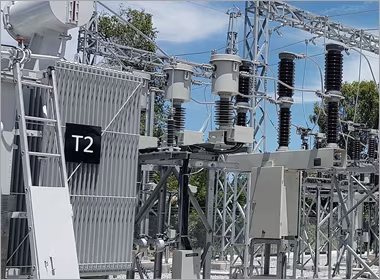
Networking for substation communications, protection systems, IEC 61850 architectures, and grid edge integration with deterministic timing requirements.
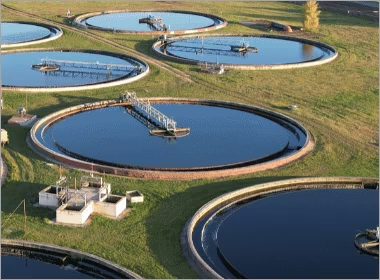
Network design for water treatment plants, distribution monitoring, pump station control, and wastewater management with reliability requirements for continuous public health protection.
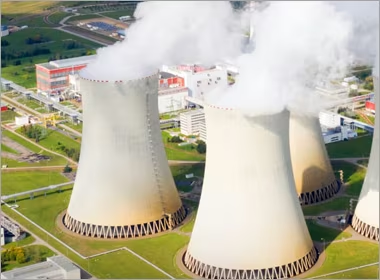
Networking for nuclear facilities and other safety-critical utilities where deterministic performance, diversity, and regulatory compliance govern network architecture and implementation.