
Underground Communications
Designing resilient leaky feeder, wireless, and fibre networks that survive rock movement, water, and blast vibration in underground mining environments.
Mining cybersecurity must protect production systems without creating single points of failure, while network resilience ensures operations continue through equipment failures, environmental stress, and connectivity interruptions in remote locations.
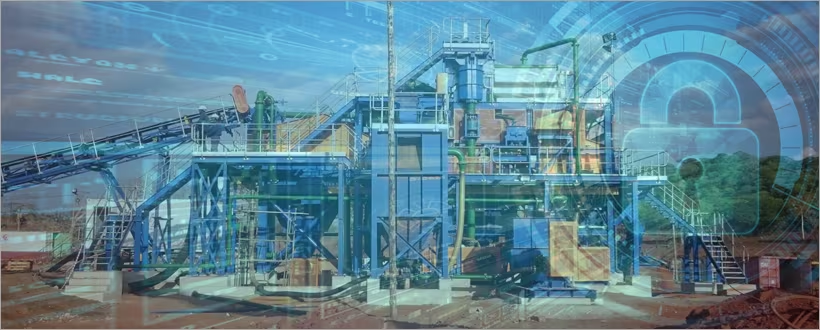
Mining operations combine critical infrastructure, harsh environments, remote locations, and complex supply chains - creating a security and resilience challenge unlike any other industry.
Mining networks must simultaneously protect safety systems (ventilation, gas monitoring, personnel tracking), production control (drills, haul trucks, processing plants), and business operations - all while operating in environments where standard IT security measures can disrupt operations or fail physically. The consequences of security breaches range from production loss to life safety incidents, while network failures can strand personnel, halt extraction, or cause environmental incidents.
Traditional IT security approaches fail in mining because they prioritise confidentiality over availability, introduce single points of failure, and assume controlled environments. Mining cybersecurity must instead focus on containment, operational continuity, and resilience to both cyber and physical threats.
Flat networks allow threats to propagate; segmentation contains them while preserving necessary communication.
Mining operations typically evolve from isolated systems to converged networks without clear segmentation. Production control systems, safety monitoring, fleet management, and corporate IT gradually interconnect, creating paths for threats to spread. Strategic segmentation creates security zones with controlled gateways between them.
Critical zones should include: safety systems (gas monitoring, ventilation control, personnel tracking), production control (PLC networks for processing plants), mobile fleet networks, and corporate IT. Firewalls or industrial DMZ appliances at zone boundaries enforce communication policies while allowing necessary data exchange. This containment ensures that a compromise in one zone doesn't automatically spread to others.

Zero-trust remote access provides OEMs and support teams controlled access to specific systems without placing them on the production network.
Mining equipment requires external support, but traditional VPNs create unacceptable risk.
Haul trucks, drills, processing equipment, and specialized instruments often require remote diagnostics and updates from OEMs or specialized technicians. Standard VPN solutions grant broad network access, creating potential entry points for threats. Modern secure remote access solutions use zero-trust principles, granting access only to specific devices or applications for limited durations.
These systems should broker connections rather than placing external users on the network, record all sessions for audit, require multi-factor authentication, and automatically terminate inactive connections. Access policies should be role-based, allowing maintenance technicians to reach specific PLCs while preventing access to safety systems or unrelated equipment.
Mining control networks have predictable traffic patterns - deviations indicate potential compromise.
Unlike enterprise IT with highly variable traffic, mining operational networks are deterministic. PLCs poll sensors at fixed intervals, control loops execute on predictable schedules, and mobile equipment reports telemetry in consistent patterns. Industrial intrusion detection systems (IDS) can establish this baseline and alert on anomalies.
Key indicators include: new network connections to unusual destinations, traffic at unexpected times (such as during maintenance shutdowns), protocol violations, or communication with known malicious IP addresses. Because many mining control devices cannot run endpoint protection, network-based detection becomes the primary defense layer after segmentation.
Regulatory and insurance requirements increasingly mandate specific security controls for mining operations.
While no single global standard governs mining cybersecurity, frameworks like IEC 62443 (industrial automation), NIST SP 800-82 (ICS security), and industry-specific guidelines provide structured approaches. Mining operations must also comply with safety regulations that intersect with cybersecurity, such as requirements for safety instrumented systems (SIS) that cannot be compromised.
A risk-based approach identifies critical assets (safety systems, primary production controls, environmental controls) and applies appropriate security levels. Documentation of security policies, procedures, and technical controls becomes essential not only for operational security but also for regulatory compliance, insurance renewals, and investor confidence.
When security incidents occur, response must prioritise safety and production continuity over investigation.
Mining incident response differs fundamentally from IT incident response. The primary goals are: ensure personnel safety, maintain critical operations (especially safety systems), contain the threat, and restore normal operations. Forensic investigation and evidence preservation come after these operational priorities are addressed.
Response plans should include clear decision authorities, communication protocols (including when to involve regulatory bodies), and technical playbooks for common scenarios. Regular tabletop exercises involving operations, safety, and IT teams build muscle memory for coordinated response under pressure. Isolated backup control capabilities - perhaps manual override panels or segregated backup systems - provide resilience if primary control networks are compromised.
Mining equipment has long lifecycles with components from global suppliers, creating embedded risk.
A single haul truck or processing plant control system contains components from dozens of suppliers worldwide, many with their own sub-suppliers. Vulnerabilities or malicious code can be introduced at any point in this chain. Supply chain security requires vetting suppliers, verifying software/firmware integrity, and maintaining inventories of installed components with their security status.
For critical systems, consider: requiring suppliers to provide software bills of materials (SBOM), verifying firmware checksums before installation, isolating third-party maintenance networks, and periodically auditing supplier security practices. This is particularly important for safety systems where compromise could have immediate physical consequences.
Industrial-grade switches, firewalls, and gateways must survive vibration, dust, temperature extremes, and power fluctuations while providing security services.
Security devices must survive the same conditions as the equipment they protect.
Standard IT security appliances fail quickly in mining environments. Switches, firewalls, and gateways must be rated for wide temperature ranges (-40°C to +75°C), high vibration resistance, dust ingress protection (IP65 or better), and electrical noise immunity. They should support deterministic networking for control traffic while providing security services like access control lists, VLANs, and VPN termination.
Physical security of network infrastructure is equally important. Communication cabinets should be lockable, located in secure areas when possible, and monitored for unauthorized access. In remote locations, consider tamper-evident enclosures and cellular-based alarm systems that alert to physical intrusion attempts.
Single points of failure in network design create both availability and security vulnerabilities.
Networks with single choke points for security inspection create availability risks - if the firewall fails, all communication stops. They also create security risks - attackers who compromise the central device gain control over all traffic. Resilient designs use redundant security appliances in active-active or active-passive configurations, with diverse physical paths to avoid single points of failure.
For critical safety and production networks, consider geographically separate control rooms with independent network paths. This ensures that an incident at one location (fire, flood, physical attack) doesn't disable entire operations. The goal is defense-in-depth where security controls are distributed rather than centralized, and failures degrade gracefully rather than catastrophically.
Remote mining sites require centralized visibility with local autonomy for critical functions.
Large mining operations span multiple pits, processing plants, and support facilities across vast distances. Network and security management must provide centralized visibility and control while allowing local sites to operate independently during communication outages. This typically involves hierarchical management with local controllers handling time-sensitive functions and reporting to a central security operations center.
Bandwidth constraints at remote sites influence security architecture. Continuous video feeds from multiple cameras may need local storage with only exception clips transmitted centrally. Security alerts should be prioritized so critical incidents receive immediate attention while lower-priority notifications are queued for periodic transmission. The management system itself must be secure, with encrypted communications and strict access controls.
Throughput Technologies advises on cybersecurity and network resilience architectures that protect mining operations without compromising safety, availability, or production efficiency in harsh, remote environments.
Talk with a Solutions Specialist to conduct a cybersecurity and resilience assessment of your mining operations.
Standard IT security tools often fail in mining for several reasons: they can't withstand harsh environments (dust, vibration, temperature extremes); they may block or delay industrial protocols they don't understand; they typically lack deterministic performance needed for control systems; and they often require frequent updates/reboots that disrupt 24/7 operations. Industrial security appliances are designed specifically for these challenges - they're hardened physically, understand industrial protocols, provide predictable performance, and support long maintenance windows.
Safety always takes precedence. Security controls must never interfere with safety system operation. This is achieved through careful segmentation: safety networks should be isolated with very limited (preferably one-way) communication paths to other networks. Safety systems should have independent, validated communication paths that bypass security checkpoints for emergency signals. Security monitoring of safety networks should be passive (observation only) rather than active (blocking). Regular testing verifies that security measures don't impede safety functions during drills or actual emergencies.
Flat network architecture without segmentation. When production control, safety systems, fleet management, and corporate IT all share the same network, a compromise in one area (like a contractor's laptop on the corporate network) can spread to critical control systems. Many mining networks evolved organically with devices added as needed, creating undocumented connections and hidden pathways. Strategic segmentation is the most effective first step - it contains threats and makes subsequent security measures more manageable.
Mobile equipment requires a layered approach: secure wireless networks (WPA3-Enterprise for Wi-Fi, properly configured LTE), onboard firewalls or secure gateways that filter traffic between vehicle systems and the network, encrypted communications for control signals, and physical security for onboard electronics. Vehicles should authenticate to the network (not just connect), and communications should be segmented so that, for example, engine diagnostics can't access autonomous control systems. Regular security updates for vehicle software are challenging but essential, often requiring scheduled maintenance windows.
Continuously and periodically. Continuous monitoring should watch for anomalies in network traffic, unauthorized access attempts, and system changes. Formal penetration tests or security assessments should occur at least annually, or after any significant network changes, new equipment installations, or security incidents. Tabletop exercises simulating cyber incidents should be conducted quarterly with operations, safety, and IT teams. The remote and distributed nature of mining operations makes ongoing vigilance essential - threats can emerge at any site, at any time.
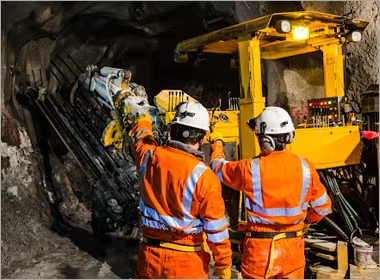
Designing resilient leaky feeder, wireless, and fibre networks that survive rock movement, water, and blast vibration in underground mining environments.
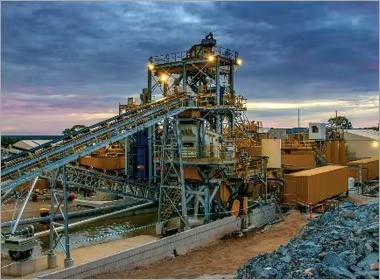
Designing industrial networks for crushers, conveyors, processing plants, and surface infrastructure that withstand dust, vibration, and continuous operation.
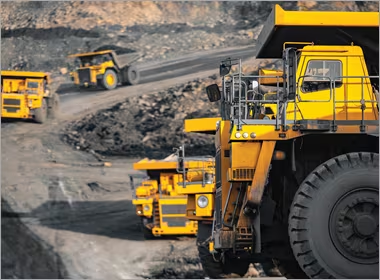
Enabling reliable communications for haul trucks, drills, shovels, and autonomous vehicles across pit operations, haul roads, and maintenance areas.