
Underground Communications
Designing resilient leaky feeder, wireless, and fibre networks that survive rock movement, water, and blast vibration in underground mining environments.
Fleet connectivity determines whether autonomous systems remain supervised, production data flows continuously, and safety interventions reach mobile assets during critical moments across dynamic mining terrain.
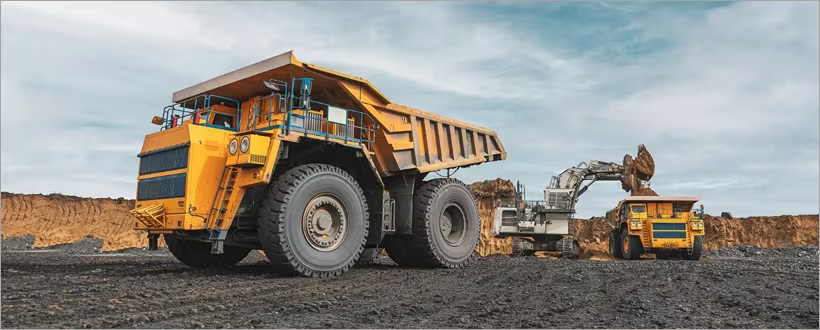
Mobile assets move through radio shadows, interference zones, and coverage gaps that static networks never experience.
Haul trucks, drills, shovels, and support vehicles operate across constantly changing terrain with varying elevations, obstructions, and interference sources. Unlike fixed plant networks, fleet communications must maintain connectivity through these dynamic conditions while vehicles travel at speed, carry shifting loads, and operate near large metal structures. The result is a connectivity challenge that combines the worst aspects of industrial and mobile networks.
Connectivity gaps rarely occur at predictable locations. Instead, they coincide with specific vehicle orientations, loading states, or interactions with other equipment. These intermittent dropouts disrupt telemetry, interrupt autonomous operations, and create safety risks when vehicles become "dark" to control systems at inopportune moments.
Mine Wi-Fi is not office Wi-Fi scaled up; it requires completely different design principles.
While Wi-Fi is commonly used for fleet connectivity, mining environments present unique challenges. The open pit creates a bowl-shaped environment with significant multipath reflection from pit walls. Haul roads wind through varying elevations, creating line-of-sight issues. Large moving metal vehicles themselves block and reflect signals unpredictably.
Successful mine Wi-Fi requires directional antennas strategically placed to create overlapping coverage zones without interference, careful channel planning to avoid adjacent channel interference, and access points rated for extreme temperature ranges and dust ingress. The network must be designed for vehicular roaming with fast, seamless handoffs between access points to maintain continuous connectivity.

Private LTE provides wide-area coverage for mobile assets but requires careful frequency planning and base station placement to overcome pit geometry challenges.
Private cellular networks offer wider coverage but introduce spectrum and infrastructure complexities.
Private LTE networks operating in dedicated spectrum bands (such as 450 MHz, 900 MHz, or 1.8 GHz) provide broader coverage than Wi-Fi with better penetration through dust and light obstructions. However, they require substantial infrastructure investment in base stations, backhaul, and core network equipment. Frequency selection must consider propagation characteristics, license availability, and potential interference with other mine systems.
The cellular architecture must support low-lency communication for teleoperation and autonomous control while handling high-density vehicle traffic in loading and dumping areas. Network slicing or quality of service (QoS) mechanisms ensure that critical control traffic receives priority over less time-sensitive data like video streaming or file transfers.
V2I enables coordination but demands deterministic latency that standard networks cannot guarantee.
Advanced fleet management and autonomous operations require vehicles to communicate with fixed infrastructure - traffic management systems, loading assistants, dump point coordinators, and safety systems. This V2I communication must have bounded latency and high reliability to support real-time decision making.
Dedicated short-range communications (DSRC) or Cellular-V2X (C-V2X) technologies provide the deterministic timing needed for safety-critical applications like collision avoidance or priority right-of-way. These systems operate alongside broader data networks, creating a layered communications architecture where safety messages receive guaranteed delivery while operational data uses best-effort transport.
Vehicle networks must survive vibration, temperature extremes, and electrical noise while integrating multiple systems.
Modern mining vehicles contain complex onboard networks connecting engine control, braking, payload monitoring, cameras, sensors, and communication gateways. These networks must operate reliably despite constant vibration, wide temperature swings, and electrical noise from high-power systems. Industrial-grade Ethernet switches with conformal coating, locking connectors, and wide temperature ratings are essential.
Onboard networks should be segmented to isolate critical control systems from auxiliary devices. Engine and braking networks should remain separate from entertainment or non-essential monitoring to prevent a fault in one system from affecting vehicle safety. Gateway devices provide controlled interfaces between these segments while enforcing security policies.
Continuous data flow requires networks that handle burst traffic without dropping critical information.
Mobile assets generate vast amounts of telemetry - engine parameters, fuel consumption, payload data, location, health monitoring, and operational status. This data typically transmits in bursts when vehicles enter coverage zones or at regular intervals. The wireless network must handle these bursts without congestion that could delay or drop packets, while the backhaul infrastructure must have sufficient capacity to aggregate data from dozens or hundreds of vehicles.
Data prioritisation ensures that safety alerts and critical fault notifications receive immediate transmission, while historical trend data can be buffered and sent during periods of lower network utilisation. Edge computing on vehicles can pre-process data, sending only summaries or exceptions to reduce network load without losing operational intelligence.
Autonomous systems amplify connectivity requirements from "important" to "safety-critical."
Autonomous haul trucks, drills, and dozers rely on continuous, low-latency communication for supervision, exception handling, and periodic updates. Loss of connectivity doesn't just interrupt data flow - it may trigger vehicle shutdowns or require manual intervention. Networks supporting autonomous operations must therefore have redundant paths, rapid failover, and guaranteed minimum bandwidth.
Tele-remote operation adds video requirements to the mix. Multiple camera streams from different angles must reach operators with minimal latency to enable precise control. This demands both high bandwidth and consistent quality of service, often requiring dedicated network segments or priority queuing to ensure operator responsiveness isn't compromised by other network traffic.
As mining advances and pit geometry changes, wireless coverage must be re-planned to maintain connectivity in active work areas without creating interference.
Mining is not static; coverage plans must evolve with pit development.
Unlike fixed industrial facilities, mines change shape continuously as extraction progresses. Wireless coverage that was adequate last month may develop gaps as new benches are cut or haul roads are rerouted. Effective fleet connectivity requires periodic RF surveys and adaptive network planning to maintain coverage in active work areas.
Temporary or relocatable infrastructure - such as trailer-mounted base stations or rapidly deployable access points - can provide coverage in new mining areas while permanent infrastructure is installed. This phased approach ensures connectivity keeps pace with mining advance rather than lagging behind operational needs.
Mining sites accumulate wireless systems that can interfere with each other if not properly coordinated.
A typical mine operates multiple wireless systems: fleet communications, personnel communications, survey equipment, drone control, sensor networks, and possibly radar or other specialised systems. These systems often share unlicensed frequency bands (2.4 GHz, 5 GHz) or have adjacent licensed allocations that can cause interference.
Centralised frequency coordination, regular spectrum monitoring, and careful geographic separation of potentially interfering systems are essential. Directional antennas help confine signals to intended coverage areas, reducing spillover into adjacent bands or operational zones. When interference occurs, diagnostic tools must quickly identify the source to minimise operational impact.
Vehicle-mounted electronics face extreme conditions that fixed infrastructure avoids.
Communications equipment on mobile assets must operate despite vibration that can reach 5-10g during loading and dumping, temperature extremes from -30°C to +70°C, dust ingress that clogs cooling vents and connectors, and voltage fluctuations from vehicle electrical systems. Equipment selection must consider these environmental ratings, not just functional specifications.
Power conditioning protects sensitive electronics from vehicle electrical noise and voltage spikes. Redundant power inputs from separate vehicle circuits ensure communication continuity if one power source fails. Regular maintenance schedules should include inspection and cleaning of antennas, connectors, and cooling systems to prevent gradual degradation from environmental exposure.
Throughput Technologies advises on mobile and fleet connectivity architectures that keep haul trucks, drills, shovels, and autonomous systems connected, controllable, and productive across dynamic mining terrain.
Talk with a Solutions Specialist to review your mobile fleet communications infrastructure.
This is typically caused by radio shadows created by pit geometry or large equipment. As a truck descends into the pit, the high wall blocks line-of-sight to access points. When positioned near a shovel or drill, the large metal structure can block or reflect signals. When loading, the raised body can shadow the antenna. These are predictable coverage gaps that require strategic access point placement, possibly with antennas angled downward into the pit or additional infrastructure at pit bottom.
For supervised autonomy where vehicles operate independently but can request human intervention, round-trip latency should generally be under 200 milliseconds. For direct teleoperation, latency should be under 100 milliseconds to maintain operator effectiveness. Video streams for monitoring typically require under 500ms latency to be useful. These targets dictate network design, often requiring dedicated bandwidth, priority queuing, and potentially edge processing to reduce data volumes.
Wi-Fi offers higher bandwidth (typically 100+ Mbps per access point) but shorter range (300-500m) and operates in crowded unlicensed bands. Private LTE offers longer range (several kilometers per base station), better penetration through dust and light obstructions, and operates in licensed spectrum with less interference, but with lower per-user bandwidth (10-50 Mbps). Wi-Fi suits dense vehicle areas like loading zones; LTE suits widespread coverage across haul roads and pit perimeters. Many mines use both in a complementary architecture.
Seamless roaming is essential. Vehicles should maintain active sessions as they move between coverage zones. For Wi-Fi, this requires access points configured with the same SSID and security, with controllers that handle fast roaming (802.11r/k/v standards help). For LTE, the cellular network manages handoffs between base stations automatically. The critical factor is overlapping coverage at zone boundaries so vehicles establish connection to the next point before losing the current one. Gap-free coverage maps based on actual drive tests are essential for planning.
Yes, but integration complexity varies. Modern retrofit kits include antennas, radios, onboard routers/switches, and often gateway devices to interface with existing vehicle networks (like J1939 CAN bus). The challenge is often power and space - finding suitable mounting locations with adequate vibration isolation and clean power sources. Retrofit should also consider future upgrades, leaving capacity for additional sensors or systems. It's often more cost-effective to retrofit an entire fleet class at once rather than piecemeal, to standardise support and training.
Designing resilient leaky feeder, wireless, and fibre networks that survive rock movement, water, and blast vibration in underground mining environments.
Designing industrial networks for crushers, conveyors, processing plants, and surface infrastructure that withstand dust, vibration, and continuous operation.

Protecting production and safety networks from cyber threats while ensuring operational continuity in remote and harsh mining environments.