
Underground Communications
Designing resilient leaky feeder, wireless, and fibre networks that survive rock movement, water, and blast vibration in underground mining environments.
Processing plant networks must deliver deterministic control through dust storms, equipment vibration, and electrical noise while remaining accessible for maintenance and expansion over decades of operation.
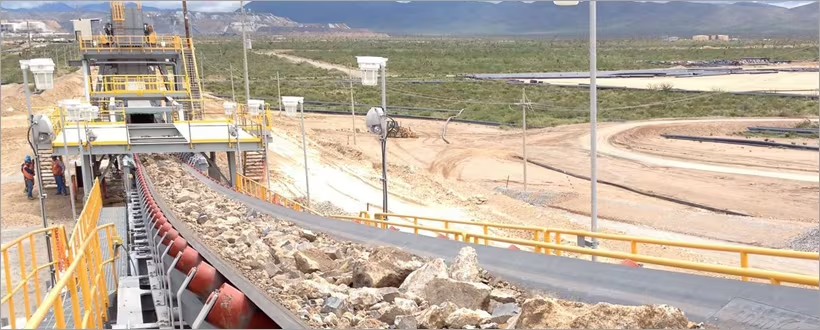
Dust, vibration, and electrical interference accumulate silently until control becomes unreliable.
Surface plants - including crushers, conveyors, mills, and processing circuits - operate in some of the harshest industrial environments. While individual devices may be rated for these conditions, the networks connecting them face cumulative stress that standard industrial Ethernet equipment often cannot withstand. The result is not sudden failure, but gradual degradation: increased packet loss, timing drift, and intermittent connectivity that manifests as production variability or unexplained process upsets.
These symptoms are frequently misdiagnosed as PLC or sensor issues, leading to costly component replacements that provide only temporary relief. The root cause often lies in network infrastructure that was selected for office-like conditions rather than mining plant realities.
Plant networks are not scaled-up office networks; they require different design rules.
Processing plants span large geographic areas with distributed control points. A flat Layer 2 network design that works in a compact factory becomes unstable at plant scale due to broadcast propagation and spanning tree convergence times. The architecture must instead be hierarchical, with clear aggregation points and controlled communication paths between zones.
Critical zones - such as primary crushing, grinding circuits, and tailings handling - should operate as independent network segments with dedicated uplinks to control rooms. This containment prevents a fault in one area from cascading through the entire production network, preserving operational stability even during localised issues.

Wireless networks enable mobile equipment monitoring but require careful channel planning to avoid interference from plant machinery and structures.
Wireless enables mobility but introduces new failure modes in metal-rich environments.
Wi-Fi and private LTE networks support mobile equipment, portable instruments, and temporary monitoring points. However, processing plants are filled with metal structures that create complex multipath reflection and signal attenuation. Concrete walls with steel reinforcement, metal cladding, and large equipment create radio shadows and interference patterns that change as equipment moves or processes operate.
Successful plant wireless requires site-specific RF surveys, directional antennas to focus coverage, and redundant access points to ensure continuous service as conditions change. Control traffic over wireless should be limited to non-critical monitoring, with critical control remaining on wired infrastructure whenever possible.
High-vibration areas demand physically robust network design, not just rugged devices.
Primary crushers, screens, and transfer points generate constant vibration that loosens connectors, fatigues cables, and damages sensitive electronics. Network equipment in these zones must be mounted on vibration-isolated panels, use locking connectors, and have cable strain relief that exceeds standard industrial ratings.
Conveyor networks present a different challenge: long linear distances with distributed drives, sensors, and safety systems. Fibre optic backbones with strategically placed Ethernet switches provide both bandwidth and electrical isolation over these distances, while ensuring that ground potential differences between distant equipment do not corrupt data or damage devices.
Dust ingress is a primary cause of network equipment failure in mineral processing.
Processing plants generate fine particulates that penetrate standard IP-rated enclosures over time. Silica, coal, and metallic dusts are particularly damaging, causing insulation breakdown, contact corrosion, and overheating. Network equipment must either be installed in pressurised cabinets with filtered air supplies or selected with specific dust-tight ratings (IP6X) validated for the particulate types present.
Regular maintenance schedules should include inspection and cleaning of enclosure seals, filter replacement, and thermal monitoring of network devices. Proactive maintenance prevents the gradual accumulation that leads to unexpected failures during production peaks.
Variable frequency drives and large motors create electromagnetic interference that disrupts unshielded networks.
Processing plants contain high-power electrical equipment that generates broadband EMI. VFDs for large pumps and conveyors, thyristor drives for mills, and welding operations create noise that can induce voltages in nearby network cables, corrupting data or causing communication resets.
Protection strategies include using shielded industrial Ethernet cables with proper grounding at one end only (to avoid ground loops), physical separation from power cables, and fibre optic links in high-noise areas. Equally important is ensuring a clean equipment grounding system that provides a low-impedance path for noise, preventing it from coupling into sensitive circuits.
Older PLCs, weigh scales, and analyzers often communicate via serial protocols that must be integrated into modern networks.
Processing plants evolve over decades, with equipment from multiple generations operating side by side. Serial-to-Ethernet converters allow legacy Modbus RTU, PROFIBUS, or DeviceNet devices to communicate over IP networks, but these gateways must be carefully configured to match the timing requirements of the original serial networks.
Serial protocols are often timing-sensitive, with specific response time expectations. Gateway configuration must preserve these characteristics while providing necessary network services like addressing, routing, and security. Improperly configured gateways can introduce delays or data corruption that make legacy equipment appear faulty.
Critical circuits require redundant network paths that switch automatically during failures without disrupting control sequences or production data.
24/7 operation demands networks that survive single points of failure without production interruption.
Processing plants operate continuously, with planned maintenance windows measured in hours rather than days. Network redundancy must therefore be hitless, with automatic failover that does not disrupt control loops or data collection. Protocols like MRP (Media Redundancy Protocol) or PRP (Parallel Redundancy Protocol) provide sub-second recovery for Ethernet networks, while dual-path fibre rings ensure physical diversity.
Redundancy planning should focus on the entire communication path, not just individual switches. This includes diverse cable routes, separate power supplies, and geographically separated control room connections. The goal is to ensure that no single event - whether equipment failure, cable damage, or power loss - can isolate critical process areas from control and monitoring.
Safety systems, production control, and business data require separate but connected network domains.
Modern plants integrate safety instrumented systems (SIS), process control, video surveillance, and business reporting on a common infrastructure. Without proper segmentation, these different classes of traffic interfere with each other. Safety networks require guaranteed bandwidth and lowest possible latency, while video surveillance consumes large amounts of bandwidth with less strict timing requirements.
VLAN segmentation, coupled with quality of service (QoS) policies at network switches, ensures that critical control and safety traffic receives priority. Firewalls or industrial DMZ appliances provide controlled interfaces between production networks and corporate IT systems, allowing necessary data exchange while protecting control systems from external threats.
Network equipment lifetime is directly related to operating temperature in plant electrical rooms.
Electrical rooms and control cabinets in processing plants often experience elevated ambient temperatures due to nearby equipment heat loads. Network switches and gateways operating at the upper end of their temperature specification experience accelerated component aging and increased failure rates. Active cooling, proper ventilation, and thermal monitoring extend equipment life and improve reliability.
When selecting network equipment for plant environments, the declared operating temperature range should include a safety margin above the expected maximum ambient. Equipment rated for -40°C to +75°C provides more headroom than devices rated for 0°C to +60°C, even if the plant rarely exceeds 50°C. This margin accommodates unexpected heat waves, cooling system failures, or changes in plant layout.
Throughput Technologies advises on surface and processing plant network architectures that withstand harsh conditions, ensure deterministic control, and support long-term operational evolution.
Talk with a Solutions Specialist to review your processing plant network infrastructure.
Three primary reasons: environmental stress, electrical interference, and scale. Dust and vibration gradually degrade connectors and components. EMI from large motors and VFDs induces noise in cables. At plant scale, network timing and broadcast traffic behave differently than in compact office environments, leading to unpredictable behaviour under load. These factors combine to create intermittent issues that are difficult to reproduce and diagnose.
Extremely critical. Improper grounding is a leading cause of network instability in industrial environments. Ground potential differences between distant equipment can reach tens of volts during motor starts or fault conditions, damaging equipment or corrupting data. A single-point grounding system for all electronic equipment, coupled with isolated or fibre-optic links between areas with different ground potentials, is essential for long-term reliability.
For monitoring and non-critical control, yes. For critical safety or high-speed control loops, wired connections are strongly preferred. Wireless introduces variable latency, potential interference, and coverage gaps that can disrupt time-sensitive operations. If wireless must be used for control, it should be on dedicated, licensed frequency bands (not crowded 2.4GHz Wi-Fi), with redundant paths and thorough RF planning to ensure consistent performance.
Use industrial protocol gateways specifically designed for the legacy protocol. These devices convert serial protocols to Ethernet while preserving timing characteristics and error handling. They should be installed close to the legacy equipment to keep serial cable runs short, and configured with the same baud rates, parity, and stop bits as the original system. The gateway then appears as a standard Ethernet device on the network, allowing modern SCADA and control systems to communicate with the legacy equipment without modification.
A formal review should occur with every major plant expansion or process change, and at least every 3-5 years otherwise. Technology evolves, traffic patterns change, and environmental conditions gradually degrade infrastructure. Proactive review identifies capacity constraints, aging equipment, and emerging risks before they cause production impacts. This is more cost-effective than reacting to failures during peak production periods.
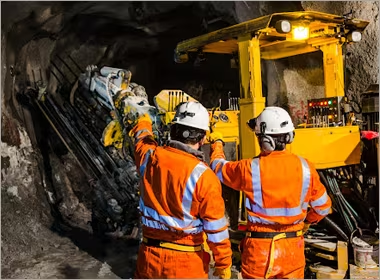
Designing resilient leaky feeder, wireless, and fibre networks that survive rock movement, water, and blast vibration in underground mining environments.
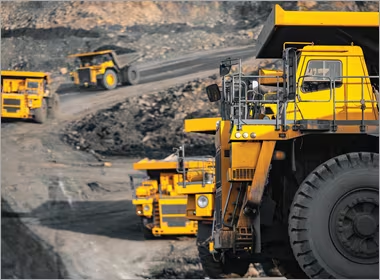
Enabling reliable communications for haul trucks, drills, shovels, and autonomous vehicles across pit operations, haul roads, and maintenance areas.

Protecting production and safety networks from cyber threats while ensuring operational continuity in remote and harsh mining environments.