
Fibre Optic Networks Along Rail Corridors
Designing trackside fibre infrastructure that withstands distance, environmental exposure, and long asset lifecycles while supporting signalling and operations.
Rail control centres concentrate operational authority, system visibility, and risk. Network architecture within these environments determines whether faults remain contained or cascade across signalling and operations.
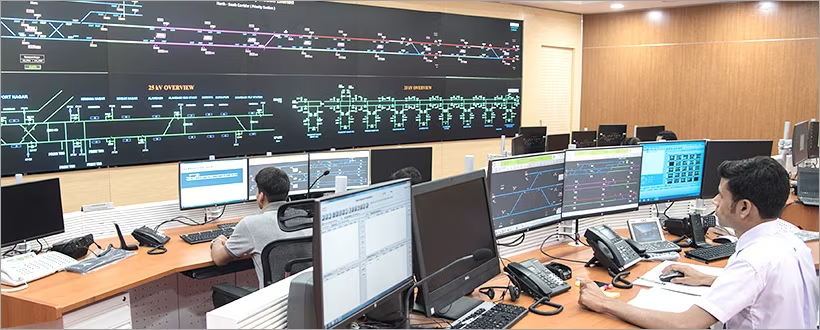
Control centres are convergence points where signalling, operations, and enterprise systems intersect.
Rail control centres bring together signalling backends, traffic management systems, SCADA platforms, operational voice, CCTV, analytics, and operator workstations within a single physical and logical environment. This convergence creates efficiency, but it also concentrates risk. A network fault, misconfiguration, or uncontrolled connection in a control centre can propagate rapidly across the entire rail system.
Unlike trackside networks, where faults tend to be geographically contained, control centre failures are systemic by nature. They affect visibility, command authority, and coordination simultaneously. For this reason, control centre network architecture demands a higher level of discipline than almost any other rail environment.
In rail control centres, segmentation protects signalling from everything else.
Network segmentation in control centres is often discussed in cybersecurity terms, but its primary value is operational containment. Segmentation ensures that failures, load spikes, misconfigurations, or security incidents in non-critical systems do not interfere with signalling and train control functions.
Effective segmentation separates signalling backends, operational control systems, support services, and enterprise interfaces into distinct zones with explicitly defined interactions. This prevents the gradual erosion of safety boundaries that occurs when networks are allowed to flatten over time.

Flat networks feel simple until something goes wrong.
Flat architectures persist in many control centres because they simplify initial deployment and troubleshooting. However, this simplicity is deceptive. As systems are added, updated, and interconnected, a flat network accumulates hidden dependencies that are poorly understood and rarely documented.
When an incident occurs, these hidden dependencies reveal themselves through unpredictable behaviour: signalling systems impacted by workstation updates, CCTV traffic affecting control system responsiveness, or remote access sessions degrading operator visibility. Segmentation exists to prevent precisely these scenarios.
Clear zones and tightly governed conduits preserve determinism.
A robust control centre architecture defines clear functional zones: signalling core, operational control, supervision and monitoring, support services, and external connectivity. Communication between these zones is permitted only through controlled conduits where behaviour can be inspected, logged, and bounded.
This zoning model supports deterministic signalling by ensuring that timing-sensitive systems are insulated from variable traffic patterns and non-deterministic workloads. It also simplifies change management, as the impact of modifications can be assessed zone by zone rather than across the entire network.
Operator environments are often the weakest architectural boundary.
Control centre workstations are frequently treated as benign endpoints, yet they are among the most dynamic elements in the environment. Software updates, peripheral devices, remote support tools, and user behaviour all introduce variability that can affect network stability.
Proper architecture isolates operator environments from signalling backends, ensuring that workstation activity cannot influence safety-critical processes directly. Access is mediated through defined interfaces rather than implicit network trust.
External access is inevitable, but unmanaged access is optional.
Modern control centres rely on OEM support, remote diagnostics, and vendor maintenance. Without architectural controls, these connections become persistent risk vectors that bypass segmentation and erode operational confidence.
Purpose-built access gateways, session-based controls, and time-limited connectivity allow necessary interaction without exposing the control centre to uncontrolled inbound access. This preserves both security posture and deterministic network behaviour.
Control centres evolve continuously, even when infrastructure does not.
New systems, analytics platforms, and operational tools are regularly introduced into control centres. Architectures that lack segmentation struggle to absorb this change without destabilising existing systems.
Segmented designs absorb growth by containing it. New capabilities are introduced into defined zones with known interactions, reducing risk and avoiding repeated architectural overhauls.
Deterministic architectures enable legacy signalling systems to coexist within modern Ethernet backbones
Control centre networks must assume failure and be designed to limit its impact.
One of the most overlooked aspects of control centre architecture is failure containment. While availability is often discussed in terms of redundancy and uptime, the more critical question is how a network behaves when something inevitably goes wrong. In poorly segmented environments, minor faults escalate quickly because systems are tightly coupled and dependencies are implicit rather than engineered.
Effective segmentation ensures that failures remain local. A malfunctioning analytics platform, a misbehaving workstation, or an overloaded monitoring system should never impair signalling backends or operator command functions. This separation is achieved not through policy alone, but through deliberate architectural boundaries that limit blast radius.
Predictable networks support predictable decision-making under pressure.
Control centres operate under time pressure, particularly during incidents. When network behaviour is predictable, operators and engineers can make informed decisions quickly. They understand which systems are affected, which remain trustworthy, and where intervention is required. In contrast, flat or loosely segmented networks introduce uncertainty at precisely the moment when clarity matters most.
Over time, predictable architecture builds institutional confidence. Operators trust the systems they rely on, engineers understand failure modes, and change becomes manageable rather than disruptive. This predictability is one of the most valuable — and least visible — outcomes of disciplined control centre network design.
Throughput Technologies helps rail operators design segmented control centre networks that protect signalling integrity while supporting operational growth.
Talk with a Solutions Specialist to review your control centre network architecture and identify containment, segmentation, and resilience gaps.
Segmentation is critical because control centres host systems with very different risk profiles and operational roles. Signalling backends, operator workstations, monitoring platforms, and enterprise services should not share implicit trust. Segmentation ensures that faults, traffic spikes, misconfigurations, or security incidents in non-critical systems cannot interfere with safety-critical signalling and control functions. In rail environments, segmentation is a containment mechanism that preserves operational integrity under fault conditions.
Flat networks often persist because they simplify early deployment and appear easier to manage. During initial system rollout, fewer boundaries mean faster integration and fewer design decisions. Over time, however, these networks accumulate hidden dependencies as new systems are added. What began as simplicity becomes fragility, and faults become harder to diagnose because impact paths are no longer clear or predictable.
Remote access introduces external dependency into the most sensitive part of the rail network. Without architectural controls, remote connections bypass segmentation and introduce unpredictable traffic, behaviour, and risk. When remote access is mediated through secure gateways with session control, time limits, and clear scope, resilience improves. The issue is not remote access itself, but unmanaged and persistent access paths.
Yes. Proper segmentation enables flexibility by allowing systems to change within defined zones without destabilising the entire environment. New tools, analytics platforms, or operational systems can be introduced into appropriate zones with known interaction points. This makes change safer and more predictable, rather than requiring repeated re-architecture as the control centre evolves.
Longevity comes from architecture that anticipates change rather than resists it. Clear zoning, controlled conduits, standards alignment, and disciplined documentation allow networks to evolve over decades. Instead of redesigning the control centre for every new system, a well-segmented architecture absorbs change incrementally while preserving signalling integrity and operational stability.
Designing trackside fibre infrastructure that withstands distance, environmental exposure, and long asset lifecycles while supporting signalling and operations.
Applying railway-specific cybersecurity principles to control centre and trackside networks without compromising deterministic behaviour or availability.
How engineered network behaviour ensures predictable latency, bounded recovery, and safe operation within modern rail signalling and interlocking systems.