
Fibre Optic Networks Along Rail Corridors
Designing trackside fibre infrastructure that withstands distance, environmental exposure, and long asset lifecycles while supporting signalling and operations.
In rail signalling, a single uncontrolled remote connection or delayed packet can escalate from a minor fault into a system-wide operational incident. Modern rail networks demand deterministic performance, strict access control, and architectures designed for safety-critical uptime.
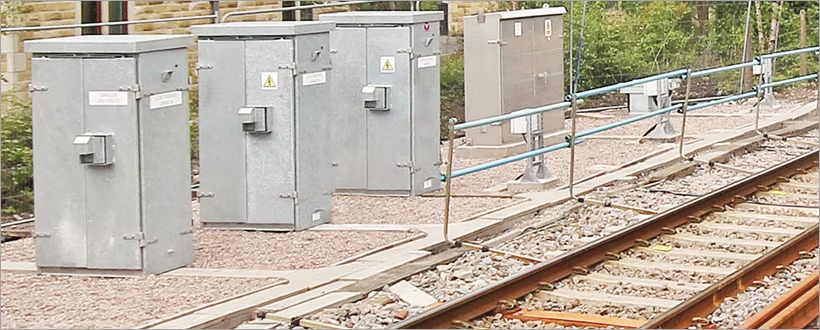
Rail signalling networks must behave predictably, recover cleanly, and operate without ambiguity under all conditions.
In rail signalling, the network is never an abstract transport layer hidden behind applications. It is an active participant in the safety system itself. Every signalling decision, interlocking state, movement authority, and protection mechanism ultimately depends on communication that arrives on time, in order, and in a known state. When that communication becomes unpredictable, the signalling system does exactly what it is designed to do: it protects life by stopping trains. Operationally, however, that protection translates into delays, service disruption, and loss of confidence.
Conventional IT Ethernet networks were built around very different assumptions. Variability is tolerated. Congestion is expected. Recovery is reactive. In rail OT environments, those assumptions collapse. Variability becomes risk, congestion becomes failure, and recovery must be immediate and deterministic. This fundamental mismatch is why rail signalling networks demand a different design philosophy rather than incremental adaptation of enterprise practices.
Ethernet alone does not guarantee when a packet will arrive, or how the network will behave during failure.
Standard Ethernet prioritises flexibility, throughput, and efficient resource utilisation. These are strengths in office and data-centre environments, but they introduce unacceptable uncertainty into safety-critical rail systems. Broadcast amplification, uncontrolled multicast traffic, topology reconvergence, and best-effort queuing can all introduce jitter and delay that directly affect signalling behaviour.
In signalling environments, the problem is not that Ethernet is unreliable, but that its behaviour under abnormal conditions is often undefined. Deterministic Ethernet addresses this by engineering timing, prioritisation, and failure response into the architecture itself, so that the network behaves in known, validated ways even when components fail or load conditions change.

Deterministic Ethernet topologies preserve predictable signalling behaviour during faults and recovery events
No protocol alone delivers determinism; it emerges from disciplined network design.
Deterministic Ethernet is frequently misunderstood as a checkbox feature or a specific standard. In practice, determinism is the outcome of multiple architectural decisions working together. Topology selection, traffic engineering, redundancy mechanisms, synchronisation, and operational controls all contribute to whether a network behaves deterministically or not.
Technologies such as PRP and HSR enable zero-time recovery at the network layer, while VLAN separation and Quality of Service prevent non-critical traffic from interfering with signalling flows. When combined with industrial-grade switching platforms designed for rail environments, these elements create networks whose behaviour remains stable and predictable, even under fault conditions.
In signalling networks, worst-case performance matters more than averages.
Rail signalling networks must be designed around worst-case latency and recovery scenarios, not typical operating conditions. A network that performs well most of the time but occasionally violates timing constraints is inherently unsafe for signalling. Deterministic Ethernet enables engineers to define, measure, and validate maximum latency, jitter, and failover times so that behaviour remains within safety margins at all times.
This predictability simplifies both engineering and regulatory processes. When network behaviour is bounded and repeatable, safety cases are clearer, acceptance testing is more objective, and long-term operational risk is reduced. Determinism removes ambiguity, replacing assumptions with evidence.
Modernisation in rail demands coexistence, not wholesale replacement.
Very few rail networks operate in greenfield conditions. Modern IP-based signalling systems often coexist with legacy interlockings, serial interfaces, and proprietary trackside equipment. Deterministic Ethernet architectures must therefore accommodate heterogeneous environments rather than forcing premature replacement of proven assets.
Industrial gateways and managed switches provide controlled mediation between legacy and modern systems. By encapsulating legacy protocols, enforcing segmentation, and preserving timing characteristics, these devices allow deterministic principles to extend across mixed-generation environments without disrupting certified signalling logic.
Security controls must preserve timing guarantees, not interfere with them.
As rail signalling networks increasingly interface with external systems, cybersecurity can no longer be treated as an afterthought. However, security mechanisms that introduce unpredictable latency or inline inspection can undermine deterministic behaviour. Deterministic Ethernet architectures address this by enforcing security at well-defined network boundaries rather than within critical traffic paths.
Segmentation, identity-based access control, and secure remote access are implemented through purpose-built industrial gateways and management planes. This approach aligns with railway cybersecurity principles while ensuring that signalling traffic remains isolated from non-deterministic influences.
Determinism improves operational confidence as much as technical performance.
While deterministic Ethernet is often justified on safety grounds, its operational benefits are equally compelling. Predictable network behaviour accelerates fault diagnosis, reduces false alarms caused by transient communication issues, and enables more effective remote maintenance under controlled conditions.
When engineers understand exactly how the network will behave, intervention becomes deliberate rather than reactive. This improves coordination between signalling, telecoms, and operations teams, ultimately enhancing service reliability and passenger confidence.
Deterministic Ethernet does not require a disruptive “big bang” transformation.
One of the most persistent misconceptions in rail modernisation projects is that deterministic networking demands wholesale replacement of existing infrastructure. In reality, the most successful rail deployments follow phased implementation strategies that respect operational continuity, certification constraints, and organisational readiness. Determinism is introduced progressively, not imposed abruptly.
In practice, this means starting where risk is highest and control is weakest. External connectivity is often the first focus area. OEM diagnostics, maintenance access, and monitoring platforms frequently represent the largest deviation from historical signalling assumptions. By stabilising these interfaces first — through deterministic gateways, controlled access paths, and bounded behaviour — immediate risk reduction is achieved without touching the core signalling logic.
Deterministic architectures enable legacy signalling systems to coexist within modern Ethernet backbones
Subsequent phases typically address critical signalling interfaces where deterministic behaviour delivers the greatest operational benefit. Introducing deterministic redundancy at interlockings, radio interfaces, or trackside aggregation points improves fault tolerance while building engineering confidence in the architecture. Importantly, these changes are measurable. Latency, jitter, and recovery behaviour can be validated incrementally, reinforcing trust in the design.
Only once deterministic principles are well understood operationally do they extend into secondary systems. Condition monitoring, asset management, and non-safety telemetry can then be integrated into the same architectural framework without threatening signalling performance. At this stage, determinism becomes an organising principle rather than a specialised exception.
This phased approach aligns naturally with rail asset lifecycles and maintenance planning. It allows deterministic Ethernet to evolve alongside renewal programmes, avoiding unnecessary disruption while steadily improving network resilience. From a governance perspective, it also simplifies safety assurance. Each phase can be justified, documented, and accepted independently, reducing the burden on engineering and regulatory teams.
Perhaps most importantly, phased implementation recognises that deterministic networking is as much an organisational capability as a technical one. Engineering teams, operations staff, and maintainers all adapt to predictable behaviour differently than they do to best-effort systems. Gradual introduction allows procedures, diagnostics, and decision-making processes to mature alongside the technology.
In this sense, deterministic Ethernet is not a project milestone that is “completed.” It is a capability that is cultivated over time. Networks become progressively more predictable, more observable, and more resilient — without ever requiring a moment where the railway must stop in order to become safer.
Rail networks must remain stable for decades, not technology cycles.
Rail infrastructure is expected to operate for decades, often outliving multiple generations of networking technology. Deterministic Ethernet architectures must therefore prioritise longevity, standards alignment, and controlled evolution rather than short-term optimisation or rapid feature turnover.
This demands disciplined supplier selection, architecture-level thinking, and a commitment to predictability over novelty. In rail signalling, restraint and precision deliver more value than complexity.
Throughput Technologies works with rail operators, system integrators, and OEMs to design deterministic Ethernet architectures aligned with signalling, safety, and long-term operational realities.
Talk with a Solutions Specialist to review your current signalling network and identify opportunities to improve determinism, resilience, and lifecycle stability.
Ethernet becomes deterministic when its behaviour is engineered rather than assumed. This includes defining bounded latency, controlling jitter, and ensuring predictable failure response through topology design, redundancy mechanisms, and disciplined traffic management aligned with signalling requirements.
Yes. Deterministic Ethernet architectures are designed to integrate legacy serial and proprietary signalling systems using controlled gateways and segmentation, enabling phased modernisation without compromising existing safety certifications.
When implemented correctly, cybersecurity controls are placed at network boundaries and management planes rather than inline with signalling traffic, preserving deterministic performance while strengthening overall security posture.
PRP and HSR provide zero-time recovery and are widely used in rail signalling, but determinism can also be achieved through other validated redundancy mechanisms, provided recovery times are bounded and demonstrably safe.
Deterministic Ethernet prioritises standards alignment, predictable behaviour, and controlled evolution, allowing networks to remain stable and supportable over decades while accommodating incremental upgrades.

Designing trackside fibre infrastructure that withstands distance, environmental exposure, and long asset lifecycles while supporting signalling and operations.
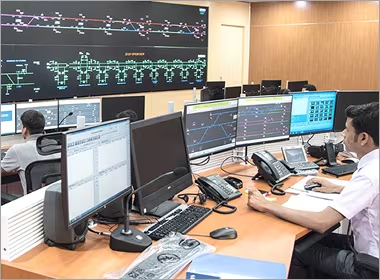
Structuring control centre networks to contain faults, preserve availability, and prevent non-critical systems from impacting rail operations.

Applying railway-specific cybersecurity principles to control centre and trackside networks without compromising deterministic behaviour or availability.