
Control Centre Network Architectue & Segmentation
Structuring control centre networks to contain faults, preserve availability, and prevent non-critical systems from impacting rail operations.
Along rail corridors, fibre optic networks are not a convenience layer. They are the physical backbone that carries signalling, operational, and safety-critical communications across distance, exposure, and time.
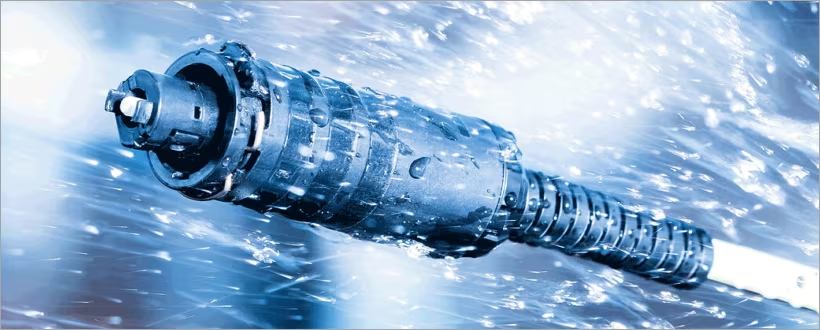
Rail corridor fibre networks must survive distance, exposure, and decades of operation.
Fibre optic networks deployed along rail corridors operate in conditions that differ fundamentally from enterprise, campus, or industrial plant environments. They span long distances, traverse remote terrain, and are exposed continuously to vibration, temperature extremes, moisture ingress, and third-party interference. Despite this, they are expected to support signalling, train control, operational communications, and monitoring systems without interruption.
In this context, fibre is not selected primarily for bandwidth. It is selected because it provides electrical isolation, immunity to electromagnetic interference, and stable performance over long distances. These characteristics are essential in rail environments where traction power systems, lightning exposure, and ground potential differences make copper-based communications inherently risky.
Along rail corridors, fibre becomes part of the operational and safety fabric.
Trackside fibre rarely supports a single application. Signalling, telecoms, SCADA, CCTV, condition monitoring, and operational voice systems often share the same physical infrastructure. As a result, fibre networks become multi-service platforms whose availability directly affects multiple operational domains.
This reality demands architectural discipline. Service separation, controlled failure domains, and predictable recovery behaviour must be engineered deliberately. Treating fibre as an abstract transport layer ignores the cascading impact a physical fault can have across rail operations.

Trackside fibre must withstand electrical, mechanical, and environmental stress
Rail corridors concentrate electrical and mechanical risks.
Traction return currents, lightning-induced surges, long earthing paths, and ground potential rise create hostile electrical environments along rail routes. Fibre optic cabling eliminates conductive paths between locations, preventing the transfer of dangerous voltages into trackside equipment rooms and control facilities.
Mechanical stress is equally significant. Vibration from passing trains, thermal expansion, water ingress, and accidental damage from maintenance or third parties all degrade poorly specified installations over time. Cable selection, routing, ducting, and termination practices therefore determine long-term reliability as much as active equipment does.
In linear rail corridors, topology determines whether faults remain local or become systemic.
Rail corridors naturally encourage linear network designs, but simple daisy-chain topologies are fragile. A single fibre cut can isolate large sections of the network, disrupting signalling, communications, and operations simultaneously. Robust fibre architectures introduce redundancy through rings, parallel routes, or geographically diverse paths.
The objective is not merely to restore connectivity after a break, but to control behaviour during the fault. Well-designed trackside fibre networks ensure critical systems continue operating while faults are detected, isolated, and repaired.
Long-distance fibre must be engineered with margin, not optimism.
Trackside fibre networks frequently exceed distances typical of enterprise deployments. Signal attenuation, splice loss, connector quality, and transceiver sensitivity must be calculated conservatively, with allowance for ageing, contamination, and repair work over decades.
Designs that work on day one often fail prematurely when optical margins are tight. Conservative budgeting, documented loss measurements, and consistent standards across the corridor reduce the risk of future failures that are difficult and expensive to diagnose.
Trackside cabinets form the interface between fibre infrastructure and active systems
Fibre reliability is limited by the equipment terminating it.
Trackside switches, media converters, and optical interfaces operate in constrained enclosures with limited power, cooling, and access. Equipment must tolerate temperature variation, vibration, and electrical noise while delivering predictable behaviour.
Industrial-grade devices designed for rail environments offer extended temperature ranges, long lifecycle support, and stable optical performance. Correct selection reduces intervention frequency and supports predictable maintenance planning.
Knowing where a fibre fault is matters as much as knowing that it exists.
Fibre faults along rail corridors are rarely convenient. Rapid localisation is essential to minimise service disruption. Networks designed with monitoring at aggregation points allow operators to distinguish between cable damage, equipment failure, and power loss without extensive physical inspection.
Visibility transforms fibre from passive infrastructure into an observable system. Over time, this enables trend analysis, proactive maintenance, and informed investment decisions.
A recurring challenge in trackside fibre deployments is that faults are often treated as rare, external events rather than inevitable operational conditions. In reality, fibre faults along rail corridors are not exceptional; they are expected over the lifespan of the asset. Ground movement, drainage work, cable theft, civil construction, and even routine maintenance activities introduce continuous risk. Networks that are not designed with this assumption become operational liabilities rather than resilient infrastructure.
One of the most damaging misconceptions is that fibre itself is inherently reliable, and therefore requires minimal operational oversight once installed. While fibre does not corrode or short-circuit like copper, its failure modes are simply different — and often harder to detect. Micro-bends, degraded splices, contaminated connectors, and marginal optical budgets can all exist long before a complete outage occurs. Without visibility into these conditions, rail operators are forced into reactive maintenance when failures finally manifest.
Effective trackside fibre design therefore extends beyond physical installation into operational observability. This includes deliberate aggregation points where optical paths can be monitored, power and equipment states correlated, and failures isolated logically rather than geographically. When visibility is designed in from the outset, incident response shifts from corridor-wide investigation to targeted intervention.
Over time, this observability changes organisational behaviour. Maintenance teams gain confidence in the infrastructure, response times improve, and service disruption becomes more predictable and manageable. Most importantly, signalling and operational teams are no longer forced to treat the fibre network as an opaque dependency. It becomes an understood, measurable component of the rail system — one that supports safe operation rather than undermining it through uncertainty.
Trackside fibre must remain serviceable for the full life of rail assets.
Rail infrastructure is expected to operate for decades. Fibre networks must support future expansion, new applications, and evolving operational practices without continual re-engineering. Spare fibres, accessible splice points, and accurate documentation preserve flexibility without compromising current operations.
A well-designed trackside fibre network preserves optionality. It allows the railway to adapt while maintaining continuity, safety, and operational confidence.
Throughput Technologies works with rail operators and integrators to design fibre optic architectures that support signalling integrity, operational resilience, and long-term maintainability.
Talk with a Solutions Specialist to review your current trackside fibre design and identify areas of risk and improvement.
Fibre networks along rail corridors are typically linear and geographically extensive, which means a single physical fault can interrupt services over many kilometres. When networks are designed without deliberate fault containment — such as rings, parallel paths, or sectionalised aggregation points — a cut or degradation event propagates far beyond its physical location. This is compounded when multiple systems share the same fibre infrastructure, causing signalling, telecoms, and operational services to fail simultaneously rather than in isolation.
The most frequent mistakes occur at the design stage rather than during installation. These include insufficient optical margin, inadequate environmental protection, poor cable routing choices, and lack of consideration for long-term maintenance access. Fibre is often treated as a one-time civil project rather than a strategic operational asset, resulting in networks that are difficult to troubleshoot, expand, or recover when faults inevitably occur.
Fault location is slow when fibre infrastructure lacks visibility and logical structure. Without monitoring at aggregation points, clear segmentation, and accurate records, operators are forced to physically patrol long corridor sections to locate faults. This turns what should be a targeted intervention into a time-consuming investigation, increasing service disruption and operational stress.
Spare fibres alone do not guarantee future usability. If spare cores lack accessible splice points, sufficient optical margin, or proper documentation, they often remain unusable in practice. Over time, changes to routing, repairs, and undocumented modifications further reduce their value. Flexibility only exists when spare capacity is deliberately engineered, documented, and maintained.
Long-term reliability improves when fibre is treated as critical infrastructure rather than passive cabling. This means conservative design margins, disciplined documentation, regular inspection and monitoring, and alignment with rail asset lifecycles. When fibre networks are observable and well understood, failures become manageable events rather than operational crises.
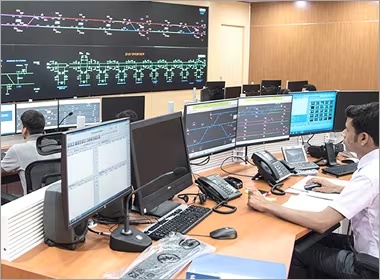
Structuring control centre networks to contain faults, preserve availability, and prevent non-critical systems from impacting rail operations.

Applying railway-specific cybersecurity principles to control centre and trackside networks without compromising deterministic behaviour or availability.
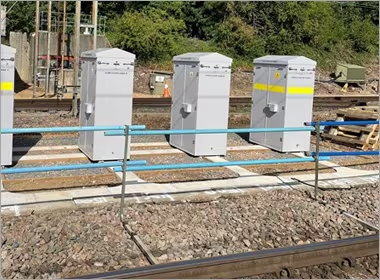
How engineered network behaviour ensures predictable latency, bounded recovery, and safe operation within modern rail signalling and interlocking systems.