
Fibre Optic Networks Along Rail Corridors
Designing trackside fibre infrastructure that withstands distance, environmental exposure, and long asset lifecycles while supporting signalling and operations.
In rail environments, cybersecurity failures are operational failures. Network resilience determines whether incidents are contained events or system-wide disruptions.

Rail networks must remain safe and predictable even while under attack.
Cybersecurity in rail environments differs fundamentally from enterprise IT. In IT systems, disruption is undesirable but often tolerable. In rail operations, disruption directly affects safety, service continuity, and public trust. Signalling systems, interlockings, control centres, and trackside infrastructure cannot simply be rebooted, isolated, or patched without consequence.
As rail networks converge toward IP-based architectures, cybersecurity must be approached as an engineering discipline rather than an overlay of defensive tools. The objective is not merely to prevent intrusion, but to ensure that when incidents occur, their impact is contained, predictable, and recoverable.
Rail standards assume exposure and require controlled trust boundaries.
EN 50159 recognises that modern rail communication systems operate over open transmission networks. Whether fibre, Ethernet, or wireless, the assumption of a closed and trusted medium no longer holds. Instead, the standard emphasises threat analysis, defensive measures, and verification of communication integrity.
Importantly, EN 50159 does not prescribe specific technologies. It requires that communication risks be understood and mitigated in a way that preserves functional safety. This aligns naturally with architectural approaches that emphasise segmentation, controlled interfaces, and deterministic behaviour.

Containment matters more than prevention alone.
In rail networks, segmentation limits the blast radius of cyber incidents. By separating signalling systems, operational control, monitoring platforms, and enterprise connectivity, segmentation ensures that compromise in one area does not propagate uncontrollably into others.
Effective segmentation is enforced through architecture rather than policy alone. Physical separation, logical zoning, and tightly governed conduits create boundaries that remain effective even when systems behave unexpectedly or credentials are misused.
Security controls must not introduce unpredictable behaviour.
Inline inspection, deep packet analysis, and adaptive filtering are common in IT security but can introduce latency and jitter that are unacceptable in rail signalling environments. Deterministic networks require security controls to be placed at defined boundaries where behaviour can be bounded and validated.
Purpose-built industrial gateways allow encryption, authentication, and access control to be applied without interfering with time-sensitive signalling traffic. This preserves deterministic behaviour while improving overall security posture.
Convenience-driven access erodes resilience over time.
Remote access is now unavoidable in rail operations. OEM support, diagnostics, and condition monitoring all depend on connectivity beyond traditional rail boundaries. When unmanaged, these connections create persistent attack paths that bypass segmentation and change control.
Resilient architectures enforce outbound-only connectivity, session-based access, and strict scoping of privileges. Access becomes an operational event rather than a standing capability, reducing exposure while preserving necessary functionality.
Resilience is measured by behaviour during failure, not absence of incidents.
Cyber incidents will occur. Network resilience is defined by how systems behave when they do. Rail networks must be engineered so that loss of connectivity, compromised components, or abnormal traffic patterns do not create unsafe conditions.
Deterministic behaviour, clear failure domains, and predictable recovery ensure that systems transition into known states rather than chaotic ones. This protects both safety and operational continuity.
Rail cybersecurity strategies often fail because they aim for absolute prevention rather than controlled failure. In complex operational environments, perfect security does not exist. What does exist is the ability to contain incidents so that their effects are limited, understood, and recoverable. In rail networks, containment is the difference between a manageable operational event and a system-wide service disruption.
Resilient architectures assume that credentials will be misused, systems will behave unexpectedly, and external dependencies will fail. By designing networks with explicit trust boundaries and limited interaction paths, incidents are prevented from cascading across signalling, control, and operational domains. This approach accepts reality rather than fighting it, and it aligns far more closely with rail safety philosophy than reactive security measures ever could.
Cybersecurity without visibility is guesswork. Rail operators cannot defend what they cannot see, and many operational networks still lack meaningful insight into traffic patterns, access behaviour, and system interactions. This is particularly dangerous in environments where signalling availability depends on predictable communication.
Visibility does not require invasive inspection of signalling traffic. Instead, it is achieved through monitoring at aggregation points, controlled access gateways, and management planes that observe behaviour without interfering with deterministic flows. When visibility is designed in, abnormal conditions are detected early, investigations become faster, and operational confidence improves.
Cyber resilience is not purely technical. Rail organisations operate on discipline, procedure, and predictability. Security approaches that introduce frequent alerts, ambiguous failures, or unpredictable system responses are quickly bypassed in the name of keeping trains moving.
Architectures that respect rail operating culture succeed because they reduce uncertainty rather than add to it. Clear segmentation, predictable behaviour, and controlled access support decision-making under pressure. Over time, cybersecurity becomes an enabler of safe operations rather than an obstacle to them.
Throughput Technologies works with rail operators and integrators to design cybersecurity and resilience into signalling, trackside, and control centre networks.
Talk with a Solutions Specialist to assess your rail network exposure and identify opportunities to improve containment and resilience.
Because modern rail systems depend on continuous, predictable communication, any cyber event that disrupts network behaviour directly affects safety. Loss of visibility, delayed data, or uncontrolled access can force signalling systems into protective states, stopping trains and degrading service. Cybersecurity therefore influences not just data protection, but operational integrity and public safety.
EN 50159 assumes that rail communication systems operate over open and potentially exposed transmission paths. It requires designers to analyse threats, define trust boundaries, and apply controls that preserve communication integrity. Rather than mandating specific technologies, it reinforces the need for architectural discipline, predictable behaviour, and verifiable risk mitigation aligned with functional safety.
Yes, when security controls are applied at defined boundaries rather than inline with critical signalling traffic. Deterministic behaviour is preserved by enforcing segmentation, controlled access, and authentication through gateways and management planes. The key is ensuring that security mechanisms do not introduce unpredictable latency or failure modes.
Remote access creates continuous connectivity between external systems and critical rail infrastructure. When unmanaged, these connections bypass segmentation and introduce uncontrolled dependencies. Resilient rail networks treat remote access as a temporary, scoped operational activity, enforced through outbound-only connections, session limits, and full auditability.
True resilience is defined by predictable behaviour during abnormal conditions. A resilient rail network contains incidents, maintains safety, and recovers in known ways. It does not rely on the absence of attacks, but on architecture that limits impact, preserves determinism, and supports controlled recovery.
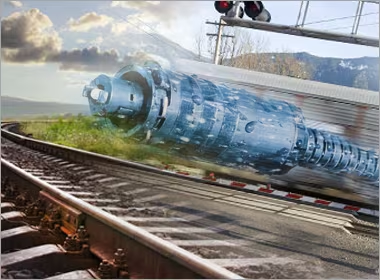
Designing trackside fibre infrastructure that withstands distance, environmental exposure, and long asset lifecycles while supporting signalling and operations.
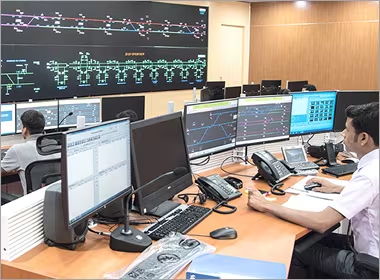
Structuring control centre networks to contain faults, preserve availability, and prevent non-critical systems from impacting rail operations.
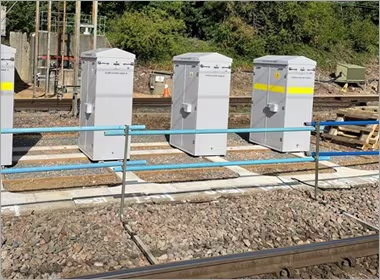
How engineered network behaviour ensures predictable latency, bounded recovery, and safe operation within modern rail signalling and interlocking systems.