
Highway Communications Backbone Networks
Designing resilient fibre and wireless backbone infrastructure for intelligent transport systems along highway corridors with appropriate redundancy.
Tolling and enforcement systems represent one of the most demanding subsystems in road transportation infrastructure, combining real-time financial transactions, enforcement, and safety-critical control at highway speeds.
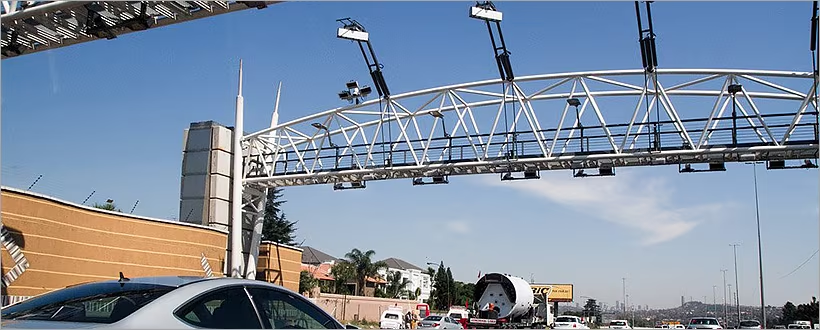
Tolling systems blend financial transaction processing with critical infrastructure control – network failures directly result in lost revenue, traffic congestion, and enforcement breakdowns.
Modern tolling relies on a complex stack: automated number plate recognition (ANPR), RFID tag readers, payment gateways, violation enforcement systems, and central transaction clearing. Each component must communicate flawlessly within milliseconds as vehicles pass at high speed. A network delay can mean a missed transaction, a false violation, or a system-wide backlog that spills into physical traffic jams.
The network design must treat each transaction with the integrity of a bank transfer. This requires deterministic latency, 99.99%+ availability, and robust cybersecurity to prevent fraud. Environmental challenges are severe, with roadside electronics exposed to weather, vibration, and electromagnetic interference from high-voltage systems.

ETC lane networks require millisecond response times to read tags, process payments, and control barriers.
Dedicated short-range communication (DSRC) and RFID systems in toll lanes require networks with millisecond-level latency and perfect synchronisation to read tags, authorise payments, and control physical gantry systems.
A typical gantry houses multiple readers, cameras, and traffic sensors. When a vehicle passes, these devices must fire in a precise sequence, coordinated by a local controller. This controller must then communicate the transaction data to a central toll host for account debiting and receive an authorisation response - all before the vehicle reaches a potential barrier or violation camera.
Network design at the lane level often uses industrial Ethernet switches hardened for outdoor use. These create a deterministic, low-latency micro-network for the gantry. Redundancy is achieved via ring topologies (e.g., Ethernet Ring Protection Switching) so a single cable cut doesn't disable the lane. The connection from this local network back to the data centre is the critical long-haul link, often requiring diverse fibre paths and automatic failover to a wireless backup like licensed microwave or private LTE.
ANPR cameras for violation enforcement generate massive image data that must be transferred, processed, and matched against databases with high accuracy – demanding high bandwidth and intelligent data reduction.
Enforcement cameras capture high-resolution images of every passing vehicle, often from multiple angles. Each image is several megabytes. Transmitting every full image in real-time would saturate even robust networks. Therefore, edge processing is non-negotiable.
The network must support cameras with on-board analytics that perform the initial plate read. Only the metadata (plate number, timestamp, location) and a small thumbnail are transmitted immediately for real-time matching against a hotlist. The high-resolution images are stored locally at the roadside and transferred later during off-peak hours for evidentiary archiving. This architectural choice drastically reduces bandwidth requirements and latency. The network design must provide sufficient local storage buffering and manage the scheduled bulk data transfers without impacting real-time transaction traffic.
The toll plaza network aggregates data from multiple lanes and integrates with back-office systems for account management, payment processing, and customer service – acting as the aggregation and distribution hub.
Each lane's local network connects to a plaza server or concentrator. This device aggregates transactions, handles local cash payments if applicable, and serves as the gateway to the wider network. Its reliability is paramount; if it fails, all lanes at that plaza are affected.
Network design here focuses on segregation and prioritisation. Transaction data heading to the central host is marked as highest priority. Enforcement image data is medium priority. Administrative traffic (software updates, configuration changes) is low priority. Physical separation is also common, with separate network rings for transaction systems and surveillance/security systems within the plaza building. Secure VPN tunnels over dedicated links connect the plaza to the central data centre, ensuring transaction data is encrypted in transit.
Open road tolling networks must process transactions across multiple lanes at full motorway speeds without disrupting traffic flow.
Open road tolling systems eliminate plazas, requiring gantries that identify and charge vehicles at full highway speed across all lanes – pushing network requirements for synchronisation and data throughput to the extreme.
An ORT gantry is a dense cluster of technology spanning the entire road. Its network must coordinate dozens of sensors and cameras simultaneously. The system must not only read tags but also perform lane association (determining which lane a vehicle is in) and classification (car, truck, etc.) for correct charging. Data from all sensors for a single vehicle must be fused into one transaction record within milliseconds.
This demands a high-performance, low-latency network backbone on the gantry itself, typically using fibre optic connections between devices. Time synchronisation via Precision Time Protocol (PTP) is critical to align timestamps from different cameras for accurate vehicle matching. The backhaul from the gantry needs sufficient bandwidth to handle the aggregate transaction rate of peak traffic, which can be thousands of vehicles per hour per gantry. Network capacity planning is directly tied to traffic engineering forecasts.
The journey from a potential violation to a legally enforceable notice requires a secure, auditable chain of custody for digital evidence, governed by strict network and data governance policies.
When a potential violation is detected (e.g., no valid tag), the system triggers a high-resolution image capture. These images become legal evidence. The network must ensure this data is never lost, tampered with, or accessed unauthorised. This involves secure transfer from the roadside to a dedicated evidence server, often with write-once, read-many (WORM) storage characteristics.
The network segment for evidence management is highly isolated and monitored. Access is strictly controlled and logged. Data integrity is verified using hashes at each transfer point. The design must also consider the workflow of enforcement staff who review images, the interface with vehicle licensing databases, and the secure generation of violation notices. Bandwidth must accommodate the transfer of full evidentiary image sets from multiple violation events simultaneously, especially after a system outage is resolved and backlogged data needs to be uploaded.
In regions with multiple toll operators, interoperability networks and central clearing houses reconcile transactions between systems – requiring secure, standardised data exchange with financial-grade auditing.
A vehicle with one operator's tag may use another operator's road. The transaction data must be exchanged securely between the two entities, matched, and the funds settled. This happens through a central clearing house or via direct secure peering.
The network connecting an operator to the clearing house is a critical business link. It uses standardised protocols (like the ISO-based CEN/TS standards in Europe) over highly secure connections, often with dedicated leased lines. Reliability and security are paramount, as this network carries the financial settlement data that determines revenue. The design includes multiple layers of encryption, intrusion detection, and comprehensive logging for financial auditing and dispute resolution.
Throughput Technologies provides advisory and design services for tolling networks that meet the stringent requirements of financial transaction integrity, high availability, and seamless traffic flow. We understand that in tolling, the network isn't just carrying data; it's carrying money.
Talk with a Solutions Specialist to design or audit your tolling and enforcement network infrastructure.
The total system latency, from tag read to barrier raise (if applicable), must typically be under 150-250 milliseconds. The network component of this should be a small fraction. For open road tolling without barriers, the window is slightly larger but still under 500 ms for real-time hotlist matching. This requires local processing and network paths with guaranteed low latency and minimal jitter. Design must account for worst-case scenarios, such as network failover events, which should not cause latency to exceed these thresholds.
Each gantry must have sufficient local storage to hold transactions for the duration of a prolonged outage—often 24-72 hours worth of peak traffic. Transactions are stored securely on-site and transmitted in a controlled batch when connectivity is restored. The system must have a robust mechanism for reconciling these batched transactions with the central host to avoid double-charging. For enforcement, high-resolution images are stored locally on ruggedised, high-capacity solid-state drives until they can be retrieved.
Priorities are: 1) Transaction Integrity: Prevent tampering with financial data in transit. 2) System Availability: Protect against denial-of-service attacks that could halt toll collection. 3) Evidence Security: Protect violation images from tampering or deletion. 4) Customer Data Protection: Secure account holder information. Implementation involves network segmentation, encryption for all data in motion (especially over backhaul links), strict access controls, regular security patching for roadside devices, and continuous monitoring for anomalous activity.
Yes, but with careful design. Licensed point-to-point microwave is excellent for primary backhaul, offering high capacity and reliability comparable to fibre for line-of-sight paths. Cellular (4G/5G) is suitable as a secondary backup path for transaction data or as a primary link for lower-volume sites. The key is to understand the traffic profile: real-time transactions need a low-latency, low-jitter path, while bulk image transfers can use a best-effort connection. A hybrid design using fibre primary, microwave diverse path, and cellular failover is often the most resilient.
Accurate time is the foundation of evidence. If timestamps from front and rear ANPR cameras are off by even a few milliseconds, it becomes difficult to prove they images are of the same vehicle. This can compromise a violation case. All devices—cameras, sensors, roadside controllers—must be synchronised to a single time source, typically via Network Time Protocol (NTP) from a reliable stratum-1 source, or better yet, Precision Time Protocol (PTP) for sub-microsecond accuracy. The network infrastructure must support these protocols without introducing significant delay variation.
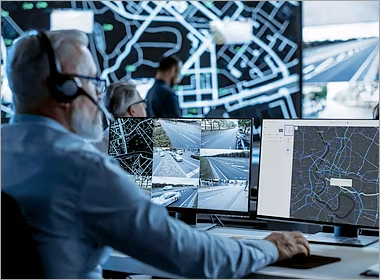
Designing resilient fibre and wireless backbone infrastructure for intelligent transport systems along highway corridors with appropriate redundancy.
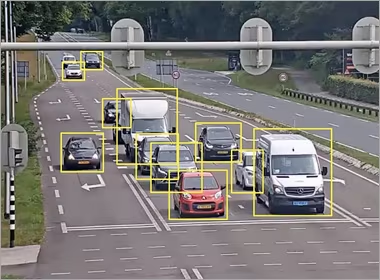
Network architecture for traffic management centres integrating video, control systems, and data for operational decision-making.
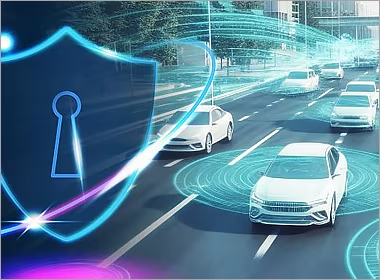
Protecting transportation networks from cyber threats while ensuring operational continuity through segmentation, secure access, and resilient design.