
Highway Communications Backbone Networks
Designing resilient fibre and wireless backbone infrastructure for intelligent transport systems along highway corridors with appropriate redundancy.
Transportation networks are critical infrastructure where a cyber incident can have immediate physical consequences – effective security must be woven into resilient network design to protect safety and continuity without compromise.
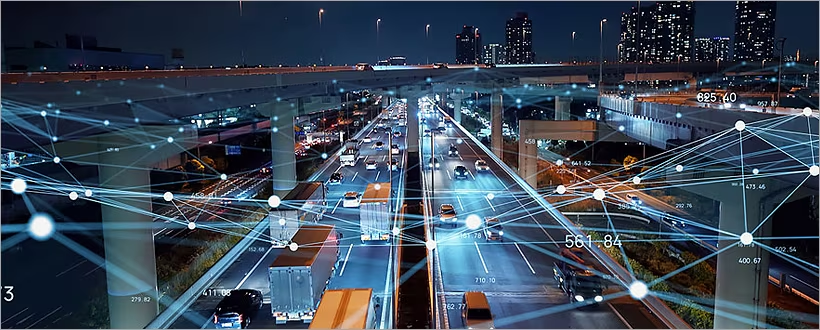
Operational technology (OT) for traffic control, tolling, and safety systems has fundamentally different priorities than IT – availability and safety override confidentiality, requiring a tailored security and resilience approach.
In transportation OT, a system that is secure but unavailable is a failure. A denial-of-service attack on a traffic management centre network could blind operators during a major incident. Similarly, an overzealous security patch that reboots a roadside controller could take a critical variable message sign offline without warning. The challenge is to implement robust security controls that defend against sophisticated threats without introducing single points of failure or disrupting the deterministic operation of safety-critical systems.
Resilience and security are two sides of the same coin. A resilient network can withstand and recover from failures, whether caused by a cable cut or a ransomware attack. The design principles for both are similar: redundancy, segmentation, simplicity, and comprehensive monitoring. The key is to apply them with an understanding of operational constraints and safety implications.

Logical segmentation creates security zones for traffic control, tolling, surveillance, and corporate IT.
Effective segmentation is the cornerstone of transportation cybersecurity, isolating critical control systems from less trusted networks while enabling necessary data flows for operations.
A flat network where traffic cameras, signal controllers, corporate workstations, and public Wi-Fi share the same broadcast domain is indefensible. Segmentation involves creating logical security zones. A common model includes: Safety-Critical Control (signal systems, lane control), Supervisory (TMC operator workstations, video management), Field Data (cameras, sensors), Corporate (business IT), and Demilitarized Zone (DMZ) for external partners.
Segmentation is implemented using VLANs, firewalls, and industrial demilitarized zones (IDMZ). The key is to define clear communication matrices: what traffic must flow between zones, in which direction, and using which ports and protocols. This "allow-list" approach denies all other traffic by default. Monitoring and logging all inter-zone traffic is essential for detecting anomalies. The resilience aspect requires that segmentation does not create a single choke point; firewall clusters must be highly available, and network paths must remain redundant even when traversing security boundaries.
Maintenance, vendor support, and inter-agency coordination require remote access – a major attack vector that must be secured without hindering operational responsiveness.
Traditional VPNs that grant broad network access are a significant risk. A compromised vendor laptop connected via VPN becomes an insider threat on the OT network. Modern secure access solutions are based on zero-trust principles: never trust, always verify.
Implementation involves a gateway that brokers connections. Users and devices are authenticated and authorised for specific applications only (e.g., a technician can access the HMI for Pump Station #5, but not the entire SCADA network). Sessions are time-limited, recorded, and monitored for suspicious activity. For third-party vendors, this is often combined with a jump host or bastion server in a DMZ, preventing direct connections to internal systems. Resilience is ensured by making the access infrastructure itself highly available, so authorised personnel can always reach systems during an emergency, even if the primary corporate network is under attack.
Transportation OT networks have predictable traffic patterns; deviations can indicate malfunction or malice – requiring monitoring tools that understand industrial protocols and operational norms.
An intrusion detection system (IDS) designed for IT networks may miss a malicious command sent via a Modbus TCP packet or unusual timing in traffic signal poll cycles. Effective monitoring requires OT-aware tools.
This involves deploying network taps or SPAN ports on critical OT segments to passively analyse traffic. The system builds a baseline of normal behavior: which controllers talk to which servers, the frequency of communications, and the typical payloads. It then alerts on anomalies, such as a programmable logic controller (PLC) initiating a connection (it should only respond), traffic to unexpected IP addresses, or commands that would change signal timings outside of approved schedules. Integrating these alerts with the TMC's operational incident management system allows cybersecurity events to be triaged alongside physical incidents, ensuring a coordinated response.
Resilient design ensures network services continue during partial compromise or failure.
Resilience architecture ensures that the transportation network continues to operate at a defined level of service even when components are compromised, failed, or under active attack.
This goes beyond hardware redundancy. It involves designing systems that can gracefully degrade. For example, if the central traffic management system is isolated due to a cyber incident, intersections should continue to operate on their last-known coordinated timing plan or revert to local sensor-based operation. Tolling gantries should store transactions locally and process them in "offline mode" until connectivity is restored.
Network resilience techniques include: Diverse Pathing (ensuring primary and backup links do not share common failure points like a single conduit or power grid), Automated Failover (with tested and predictable convergence times), and Decentralised Control (where possible). The network should also support "black start" procedures—clear, documented processes for restoring services from a complete outage, which must be practiced regularly. Cybersecurity resilience is built by ensuring security controls (like firewalls) are in high-availability pairs and that security policy updates do not themselves cause outages.
When a cyber incident affects transportation operations, the response must balance containment with the imperative to maintain safety and mobility – requiring a pre-planned, practiced playbook.
A generic IT incident response plan is insufficient. The first priority in a transportation cyber incident is often safety: ensuring no unsafe signal states, that emergency vehicles can be routed, and that the public is informed. The second is continuity: keeping traffic moving even in a degraded mode.
The response plan must be integrated with physical emergency procedures. It should define clear roles: who has authority to disconnect systems, who communicates with traffic operators, and who liaises with law enforcement. Critical steps include: isolating affected segments without collapsing the entire network, switching to manual or local control modes for critical functions, and using out-of-band communication (e.g., radios, separate mobile networks) for coordination. Recovery involves restoring systems from known-good backups, forensic analysis to understand the breach, and implementing additional controls before full restoration. Regular "tabletop" exercises that simulate attacks on specific systems, like a ransomware attack on the tolling back-office, are essential for preparedness.
Transportation systems are built with components and software from a global supply chain – managing the associated cyber risks requires vigilance over the entire lifecycle.
A vulnerability in a widely used traffic controller firmware or a backdoor in a video management system can compromise an entire network. Security must be addressed from procurement through to decommissioning.
This involves: Security Requirements in Procurement (demanding compliance with standards like IEC 62443, secure development practices), Asset Management (maintaining a detailed inventory of all OT/IT assets and their software/firmware versions), Patch Management (having a tested process for applying security updates to OT systems, which often cannot be patched as frequently as IT), and Vendor Access Management (controlling and monitoring all vendor remote support sessions). For legacy systems that cannot be patched or lack modern security features, compensatory controls like network segmentation and intrusion prevention become even more critical.
Throughput Technologies advises on the unique convergence of cybersecurity and operational resilience in transportation networks. We help you build a defensible, survivable architecture that protects your systems from evolving threats while guaranteeing the continuous operation that the travelling public depends on.
Talk with a Cybersecurity & Resilience Specialist to assess your posture and build a tailored defence-in-depth strategy.
Patching requires a formal change management process with extensive testing. First, test patches on an identical offline staging environment to check for compatibility and performance issues. Schedule installations during pre-defined maintenance windows, often at night or during periods of lowest traffic impact. Implement patches in a phased rollout, starting with less critical systems. Always have a backout plan and known-good configurations ready for immediate restoration if issues arise. For truly critical systems that cannot be taken offline, consider temporary compensatory controls (like stricter firewall rules) until a coordinated outage can be scheduled.
Encryption protects data confidentiality and integrity in transit. It is essential for all communications over untrusted networks (e.g., backhaul links, connections to cloud services). However, within a tightly controlled OT segment, the overhead and complexity of encryption may be weighed against the need for deterministic performance and the ability to monitor traffic for anomalies. A balanced approach is to encrypt all wide-area connections and remote access sessions, while using MACsec or other link-layer encryption for critical backbone links within the OT environment. The choice must consider the processing capabilities of legacy field devices, which may not support modern encryption.
A true air-gap (no physical or wireless connectivity) provides maximum security but is often operationally impractical. A modern alternative is a unidirectional security gateway (data diode). This hardware device allows data to flow out of the OT network (e.g., sending monitoring data, logs, and sensor readings to a historian or SIEM) but physically blocks any return communication. This enables remote monitoring and visibility while preventing any possibility of inbound attacks over that channel. The OT network remains effectively isolated for inbound commands, which must be performed locally or through a completely separate, highly secured access path.
Testing must be careful and phased. Start with paper-based tabletop exercises and walkthroughs of response plans. Then, move to simulated environments that replicate your production network. For live testing, use maintenance windows to test failover mechanisms (e.g., disconnecting a primary fibre link to trigger backup wireless). Use network traffic generators to simulate attack traffic and validate monitoring alerts without impacting real systems. Finally, conduct red team exercises where ethical hackers attempt to breach your defences under strict rules of engagement that define no-go zones for operational systems. Every test must have a rollback plan.
The team must bridge IT, OT, and operations. Core members include: Incident Commander (senior operations manager with authority), IT Cybersecurity Lead, OT Systems Engineer (who understands traffic controllers, SCADA), Traffic Operations Lead (to manage physical traffic impacts), Legal/Compliance Officer, and Communications Lead (for internal and public messaging). Pre-established relationships with external partners are crucial: law enforcement (for criminal incidents), cyber insurance provider, and trusted third-party forensic and recovery experts. This team must train together regularly.
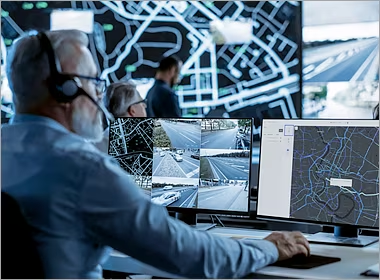
Designing resilient fibre and wireless backbone infrastructure for intelligent transport systems along highway corridors with appropriate redundancy.
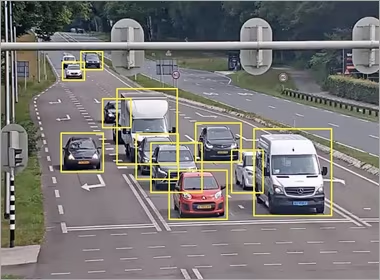
Network architecture for traffic management centres integrating video, control systems, and data for operational decision-making.
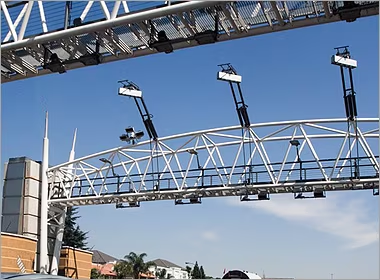
Networking for electronic toll collection, violation enforcement, and toll plaza communications with reliability requirements for revenue collection.