
- Home
- Technology Suppliers

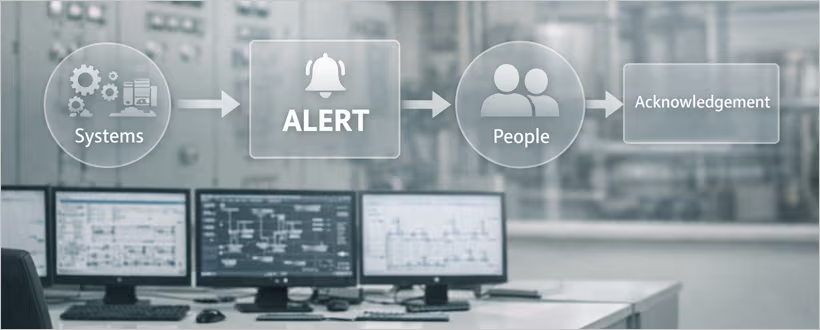
ALERT by Micromedia International is a dedicated alarm response layer that sits between your control systems and your people. It ensures that every critical alarm reaches the right person, is acknowledged in time, and is automatically escalated until responsibility is confirmed - with a complete, defensible audit trail.
The Critical Link Between Machine Alerts and Human Action
Modern automation systems detect problems with precision. They do not manage people with precision.
SCADA, PLCs, and BMS platforms are excellent at identifying abnormal conditions, but they are not designed to manage human availability, enforce accountability, or guarantee that a real person has taken ownership of an alarm. In practice, this is where many operational failures actually occur - not in detection, but in response.
ALERT is a purpose-built software platform that governs the human response to machine alarms. It does not replace your control systems; it operates above them as a structured response layer. Every alarm becomes a managed event with defined responsibility, timing, escalation, and traceability until closure.
Throughput Technologies deploys ALERT as a core component of operational resilience so that alarms are no longer unmanaged signals, but controlled actions that can be measured, audited, and improved over time.
The Architectural Role: Bridging Control Systems and Operational Reality
Control logic detects anomalies; ALERT governs how people must act.
Architecturally, ALERT sits logically above your automation layer. It consumes alarms from existing systems and applies real-world rules - who is on duty, who is authorised, how long they have to respond, and what must happen if they do not. In this way, it formalises human behaviour rather than leaving it to informal processes or ad-hoc phone trees.
This separation of concerns protects the deterministic performance of your PLCs and SCADA while introducing a predictable, auditable layer of human governance. Control integrity is preserved, but response uncertainty is removed.
What Alert Is (And How It Is Built)
A Windows-based platform designed for real industrial operations.
ALERT is a Microsoft Windows™-based software platform designed for remotely monitoring automated systems in environments with a high degree of automation. It has been Micromedia International’s flagship product since the company’s founding and is now installed at more than 12,000 sites worldwide.
The platform is designed to integrate into both simple and highly complex technical architectures. It centralises critical alarms from monitored sites and reliably forwards them to the right people using their preferred communication media and their defined on-call schedules.
ALERT natively supports industry-leading standards such as OPC, Modbus, and BACnet, along with a wide range of dedicated connectors to common monitoring systems. For more complex or site-specific requirements, it also includes a fully configurable module for retrieving, processing, and dispatching alarms.
Alarm Intelligence for Multi-Vendor Sites
One plant. Many systems. One authoritative alarm view.
Most industrial sites operate multiple generations of technology from different vendors. ALERT functions as a universal consolidation layer for alarms from SCADA, PLCs, BMS platforms, environmental monitoring systems, and IoT devices.
More importantly, it normalises this data. Regardless of source, every alarm enters a single system with consistent priorities, handling rules, and response logic. This removes dangerous silos and gives operators one coherent picture of what truly requires attention.

ALERT is a software product designed for remotely monitoring automated systems
Engineered for Continuous Operation
An alarm system that can fail is itself an operational risk.
ALERT supports high-availability architectures with redundant servers and automatic failover. If a primary system encounters a fault, a standby instance assumes control without loss of alarm state or notification continuity.
Throughput designs deployments so that alarm handling remains available during network disruptions, maintenance windows, or partial infrastructure failures. Vigilance is treated as a continuous service, not a best-effort feature.
Intelligent Escalation
Ownership matters more than notification.
When an alarm arrives, ALERT assigns it to the correct first responder based on role, duty roster, and alarm type. A response timer begins immediately.
If acknowledgement does not occur within the defined window, ALERT automatically escalates to secondary and tertiary responders in a structured chain of command until responsibility is formally accepted. This prevents lost alarms, shift-change gaps, and overload blind spots.
Dynamic On-Call Management
Availability must reflect reality, not spreadsheets.
ALERT maintains live on-call schedules that track rotations, leave, and actual duty status. Notifications are routed only to authorised personnel who are genuinely on shift. Throughput replaces manual call lists and informal processes with a living system that mirrors real operations.
Omni-Channel Delivery
The message must reach the person - by any reliable path.
ALERT can contact responders via voice calls, SMS, email, mobile app notifications, and legacy radio or paging systems where required. Every attempt is logged, and escalation continues automatically if any channel fails.
Remote Interaction with Alarms
Response is no longer tied to the control room wall.
Authorised users can interact with ALERT through a secure voice interface to check status, acknowledge alarms, and add notes. This is particularly valuable for distributed assets and after-hours coverage.
Core Operational Capabilities
ALERT provides a disciplined framework for managing the full alarm lifecycle - from detection, through human action, to documented closure.
| Capability | Operational Outcome |
|---|---|
| Centralised Alarm Intelligence | One consistent command view for all systems. |
| Guaranteed Escalation Logic | No orphaned or ignored alarms. |
| Omni-Channel Notification | Resilient delivery with full tracking. |
| Dynamic On-Call Management | Alerts reach available, authorised staff. |
| Complete Audit Trail | Every event timestamped and recorded. |
| Fault-Tolerant Architecture | Redundant design for continuous operation. |
Data Process Recorder (DPR)
Turning dispersed production messages into structured, usable data.
DPR (Data Process Recorder) is a companion software solution that collects and archives production messages from multiple operational systems into a single SQL database. Where ALERT manages real-time human response, DPR preserves operational history in a structured, analysable form.
DPR can aggregate data from DCS, SCADA, PLCs, and other industrial platforms using a wide range of interfaces including serial links, TCP/IP, DDE, file reading, OPC, SNMP, and direct database connections. This allows sites with heterogeneous architectures to converge their event data into one shared platform.
Advanced analytical rules enable DPR to normalise different message formats into a single meaningful record. Messages are categorised according to their originating system while maintaining consistency across the database.
All data is stored in an open, read-only SQL database so that users can connect standard analytics tools for reporting, compliance, or performance analysis. Records are retained across multiple time horizons - including recent data, multi-year archives, full site history, and a dedicated dataset for critical alarms linked to on-call management.
DPR integrates directly with ALERT so that critical alarms recorded in the historian can be forwarded through ALERT’s multi-channel notification and escalation framework when required.
Lone Worker Protection
Sometimes the most critical alarm comes from a person, not a machine.
ALERT’s Lone Worker Protection capability integrates with DECT devices, radios, and smartphones to detect man-down conditions, prolonged inactivity, or explicit SOS signals. When triggered, it raises a high-priority alarm and displays the worker’s location to accelerate rescue response.
Traceability For Compliance and Learning
If it is not recorded, it cannot be improved.
ALERT records every step in the alarm lifecycle - generation, notification attempts, acknowledgements, escalations, and operator notes. This creates a defensible audit trail for regulatory compliance, incident investigation, and continuous improvement of response processes.
Proven In Demanding Industries
Trusted where missed alarms have real consequences.
ALERT is deployed across more than 12,000 sites worldwide, particularly in water and wastewater, power and utilities, process industries, pharmaceutical manufacturing, hospitals, and large facilities that require 24/7 reliability and clear accountability.
The Throughput Integration Difference
Architecture determines effectiveness.
Throughput integrates ALERT with your existing OT environment, designs secure network pathways, maps alarms correctly, and aligns workflows to your operational procedures. The result is a coherent system where technology supports disciplined operations rather than complicating them.
Official Supplier Website
For detailed technical documentation, visit: https://alert.micromedia-int.com/en